From Carriages to EVs, from Traditional AC to Radiant AC: An Inevitable Revolution in Comfort
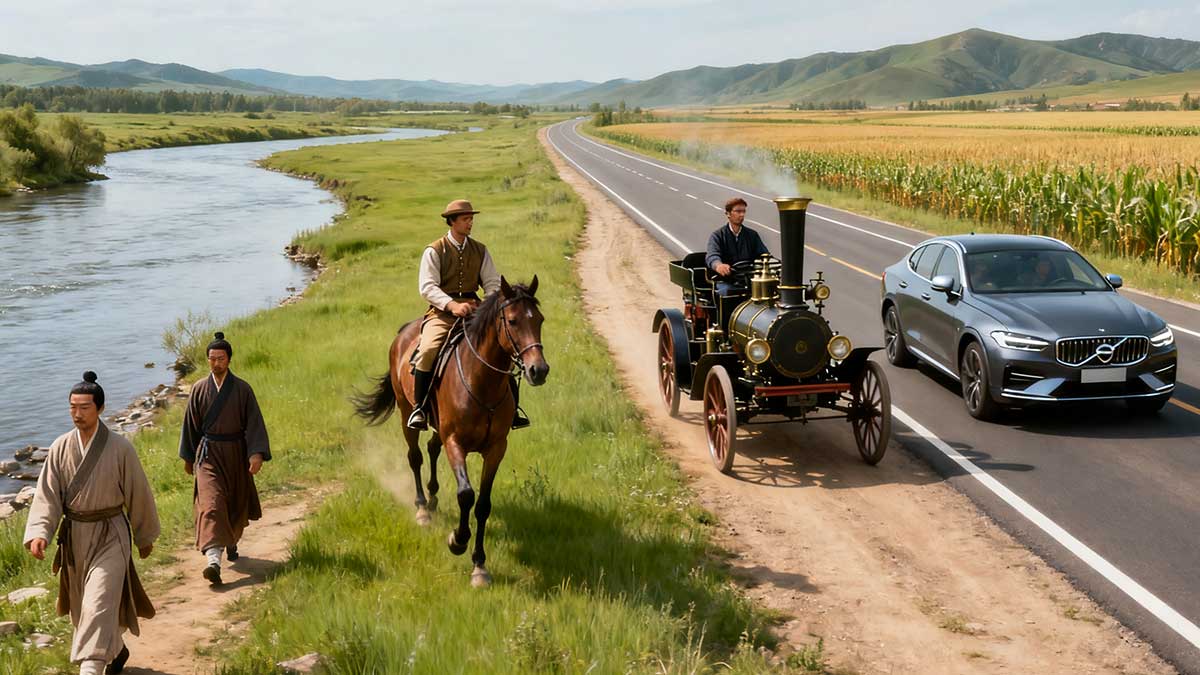
Looking back at the history of human civilization, many products that have changed our lives have followed a clear evolutionary path. Modes of transport evolved from walking, to horseback riding, horse-drawn carriages, steam cars, internal combustion engine cars, and now to electric vehicles. Each leap forward was not just a technological breakthrough but also an elevation in awareness and needs. The electric vehicle was not a new concept, but its journey to the mainstream relied on the awakening of global “environmental consciousness” and the drive towards “carbon neutrality” goals. It existed all along, waiting for the call of the times.
Similarly, the journey of air conditioning technology in the pursuit of indoor comfort has undergone a comparable evolution. From simple fans, to mechanical refrigeration, to inverter split-type AC systems, we have constantly sought more energy-efficient and comfortable temperature solutions. The principle of radiant cooling/heating – using building surfaces for heat exchange – has been physically mature for a long time. Much like the early blueprint for the electric vehicle, it awaited the perfect opportunity to merge theory with practice.
Now, that opportunity has arrived. The Coupling Radiant Air Conditioning System Based on the AC Companion, pioneered by huawa, represents a necessary and crucial step on this evolutionary ladder. It is not created out of thin air, but is a masterful “redesign” that combines known scientific principles with contemporary user needs, signaling the launch of a entirely new direction for AC technology.
I. The “Internal Combustion Engine Era” of Traditional AC and Its Limitations
Traditional split-type AC systems (including VRF systems) have dominated the market for decades, much like the internal combustion engine in the automotive world. They work by using indoor unit fans to force convection, rapidly changing the air temperature to meet basic cooling and heating needs. However, their inherent limitations are becoming increasingly apparent:
- Poor Comfort: Strong drafts can cause dryness and headaches. Temperature distribution within a room is uneven, often with noticeable “hot head, cold feet” stratification.
- Efficiency Bottlenecks: Under extreme cold or heat, the efficiency of traditional systems plummets. Operation becomes unstable, and may even require auxiliary electric heating, causing energy consumption to soar.
- Single-Dimensional Experience: They primarily address only “temperature” and “humidity,” offering little to enhance the overall environmental quality (such as uniform radiant temperature, draft-free operation, and quietness).
The market and users are calling for a more advanced solution that aligns closely with human needs – just as the focus shifted from the car’s mere “ability to move” to the EV’s “intelligence, eco-friendliness, and quietness.”
II. The huawa New AC System: Ushering in an “Electrified” New Era of Comfort
huawa’s innovative system ingeniously integrates an auxiliary heat exchange module named the “AC Companion” into the framework of a traditional split AC system, connecting it in series with an underground PE pipe radiant terminal. This is not a simple functional add-on, but a systematic “thermodynamic process re-engineering.”
Its core intelligence lies in “Division of Labor” and “Synergy”:
- Winter Heating Mode: The high-temperature refrigerant leaving the compressor no longer goes directly and entirely to the indoor unit. Instead, it first enters the “AC Companion,” transferring a portion of its heat to the water loop for floor radiant heating. Then, the refrigerant, now moderately reduced in temperature and pressure, proceeds to the indoor unit for convective heating. This process is equivalent to splitting one large condenser into two stages in series, significantly improving condensation efficiency and markedly increasing the system subcooling, resulting in stronger heating capacity and more stable operation in extremely cold weather.
- Summer Cooling Mode: After the refrigerant undergoes its first evaporation in the indoor unit (convective cooling), the not-fully-vaporized refrigerant proceeds to the “AC Companion.” Here, it utilizes its remaining cooling capacity to provide radiant cooling via the floor. This not only removes residual indoor heat but also ensures the refrigerant returns to the compressor with a higher superheat, protecting the compressor and enhancing system efficiency and lifespan.
This system essentially takes the former single, crude heat exchange process and meticulously distributes it between “convection” and “radiation” methods, achieving a 1+1 > 2 effect.
III. Why is This the Inevitable Future Trend?
- Technological Trend: From Crude to Precise
The evolution of any technology progresses from solving “existence” to pursuing “optimization.” The huawa system uses PID algorithms to precisely control heat exchange, actively managing subcooling and superheat. This is a hallmark of AC technology transitioning from the crude control of “on/off cycling” to the intelligent, precise control of “on-demand precise allocation.” - Demand Trend: From Basic Function to High-Quality Experience
As living standards improve, user demands have evolved from “not hot in summer, not cold in winter” to the experience of a Five Constant System (Constant Temperature, Humidity, Oxygen, Quietness, and Cleanliness). The huawa system perfectly aligns with this trend. It combines the draft-free, uniform, and quiet nature of radiant heat exchange with the speed and dehumidification capabilities of convection, delivering a revolutionary comfort experience. - Efficiency Trend: From Single-Scenario Efficiency to Year-Round, All-Scenario Efficiency
Under the “Dual Carbon” goals, energy saving and emission reduction are core themes for all household appliances. By increasing the effective condensation/evaporation area, this system comprehensively improves the Coefficient of Performance for both cooling and heating, performing exceptionally well especially under the extreme conditions where traditional AC efficiency is lowest. This breakthrough in Annual Energy Efficiency Ratio is fully consistent with global sustainable development directions. - Reliability Trend: From Fragile to Resilient
The system’s design, featuring liquid slugging protection and enhanced capability to handle extreme operating conditions, significantly improves equipment durability and reliability, reducing lifecycle maintenance costs. This meets consumers’ expectations for long-term, stable product value.
Conclusion
Just as the wave of electric vehicles is unstoppable, the technological direction represented by huawa’s Coupling Radiant Air Conditioning System is destined to become the mainstream for future comfortable living. It is not an unattainable concept, but a mature solution based on solid scientific principles and strong engineering feasibility. It answers the new questions posed by our era: we want not just temperature, but quality; not just energy savings, but stability; not just function, but health.
This is more than an upgrade for air conditioning; it is a cognitive revolution about comfortable living. The future is already here; it’s just not widely distributed yet. And huawa stands at the starting point of this distribution, leading us towards a new era of indoor climate that is more comfortable, more energy-efficient, and smarter.
Keywords:
Coupling Radiant Air Conditioning System, AC Companion, huawa, Split-type Air Conditioner, Plate Heat Exchanger, PE Pipe, Radiant Terminal, Subcooling, Superheat, Cooling Coefficient of Performance, Heating Coefficient of Performance, Five Constant System, PID Algorithm, Liquid Slugging Protection, Energy Efficiency Ratio, Thermodynamic Process, Convective Heating, Radiant Cooling, Comfort Experience, Carbon Neutrality