
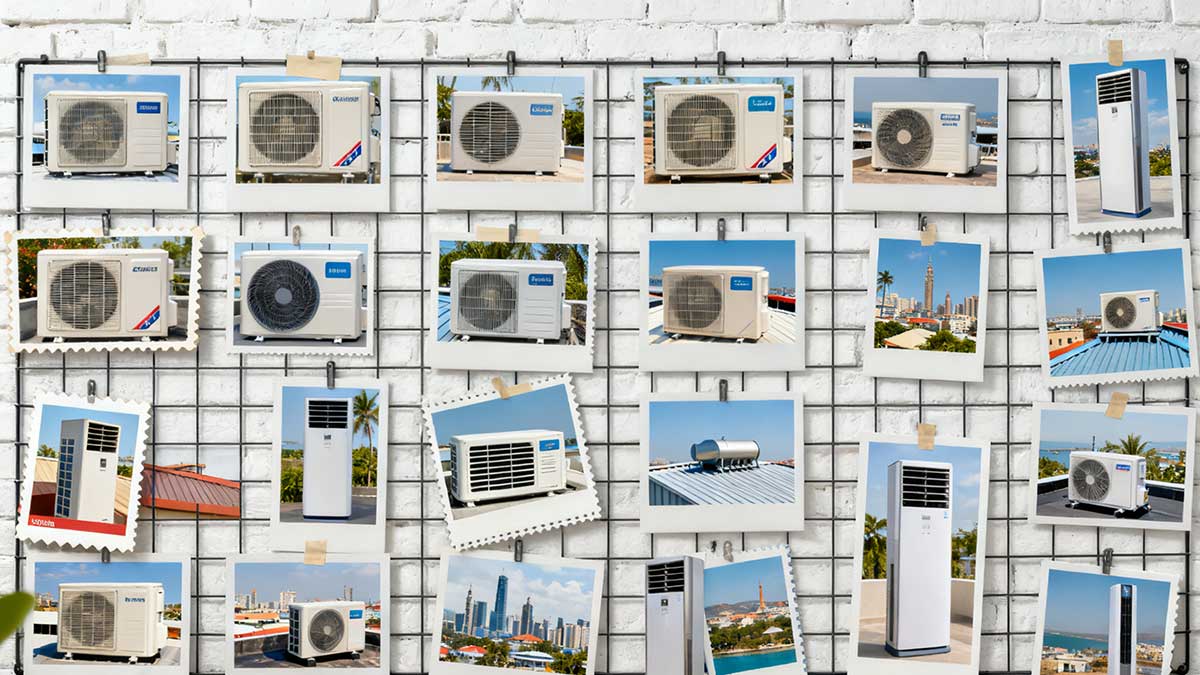
From Window Units to the ABC System: The Inevitable Evolution and Ultimate Form of Air Conditioning Technology
In the history of human technological development, the evolution of every important product follows a clear path. Just as lighting tools progressed from torches, oil lamps, and incandescent bulbs to LED smart lighting, air conditioning technology has also undergone its own evolutionary journey. From initial simple cooling to today’s intelligent regulation, air conditioning systems are continuously developing towards higher efficiency, greater comfort, and smarter functionality.
I. The Path of Air Conditioning Technology Evolution
Looking back at the history of air conditioning, we can clearly see this evolutionary path:
The Window Unit Era: Achieved basic temperature regulation, but with high noise, low efficiency, and installation limitations.
The Split System Revolution: Separated the compressor from the heat exchanger, significantly reducing indoor noise and improving installation flexibility.
The Multi-Split System: Connected one outdoor unit to multiple indoor units, meeting the demand for simultaneous use in multiple rooms.
The VRF System: Further optimized control precision based on multi-split systems, enabling independent temperature control in different rooms.
However, these systems share common limitations: a single convective heat transfer method, limited potential for efficiency improvement, and difficult-to-overcome comfort bottlenecks. The market is calling for the emergence of the next generation of air conditioning systems.
II. The ABC System: The Ultimate Form of Air Conditioning Technology
Through in-depth technical analysis and market research, we believe the ultimate form of air conditioning technology will inevitably move towards the “ABC System”:
- A (Outdoor Unit): Serves as the power core of the system, providing the basic cooling/heating source.
- B (AC Companion): A revolutionary incremental device enabling intelligent regulation and secondary heat exchange.
- C (Indoor Unit): Responsible for precise indoor air adjustment.
This is precisely the architecture adopted by the Coupled Radiant Air Conditioning System proposed by huawa. This design is not a sudden inspiration but the inevitable result of the development of air conditioning technology.
III. Why is the ABC System an Inevitable Trend?
1. The Internal Logic of Technological Development
The progression of air conditioning technology from single devices to separated systems, from simple control to intelligent regulation, and from single heat transfer to composite heat transfer, follows the basic rules of all technological evolution. The emergence of the AC Companion is an inevitable product driven by this logic.
2. The Upgrade Demand for User Experience
Modern users’ requirements for comfort have upgraded from “suitable temperature” to the comprehensive comfortable experience of the Five Constant System. The traditional single convection method cannot meet this demand, while the ABC system creates unprecedented comfort by perfectly combining Convective Heating and Radiant Cooling.
3. The Physical Limits of Efficiency Improvement
Traditional air conditioning systems are approaching physical limits in efficiency improvement. By Increasing the Effective Evaporation Area and Enhancing System Subcooling, the ABC system achieves breakthrough progress in the Cooling Coefficient of Performance and Heating Coefficient of Performance.
4. Essential Improvement in System Stability
Liquid Slugging Protection and precise Superheat control make system operation more stable and reliable, greatly extending equipment service life.
IV. Technological Breakthroughs of the huawa System
huawa’s Coupled Radiant Air Conditioning System achieves a technological leap through the following innovations:
Intelligent Control Core: Uses PID Algorithms to precisely control the operating status of the AC Companion, achieving optimal system operation.
Thermodynamic Optimization: Through unique refrigerant flow path design, it increases Superheat during cooling and Subcooling during heating, fully exploiting the performance potential of the refrigeration cycle.
System Integration: Organically integrates the Plate Heat Exchanger, PE Pipe radiant terminal, and traditional Split-type Air Conditioner to form a complete system solution.
V. The Future is Already Here
Just as smartphones replaced feature phones, it is only a matter of time before the ABC system replaces traditional air conditioning systems. This transformation is inevitable because:
Firstly, it conforms to the objective laws of technological development. The path from simple to complex, from single to system, applies to all technological products.
Secondly, it meets users’ ever-increasing demand for comfort. A superior Comfort Experience is no longer a luxury but a basic requirement.
Finally, it is more advantageous economically. A higher Energy Efficiency Ratio means lower operating costs, and a longer service life means lower cost of ownership.
Conclusion
huawa’s Coupled Radiant Air Conditioning System is not a product of mere imagination but is built on a deep understanding of the development laws of air conditioning technology. It represents the future direction of air conditioning technology, a perfect combination of technological evolution and market demand.
In this era of rapid technological iteration, only by grasping development trends can one lead the industry’s future. The ABC System is that future, and the future has already arrived.
Coupled Radiant Air Conditioning System, AC Companion, Split-type Air Conditioner, Plate Heat Exchanger, PE Pipe, Radiant Terminal, Subcooling, Superheat, Cooling Coefficient of Performance, Heating Coefficient of Performance, Five Constant System, PID Algorithm, Liquid Slugging Protection, Energy Efficiency Ratio, Thermodynamic Principles, Convective Heating, Radiant Cooling, Comfort Experience, Intelligent Control, ABC System