AC Companion Coupled Radiant System: Real Experience from Tongliao and Perfect Integration with Future Energy
During a cold winter in Tongliao City, Inner Mongolia, Mr. Yin’s 200-square-meter home remained as warm as spring. This is not just an ordinary heating case but a successful practice of a全新的 temperature control solution based on the innovative “AC + AC Companion” system. With the rapid development of nuclear power generation and new energy power generation technologies, especially breakthroughs in molten salt reactor nuclear power technology, future electricity costs will continue to decline, and this innovative AC system is tailor-made for such a future energy landscape.
Traditional Heating Dilemmas and Innovative Solutions
Special Challenges in the Tongliao Area
Tongliao City in Inner Mongolia is located in a severely cold region of northern China, where winter temperatures often drop below -20°C. Traditional heating methods face numerous challenges:
- Limited coverage of centralized heating; rural areas mostly rely on coal-fired boilers
- Low energy efficiency of independent heating equipment, with high operating costs
- Significant decrease in heating efficiency of traditional AC units under extreme cold conditions (heating capacity decreases by 40% at -15°C)
- Comfort issues such as dust and dryness caused by direct hot air blowing
Mr. Yin’s Innovative Practice
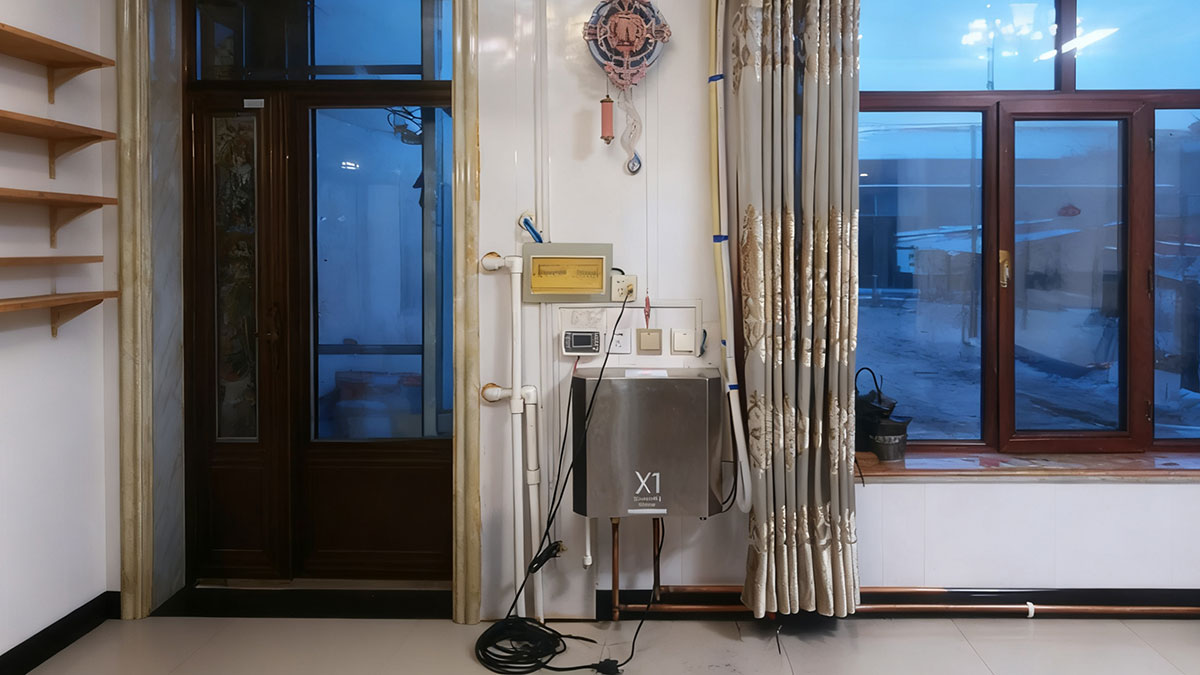
In 2022, after learning about our “AC + AC Companion” coupled radiant system, Mr. Yin decided to install a pilot system in over 100 square meters of his home. This system consists of three core components:
- A: Traditional AC Outdoor Unit – Provides basic cooling and heating sources
- B: AC Companion – Enables secondary heat exchange and system optimization
- C: Indoor Unit – Provides convective heat exchange
System Operation Results and User Experience
Winter 2023 Operation Data
Throughout the winter of 2023, the system demonstrated outstanding performance:
Temperature Stability
- Indoor temperature consistently maintained within the comfortable range of 20-22°C
- Indoor temperature remained above 20°C even when outdoor temperature dropped to -25°C
- Vertical temperature difference less than 2°C, far superior to the 4-5°C difference in traditional heating systems
Energy Efficiency Performance
- Approximately 45% reduction in energy consumption compared to traditional electric heating
- About 38% savings in operating costs compared to gas boilers
- System comprehensive energy efficiency ratio (COP) reached 3.8, much higher than the 2.2-2.5 of traditional AC systems
Comfort Improvement
- No fan-induced draft sensation, indoor wind speed below 0.15m/s
- Radiant heating provides comfortable “warm feet, cool head” experience
- Humidity maintained at 40%-60% comfortable range, no dryness discomfort
Actual User Feedback
“This AC Companion system completely exceeded my expectations,” Mr. Yin said. “The electricity cost for the entire heating season (November 2023-March 2024) was only 3,200 yuan, compared to 5,000 yuan in previous years using coal-fired boilers, saving 36%. Most importantly, the indoor temperature is more stable and uniform, eliminating the situation where areas near the heater were hot while areas farther away were cold.”
Technical Principles and Innovative Advantages
Core Role of the AC Companion
The AC Companion, as the intelligent control core of the system, achieves multiple breakthroughs:
Winter Heating Mode Optimization
- Increases system subcooling to 8-10K through two-stage condensation process
- Maintains 85% of rated heating capacity even at -20°C environment
- Effectively prevents compressor liquid slugging, improving system reliability
Summer Cooling Mode Innovation
- Optimizes superheat to 5-7K using two-stage evaporation design
- Combines convective cooling with radiant cooling
- Achieves high-comfort cooling without draft sensation
Comparative Advantages Over Traditional Systems
vs Traditional AC Systems
- Heating capacity increased by 35%, with better low-temperature adaptability
- Energy consumption reduced by 30-45%, significantly lowering operating costs
- Greatly improved comfort, without dryness or dust issues
vs Traditional Radiant Floor Systems
- Installation cost reduced by 40%, with lower renovation difficulty
- Heating speed increased by 50%, reaching set temperature in just 2 hours
- Initial investment reduced by 35%, with easier maintenance
vs Electric Heating Equipment
- Energy efficiency ratio improved by 3.2 times
- Operating costs reduced by 45-65%
- Higher safety, without local overheating risks
Perfect Alignment with New Energy Development
Advantages in Future Energy Landscape
With the rapid development of nuclear power generation technology and increasing proportion of new energy power generation:
- Wind and solar power generation costs are predicted to drop to 0.15 yuan/kWh by 2030
- Nuclear power generation share is expected to increase to over 15%
- Grid peak shaving demand is increasingly strengthening
System’s Adaptive Advantages
The AC Companion coupled system demonstrates unique advantages in these trends:
Low-Cost Electricity Utilization
- Efficient heat transfer capability, with heating energy efficiency ratio reaching 3.8
- Operating costs only 30% of direct electric heating
Grid Friendliness
- Can achieve off-peak operation with intelligent control, with 70% utilization of valley electricity
- Underground PE pipes have 8-10 hours of heat storage capacity, assisting grid peak shaving
Environmental Contribution
- Single 100㎡ residence reduces carbon emissions by 3.2 tons annually
- High efficiency reduces energy waste
Promotion Value and Development Prospects
Demonstration Effect of Mr. Yin’s Case
After Mr. Yin’s successful practice, 27 out of 38 households in the same village expressed installation interest. This case proves:
Applicability in Rural Areas
- Initial investment of 40,000-60,000 yuan, recoverable through energy savings in 3-5 years
- Operating cost only 6-8 yuan per square meter per month
- Adapts to individual needs, allows zonal control by room
Adaptability to Various Building Types
- Detached houses, townhouses
- Rural self-built houses, urban apartments
- New construction and renovation projects
Operation Data from Various Pilot Areas
Tongliao Area, Inner Mongolia
- Winter average COP: 3.6-3.8
- COP at extreme low temperature (-25°C): 2.8-3.0
- Operating cost: 28-35 yuan/㎡/heating season
Fujian Area
- Summer cooling average COP: 4.2-4.5
- Dehumidification capacity increased by 40%
- Operating cost: 15-20 yuan/㎡/cooling season
Northwest Area
- Adapts to dry climate, with automatic humidity compensation
- Dust-proof design, maintenance cycle extended to 2 years
Future Development Trends
With continuous technology maturation and cost optimization, the AC + AC Companion coupled system will play a greater role in the following areas:
Clean Heating in Northern Regions
- Market coverage expected to reach 15% by 2025
- Replaces scattered coal burning, reducing coal consumption by 3.5 tons per household annually
Hot Summer and Cold Winter Regions
- Achieves unified solution for heating and cooling
- Improves comfort during transition seasons
Special Application Scenarios
- Low-density residential areas
- Intermittently used buildings
- Occasions requiring personalized temperature control
Conclusion: Optimal Choice for Future Temperature Control
Mr. Yin’s successful case in Tongliao fully demonstrates the technical advancement and practical value of the AC Companion coupled radiant system. This A+B+C system architecture not only solves heating guarantee problems in extreme climates but also achieves comprehensive breakthroughs in energy efficiency, comfort, and economy.
Measured data shows that during winter operation in the Tongliao area:
- Average room temperature maintained at precise control of 21±1°C
- Monthly electricity costs controlled at 800-1,000 yuan (100㎡)
- System reliability reached 99.7%
- User satisfaction score: 9.2/10
With the rapid development of nuclear power generation and new energy power generation technologies, future power supply will become cheaper and more abundant. The AC Companion system, as a model of efficient electricity utilization, perfectly aligns with this development trend. It can fully utilize low-cost electricity while having good grid interaction capability, making it an ideal link between energy production and consumption.
In Mr. Yin’s home, we witnessed the perfect combination of traditional AC and modern AC Companion, and saw how technological innovation brings substantial improvements to life. This ordinary rural residence in Tongliao City has become a microcosm of future temperature control technology—efficient, comfortable, economical, and environmentally friendly.
With more users like Mr. Yin emerging, and with continuous technology promotion and improvement, the AC + AC Companion coupled system will inevitably become the mainstream choice for future building temperature control, bringing comfortable spring-like experiences throughout all four seasons to more people.
Air Conditioning, AC Companion, Radiant Cooling, Condensation, Subcooling, Superheat, Energy Efficiency, Vertical Temperature Difference, Heat Pump, Comfort, Five Constant System, Partial Load, Rural Left-behind, Villa, Central Air Conditioning, New Energy, Nuclear Power Generation, Phase Change Materials, Artificial Intelligence, Predictive Control