Security Rooted in Our Veins: Why Are Chinese People So Fond of Plain Boiled Water?
Amidst diverse global drinking habits, China presents a unique picture: from northern alleys to southern tea houses, from school corridors to high-speed rail carriages, warm plain boiled water in a thermos or enamel cup remains the “default choice” for national hydration. Even with bottled water and RO water purifiers entering millions of households, data shows that over 70% of households still insist on boiling purified water before drinking. This seemingly redundant “boiling ritual” is actually a survival code accumulated over millennia of civilization, intertwined with painful lessons from public health history, the deep influence of Traditional Chinese Medicine (TCM) wellness philosophy, and psychological self-preservation amidst modern anxieties.
Historical Imprint: The Boiling Technique and National Survival Narrative
Although ancient China had legends like Yu the Great taming the floods, it long suffered from “water hazards.” The Song Dynasty text Taiping Holy Prescriptions for Universal Relief warned: “River water often contains poisonous parasites, drinking it harms people.” Water source pollution became an even greater public health tragedy in modern times: the 1902 cholera outbreak in Shanghai claimed over a hundred lives daily; in the 1950s, schistosomiasis ravaged the Jiangnan region, images of patients with distended bellies shocking the national psyche. In an era lacking chlorination technology, boiling became the most universal “lifesaving technique for the common people” – experiments prove that sustained boiling for one minute inactivates 99.9% of pathogens. The 1952 “Patriotic Health Campaign” inscribed “Do not drink raw water” into the Epidemic Prevention Convention, embedding it into collective memory through posters and broadcasts, elevating boiling from a technical act to a survival ethic.
The TCM view of water’s nature also profoundly shaped drinking habits. The Yellow Emperor’s Classic of Internal Medicine: Basic Questions states: “Cold form and drinking cold [liquids] injure the lungs,” establishing the theoretical basis for “avoiding cold drinks.” Yuan Dynasty imperial physician Hu Sihui systematically explained in Principles of Correct Diet: “When food and drink are consistently warm, the whole body flourishes; cold water entering the mouth damages the hundred meridians.” Li Shizhen went further in the Compendium of Materia Medica, listing “hot water” (boiled water) as a medicinal substance, claiming it “assists yang energy, unblocks the meridians, and resolves pathogenic toxins.” This medical discourse filtered down to the populace through wellness texts like Constant Words for the Elderly, spawning folk sayings such as “A cup of hot boiled water upon waking surpasses ginseng soup.”
Psychological Schema: The Boiling Ritual and Compensation for Security Anxiety
In contemporary society, boiling provides a visual production of a sense of security. The digital trust in water quality monitoring reports struggles to compete with the sensory confirmation brought by seeing steam rise. Psychological experiments reveal that humans possess a cognitive reliance on “witnessed” disinfection processes. The 2013 Lanzhou tap water benzene exceedance incident and rumors about “sewer aerosol” transmission during the COVID-19 pandemic in 2020 both triggered buying sprees of water boilers – in the context of a risk society, the whistle of a kettle becomes a requiem combating uncertainty.
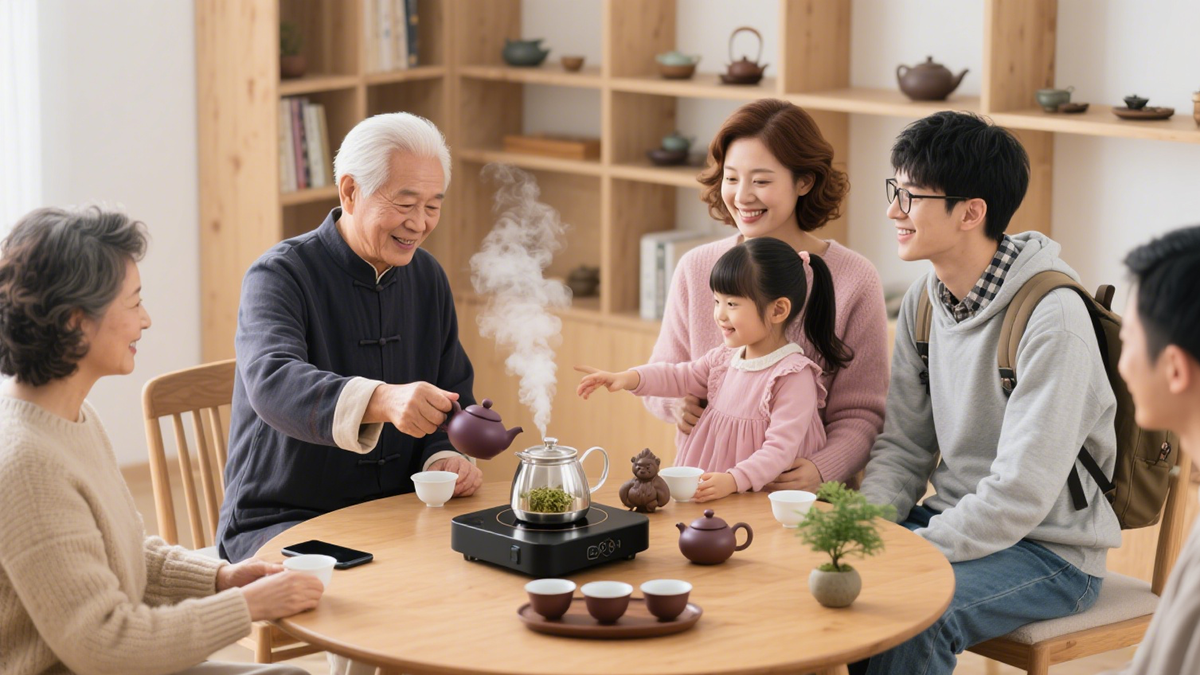
“Drink more hot water” is not merely a phrase of concern but also a recitation of cultural DNA. Anthropologist Wang Mingke points out that “Chinese families strengthen the consciousness of the bloodline community through sharing a pot of boiled water.” The scene in the TV drama Parents’ Love, where naval officer Jiang Defu keeps watch over the water boiler all night for his wife An Jie, is a visual representation of this cultural code. Changing this habit is akin to challenging familial narrative authority.
Life Practice: From Wellness Order to Spatial Adaptation
The TCM theory of “correspondence between heaven and human”衍生出精细的水温管理: derives a meticulous water temperature management system: drinking hot water upon waking ascends and expresses yang energy; sipping warm water after meals aids digestion; taking small sips of warm water before bedtime nourishes yin and body fluids. This “water temperature chronology” reaches its peak in postpartum care – the custom in Shanxi of drinking red date boiled water seven times daily during the “confinement month” reflects a ritualized symbiosis between the body and water temperature.
Plain boiled water is a “universal solvent” for multiple life scenarios:
- Tea Base: Wuyi rock tea requires 95°C boiling water to release its “rock rhyme” (characteristic flavor).
- Medication Carrier: Cephalosporin antibiotics require warm water for administration to prevent crystalluria.
- Social Medium: The water boiler room in government offices once served as information hubs.
- Symbol of Warmth: The free hot water offered by attendants on Spring Festival trains carries the symbolism of state paternalistic care.
Conclusion: The “Chineseness” in a Cup of Plain Boiled Water
This cup of clear liquid is, in reality, an overlay of three layers of civilization:
- Historical Layer: The survival rationality forged by the memory of epidemics.
- Philosophical Layer: The life technology guided by the principle of yin-yang balance.
- Modern Layer: The micro-rituals of self-redemption in a risk society.
When German companies introduce instant hot water dispensers heating to 99°C, Chinese consumers still insist on seeing the rolling bubbles – that fleeting boil is the manifestation of civilizational genes in the steam. Understanding this “attachment” is key to decoding the unique logic behind the evolution of China’s water drinking appliances.
Keywords: plain boiled water, Chinese, drinking habits, boiling, public health, Traditional Chinese Medicine, sense of security, cultural DNA, psychological anxiety, water temperature management, tea, medication, social interaction, paternalistic care, Chineseness