
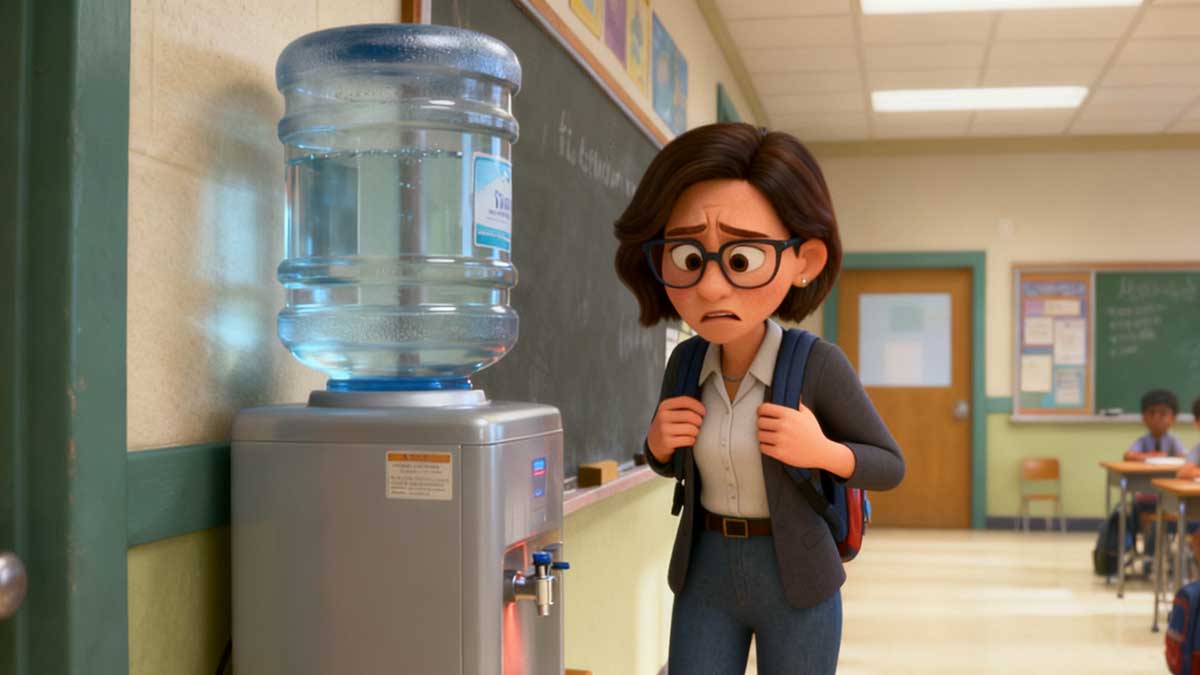
Storage-Type Water Tanks: The Overlooked Energy Drain and Safety Hazard
Following the previous chapter’s discussion on how energy-saving water dispensers meet public drinking water needs through innovation, we must now focus on a key component in their core design: the storage-type water tank, which remains at a high temperature for extended periods. This component, essential for ensuring instant hot water supply, in fact leads to continuous energy consumption and significant safety risks, becoming the “Achilles’ heel” of this technology’s achievements.
1. The “Invisible Electricity Drain” Behind the Facade of Energy Efficiency: The Staggering Cost of Continuous Heat Retention
The “energy saving” of these dispensers lies in their use of residual heat to preheat cold water. However, their storage tanks must be constantly maintained at temperatures above 90°C to meet the demand for instant hot water. This leads to an inevitable standby energy consumption:
- Physical Limits: No matter how advanced the insulation layer is, heat will irreversibly dissipate from the high-temperature tank to the cooler environment.
- Continuous Power Consumption: To compensate for heat loss, the device must heat intermittently. This process never stops, even during unused periods like nights or holidays.
This “invisible” consumption might seem insignificant for a single unit, but when scaled up nationwide, the total energy waste is staggering:
- Single Unit: A standard 60-litre dispenser consumes approximately 876 kWh annually just for heat retention, costing over 700 RMB in electricity.
- Institutional Level: A university with 2,000 students, using about 40 units, wastes 35,000 kWh per year on heat retention, with electricity costs nearing 28,000 RMB.
- National Level: Conservatively estimated, there are 3 million units in public institutions across the country, with a total annual standby energy consumption of 2.628 billion kWh, costing over 2.1 billion RMB in electricity. This energy equivalent is:
- The combustion of 840,000 tons of standard coal.
- Emissions of 2.08 million tons of CO₂.
- More than one-third of the total annual residential electricity consumption of Qinghai Province.
Conclusion: The heat retention energy consumption of traditional water dispensers has evolved from a micro-level equipment flaw into a systemic drain on municipal budgets, provincial resources, and national emission reduction targets.
2. The High-Temperature Water Tank: A Potential Safety “Heat Source”
Beyond massive energy consumption, the long-term high-temperature storage tank itself poses multiple safety hazards:
- Scalding Risk: The tank and connecting pipes are extremely hot. If a rupture occurs or maintenance is improper, the instantaneous release of high-temperature water or steam can easily cause serious accidents, posing a higher risk in venues frequented by minors.
- Material Aging and Water Quality Concerns: Long-term exposure to high temperatures and pressure accelerates the aging and potential leaching of materials like the inner tank liner and seals. If the water source is hard, scale buildup occurs, presenting potential risks to water quality.
- The “Thousand-Boils Water” Psychological Controversy: Water being repeatedly heated in a high-temperature tank, while scientifically recognized to have nitrite levels far below safety limits, still triggers unnecessary public anxiety about water safety.
3. The Era Calls for Thorough Technological Innovation
With rising societal awareness of energy conservation, environmental protection, and safety standards, the two major drawbacks of traditional storage-type energy-saving water dispensers—”continuous heat retention energy consumption” and “high-temperature storage risk”—are becoming increasingly prominent. While it was a clever compromise in its historical context, it failed to fundamentally resolve the core contradiction of public water drinking.
Chapter Conclusion
The storage-type high-temperature water tank acts like a black hole, continuously consuming electricity, increasing operational costs, and adding to environmental burdens, while also representing a latent safety hazard. When we consider the vast number of units nationwide, the sum of this waste and risk is staggering and unsustainable. Therefore, the pursuit of a全新的 solution that can completely eliminate the high-temperature storage tank while satisfying the habit of instant boiled water consumption is no longer just an option for technological optimization, but an urgent demand of the times. This paves the inevitable way for the innovative solutions, integrating instant heating and efficient heat exchange technologies, to be discussed in the following chapters.
Keywords:
Storage-type water tank, Energy-saving water dispenser, Heat retention energy consumption, Public institution energy conservation, Standby power consumption, Thousand-boils water, Scalding risk, Water and electrical safety, Energy waste, Electricity cost, Carbon dioxide emissions, Instant heating technology, Storage-type water boiler, Energy-saving retrofit, Hidden costs
Endnotes (Chapter 4):
[1] Estimation basis for heat retention power: Conservative estimate based on actual measurements and product specification data ranges (typically between 80W-150W) for mainstream 60L storage-type energy-saving water boilers. Actual values vary significantly due to insulation material, ambient temperature, set water temperature, and equipment age.
[2] Annual electricity consumption per unit calculation: Formula: Annual electricity consumption (kWh) = Heat retention power (kW) × 24 (hours/day) × 365 (days/year). 0.1 kW × 24 × 365 = 876 kWh.
[3] Average industrial and commercial electricity price: Reference the average level of selling prices from the National Development and Reform Commission’s (NDRC) catalogue of industrial and commercial electricity prices across provinces (2023/2024 data), using 0.8 RMB/kWh as a representative estimate. Actual prices vary by region, voltage level, and time-of-use. [Data Source: NDRC official website price query platform or provincial power grid company sales price lists]
[4] Estimation of the number of water dispensers in universities: Reasonable estimate based on the division of functional areas (teaching buildings, dormitories, offices, libraries, gyms, etc.) and population density on a typical university campus. Configuring 40 units for a 2,000-student university (~50 people/unit) is common; actual configuration depends on building layout and water point density.
[5] Basis for estimating the number of devices at City/Provincial/National levels:
* City level (25,000 units): Comprehensive estimate based on the number of public institutions (e.g., number of schools, hospital beds, government units, transportation hubs) in a typical prefecture-level city (non-provincial capital) from the “China City Statistical Yearbook,” combined with the prevalence of water dispenser configuration per unit.
* Provincial level (150,000 units): Scaled up proportionally from the city model based on the provincial population size (~60 million), considering higher population density and concentration of public institutions in provincial capitals and large cities.
* National level (3-4 million units): Synthesized from the following sources:
* Relevant equipment information (if available) from energy conservation reports/energy consumption statistics for public institutions released by the Ministry of Housing and Urban-Rural Development (MOHURD) or the Government Offices Administration of the State Council (GOA).
* Market research or industry white paper estimates on the installed base of public drinking water equipment from industry associations (e.g., China Energy Conservation Association, relevant commercial appliance associations).
* Retrospective calculations of the installed market based on the market share and annual sales data of major manufacturers. [Note: This is a key estimation point; actual precise data relies on authoritative statistics or large-scale market research.]
[6] Reference for annual electricity consumption of a small data center: According to industry standards, a single cabinet power is about 3-8kW. A small data center housing 20-50 cabinets consumes between several hundred thousand and 2-3 million kWh annually. 2.19 million kWh falls within this range. [Data Source: Data Center Energy Efficiency White Paper or industry reports]
[7] Reference for annual household electricity consumption: Uses data on annual per capita/household residential electricity consumption published in the National Energy Administration’s (NEA) “National Electric Power Industry Statistics Express” or the “China Electric Power Yearbook.” The average annual electricity consumption per urban household in China is generally between 1000-3000 kWh; approximately 876 kWh/household/year is used here as a reference value for simplified calculation.
[8] Supplementary estimation for provincial device count: Cross-validated and adjusted using publicly available data such as the number of schools at all levels published by the Provincial Department of Education, the number of hospitals published by the Health Commission, and the number of government agencies.
[9] Three Gorges Power Station annual electricity generation: Uses the officially announced designed average annual power generation of the Three Gorges Project (approx. 88.2 billion kWh) or recent actual generation (e.g., approx. 80.2 billion kWh in 2023) as a reference. 131.4 million kWh is a very small proportion (approx. 0.0013 or 0.13‰). [Data Source: China Three Gorges Corporation website or annual reports]
[10] Standard coal conversion and power supply coal consumption: Based on the national standard “General Principles for Calculation of Total Production Energy Consumption” (GB/T 2589-2020), using the “equivalent value” principle for the electricity conversion coefficient to standard coal. The current average coal consumption for power supply in China’s grid is approximately 300-320 grams of standard coal per kilowatt-hour (gce/kWh); 320 gce/kWh is used here for conversion. Calculation formula: Standard coal quantity (tons) = Electricity consumption (kWh) × Coal consumption for power supply (kgce/kWh) / 1000. [Data Source: National Bureau of Statistics Energy Statistical Yearbook, CEC Annual Report]
[11] National device count estimation (lower limit 3 million units): This estimate synthesizes predictions and retrospective analyses of the installed base of commercial water boilers/energy-saving water dispensers in China from multiple industry analysis reports and market research (e.g., reports from Zhiyan Consulting, Qianzhan Industry Research Institute). Considering equipment replacement cycles and the existing stock, 3 million units is a relatively conservative estimate.
[12] Definition of public institution scope: Mainly refers to party and government agencies at all levels, public service units (schools, hospitals, research institutes, etc.), mass organizations, as well as transportation hubs (stations, airports), and large venues that provide public services. Excludes purely commercial venues (e.g., company-purchased units in office buildings) and households.
[13] Carbon dioxide emission factor: Uses the regional grid average CO₂ emission factor recommended by the Ministry of Ecology and Environment (MEE) in documents like the “Guidelines for the Preparation of Provincial CO₂ Emission Peaking Action Plans.” The current national grid average emission factor is approximately 0.792 kg CO₂/kWh (2022 data, subject to annual updates). Calculation formula: CO₂ emissions (tons) = Electricity consumption (kWh) × Emission factor (kg CO₂/kWh) / 1000. [Data Source: MEE official website or relevant technical specifications]
[14] Qinghai Province residential electricity consumption: Cites annual power data released by the National Energy Administration or the Qinghai Provincial Bureau of Statistics. For example, publicly available reports or statistical bulletins show Qinghai’s total residential electricity consumption in 2023 or recent years (e.g., approx. 6 billion kWh). 2.628 billion kWh represents over one-third (approx. 43.8%) of that. [Data Source: Qinghai Provincial Bureau of Statistics website, NEA released electric power industry statistics]