
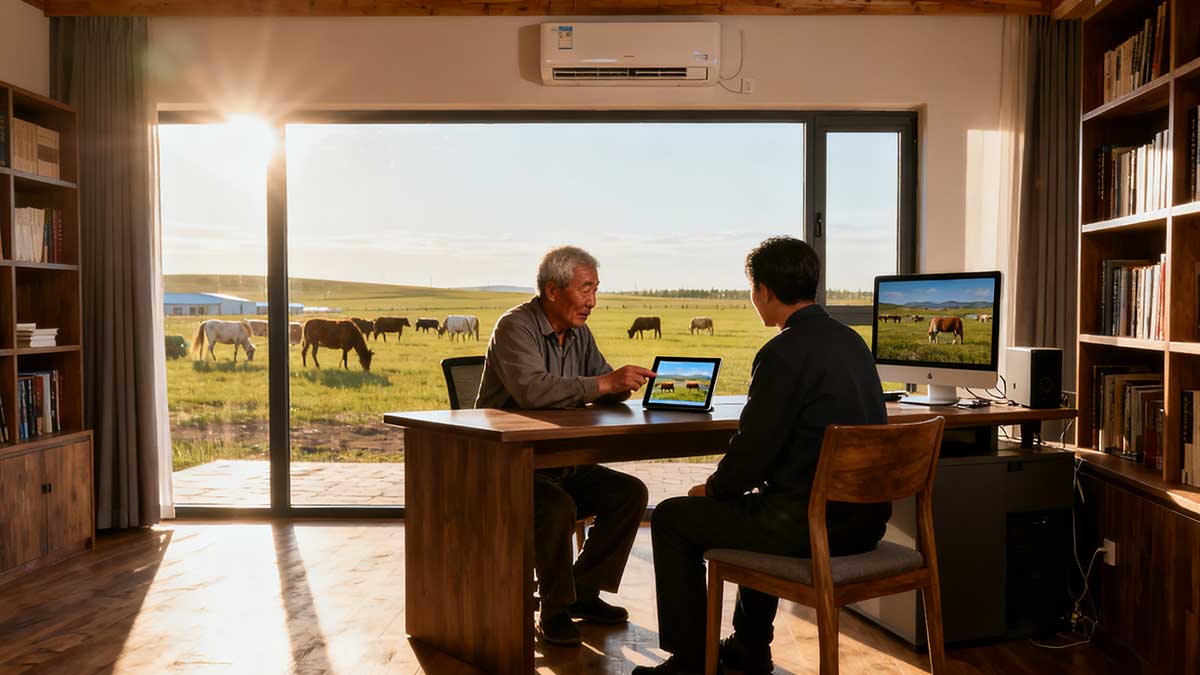
The Warm Transformation at Grandpa Zhang’s Home in Hongqi Village, Ulanqab, Inner Mongolia: One System Changes the Winter Life of Three Generations Under One Roof
In Hongqi Village on the outskirts of Ulanqab City, Inner Mongolia, the family of 67-year-old Grandpa Zhang Jianguo, a household of five, experienced unprecedented warmth this winter. This two-story self-built house, constructed in 2010 with a floor area of 180 square meters, had relied on an old coal-fired boiler paired with cast iron radiators for heating for over ten winters.
Family Background and Heating Challenges
The situation at Grandpa Zhang’s home is quite typical in the local area:
- Family Members: The old couple, their son and daughter-in-law, and a 5-year-old grandson.
- Building Characteristics: Brick-concrete structure with average thermal insulation.
- Previous Heating: One 0.5-ton coal-fired boiler, driving 12 sets of radiators.
- Annual Coal Consumption: Approximately 4 tons (about 3,200 RMB).
- Electricity Cost: Around 800 RMB during the winter heating period (for pumps and other equipment).
- Total Heating Cost: Approximately 4,000 RMB per winter.
“Winter was the biggest headache before,” recalled Grandpa Zhang. “I had to get up at 4 AM every day to add coal, and the room temperature was still unstable. My grandson often caught colds, and my daughter-in-law always said it was too hot near the radiators but cold over by the sofa.”
System Upgrade: A Key Decision in 2023
In October 2023, at his son’s insistence, the Zhang family installed the huawa Coupled Radiant Air Conditioning System. The upgrade included:
- Retaining the original inverter AC outdoor unit.
- Adding the AC Companion intelligent control module.
- Laying a PE pipe radiant system throughout the house’s floor.
- Installing an intelligent temperature control system.
The total investment was approximately 38,000 RMB, which included a 12,000 RMB subsidy from the local coal-to-electricity conversion program.
Operational Data: Tangible Benefits
Operational Data for Winter 2023-2024:
- Heating Period: Nov 1, 2023 – Mar 31, 2024 (151 days)
- Total Electricity Consumption: 4,200 kWh
- Electricity Cost: 1,680 RMB (local tiered residential electricity price)
- Savings Compared to Previous Year: 2,320 RMB
- Energy Saving Effect: 58%
Significant Improvement in Quality of Life
Grandpa Zhang listed the changes:
“Now the room temperature stays around 20°C consistently, and my little grandson can play barefoot on the floor. Most importantly, we don’t have to get up in the middle of the night to add coal anymore; we can adjust the temperature with our phones.”
His daughter-in-law added:
“Before, my hands and feet would get cold cooking in the kitchen. Now the whole house is warm. Clothes dry faster indoors, and there’s no coal smell.”
Concrete Manifestation of Technical Advantages
Stable Performance in Extreme Weather:
- Maintained stable operation during a -28°C cold wave in January 2024.
- Ensured continuous heating in low-temperature environments by precisely controlling subcooling.
- Liquid slugging protection mechanism ensured equipment safety.
Comprehensive Improvement in Comfort:
- Vertical temperature difference reduced from over 6°C to within 2°C.
- Achieved draft-free heating, reducing instances of colds for the elderly and child.
- Automatic humidity maintenance within a comfortable range.
Economic Benefit Analysis
Direct Benefits:
- Annual operational cost savings: 2,320 RMB.
- Expected payback period: 3.2 years (after subsidy).
- Equipment design life of 15 years promises significant long-term benefits.
Indirect Benefits:
- Saves 1 hour of daily labor for adding coal.
- Improves indoor air quality.
- Enhances property value.
Neighborhood Effect and Promotion Value
The success of Grandpa Zhang’s installation attracted widespread attention in the village. Currently, 8 households in Hongqi Village plan to install the same system in 2024. The village party secretary calculated:
“If all 200 households in the village complete the upgrade, it could reduce coal consumption by 800 tons annually, equivalent to reducing CO2 emissions by 2,000 tons.”
Future Outlook
This case fully demonstrates the suitability of the Coupled Radiant Air Conditioning System in rural northern areas. With the advancement of the rural revitalization strategy and the increase in farmers’ incomes, this heating method that integrates comfort, energy saving, and intelligence is becoming a new choice for new rural construction.
Coupled Radiant Air Conditioning System, AC Companion, Plate Heat Exchanger, PE Pipe, Radiant Terminal, Subcooling, Liquid Slugging Protection, PID Algorithm, Five Constant System, Rural Coal-to-Electricity Conversion, Energy-saving Renovation, Operating Costs, Indoor Constant Temperature, Vertical Temperature Difference, Draft-free, Intelligent Control, Coal Replacement, Temperature Uniformity, System Stability, Payback Period