New Coupled Radiant Air Conditioning System: A Personalized Climate Control Solution for the Future
In an era of energy transition and evolving personalized needs, an innovative air conditioning solution is quietly reshaping our understanding of indoor climate control.
Traditional heating and cooling systems face a practical dilemma: centralized systems are suitable for high-density usage but become costly to operate in rural areas, low-occupancy communities, or partially occupied villas, where large systems often prove inefficient and sometimes even fail to function properly.
Meanwhile, single-mode cooling or heating systems struggle to simultaneously meet the dual demands of energy efficiency and comfortable experience.
01 Market Challenges of Current Climate Control Systems
In the field of contemporary building climate control, we face a difficult-to-reconcile contradiction. Large centralized heating systems require high user density to achieve economical operation, yet the reality is that many rural areas and urban communities have insufficient occupancy rates, making traditional centralized heating ineffective.
For single-family homes, rural villas, or spaces with low usage rates, operating a full central air conditioning or air-to-water heat pump system proves highly uneconomical.
Comfort-wise, traditional air conditioning systems also have significant shortcomings. Traditional convective cooling systems rely on forced air circulation, which not only creates noticeable drafts, uneven temperature distribution, and noise issues but also carries the risk of spreading airborne pollutants.
On the other hand, ideal radiant cooling systems, while capable of providing a more gentle comfort experience, have been limited by technical bottlenecks of condensation risk and insufficient cooling capacity, particularly in hot and humid climates.
02 Core Principles of the Innovative Solution
Addressing these challenges, our proposed “Coupling Radiant Air Conditioning System Based on Air Conditioner Companion” (ABC system) offers a breakthrough solution. This system ingeniously combines traditional split air conditioning with radiant terminals, achieving a qualitative leap in performance through unique process design.
The ABC system consists of three core components: a traditional split air conditioning system, an innovative “Air Conditioner Companion” auxiliary heat exchange module, and a PE pipe radiant terminal system installed under the floor.
The “Air Conditioner Companion” serves as the intelligent hub of the system, containing a plate heat exchanger, circulating water pump, and precise control system, responsible for coordinating the operation of both terminals.
The most innovative feature of this system is its dual-mode operation capability:
- Winter Heating Mode: The system adopts an A-B-C circulation path, where the refrigerant first passes through the Air Conditioner Companion to release heat to the radiant terminal, then enters the indoor unit to complete the second heat release. This two-stage condensation design significantly increases the effective condensation area and enhances the system’s subcooling degree.
- Summer Cooling Mode: The system switches to an A-C-B circulation path, where the refrigerant first absorbs heat through the indoor unit, then dissipates heat to the underground PE pipes via the Air Conditioner Companion. The two evaporation processes ensure higher superheat of the return gas while perfectly combining convective cooling and radiant cooling.
03 Why ABC is the Optimal Solution for Diverse Scenarios
Scale Adaptability: From Single Rooms to Entire Buildings
The unique advantage of the ABC system lies in its unparalleled flexibility. Unlike traditional central air conditioning or centralized heating, it can provide climate control for single rooms, specific areas, or entire buildings according to actual needs.
For rural households with left-behind family members or low-occupancy communities, this on-demand activation characteristic avoids energy waste.
In comparison, large central air conditioning systems, while suitable for entire buildings, cannot achieve economical operation in localized spaces; whereas ordinary split air conditioners, while capable of localized use, cannot provide the comfort experience of radiant climate control.
The ABC system perfectly fills this market gap – it’s as flexible as traditional split air conditioners while providing comfort comparable to central air conditioning.
Breakthrough in Energy Efficiency
The ABC system significantly improves energy efficiency through two core technologies: increasing subcooling degree in the heating cycle and enhancing superheat degree in the cooling cycle.
This design not only improves the system’s overall energy efficiency but also broadens its operating range. Experimental research shows that radiant cooling systems based on similar principles can achieve maximum cooling effects of 12.65°C when optimally operated.
In terms of energy utilization, the ABC system perfectly complements emerging thorium-based nuclear power generation technology.
With the maturation of thorium-based molten salt reactor technology in China, future electricity supply will become more abundant and economical. Thorium resources are abundant in China with low acquisition costs, and the “non-thirsty” nature of thorium-based molten salt reactors allows them to be built in desert areas, fundamentally solving the long-term dependence on imported nuclear fuel.
Comfort Revolution
The ABC system integrates convective and radiant heat transfer methods, creating an unprecedented comfort experience.
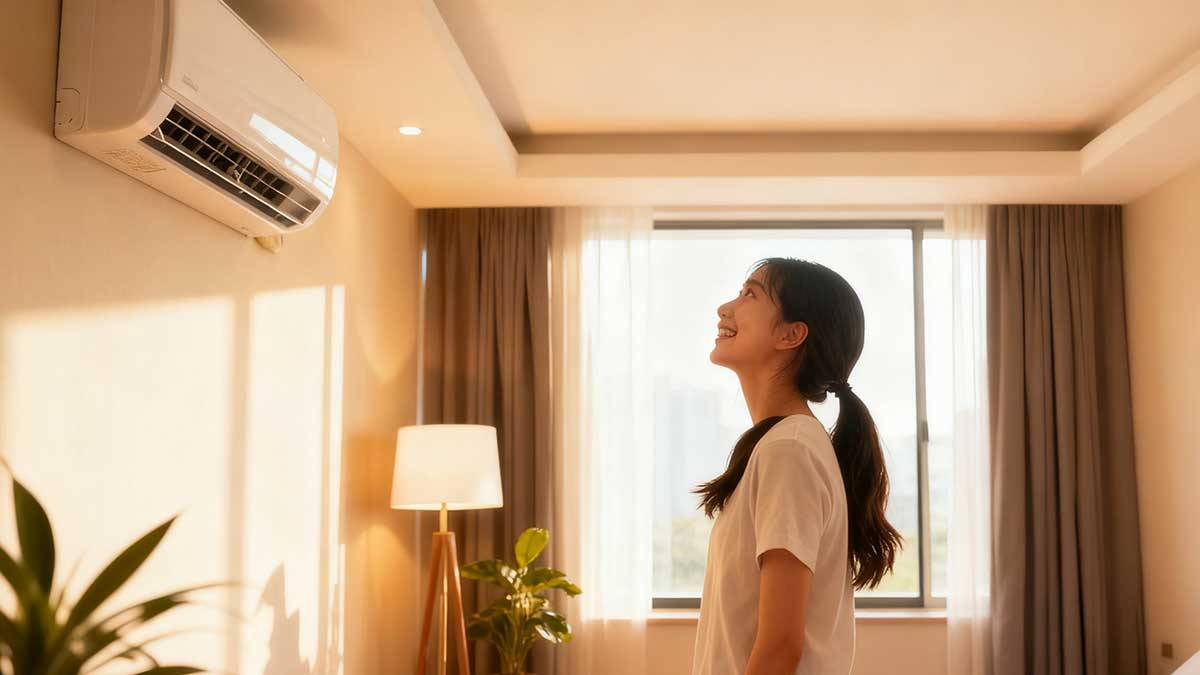
Compared with traditional air conditioning, it reduces vertical temperature differences indoors through radiant cooling/heating, avoiding the discomfort of strong air drafts, and creating a softer, more uniform thermal environment.
This comfort improvement is manifested not only in temperature perception but also in noise control. By reducing reliance on fan air delivery, system operating noise is significantly reduced, similar to the quiet environment below 30 decibels achievable by TABS radiant air conditioning systems.
04 Comprehensive Comparison with Traditional and High-end Systems
Comparison with Traditional Split Air Conditioners
Traditional split air conditioners rely on a single convective heat transfer method, suffering from inherent drawbacks such as uneven temperature distribution, strong drafts, and high noise. The ABC system addresses these issues by incorporating radiant terminals, while also improving system stability in extreme weather conditions through its two-stage heat exchange design.
Particularly in low-temperature heating scenarios, traditional air conditioners often face challenges of short heating runtimes and unstable temperature control, while the ABC system effectively enhances low-temperature adaptability by increasing the subcooling degree, maintaining efficient operation even when outdoor temperatures are low.
Comparison with Central Air Conditioning Systems
Central air conditioning systems are suitable for commercial buildings and high-end residences with high density usage, but their high initial investment and operating costs prove highly uneconomical in low-usage scenarios.
The ABC system offers the possibility of zonal on-demand control, avoiding energy waste. For residential spaces like villas, homeowners can activate the climate control system only in frequently used areas without operating the entire central system, significantly reducing energy costs.
Comparison with High-end Radiant Air Conditioning Systems
Traditional radiant cooling systems like TABS (Thermally Activated Building Systems), while offering advantages such as 20%-30% energy savings and improved thermal comfort, have limited application scope due to their complex structures and control strategies.
The ABC system simplifies the system structure through innovative “Air Conditioner Companion” design, while addressing the technical bottleneck of radiant cooling application in humid environments through intelligent condensation prevention control.
05 Future Development and Market Prospects
With the development of AIoT technology, the intelligent potential of the ABC system will be fully realized. Similar to the air conditioner companion solution developed by Tuya Smart, future ABC systems can integrate more intelligent functions:
- Remote Control: System operation control via mobile APP;
- Power Statistics: Real-time monitoring of energy consumption, optimizing operation strategies;
- Smart Scene Integration: Interconnection with other smart devices for whole-house intelligence;
- Voice Control: Voice operation through smart speakers;
- OTA Updates: Remote firmware upgrades for continuous system optimization.
Under the trend of energy conservation and environmental protection, the advantages of the ABC system will become increasingly evident. Research shows that innovative cooling technologies can achieve significant energy savings and CO2 emission reduction under different climate conditions.
Combined with future cheaper electricity supply – such as thorium-based molten salt reactors potentially achieving levelized electricity costs of 20欧元/MWh – the operating economy of the ABC system will be further highlighted.
The transformation of future energy structure and climate control demands has already begun. Driven by both thorium-based nuclear power generation and intelligent technology, the ABC system, with its flexibility, high efficiency, and exceptional comfort, is becoming the perfect bridge connecting future energy and personalized comfort needs.
Air Conditioner Companion, Radiant Cooling, Thorium-based Molten Salt Reactor, Subcooling Degree, Superheat Degree, Two-stage Heat Exchange, Personalized Climate Control, Energy Efficiency, Split Air Conditioning, Thermodynamic Optimization, Coupled System, PE Piping, Plate Heat Exchanger, Rural Heating, Villa Air Conditioning, Energy-saving Technology, Intelligent Control, Condensation Control, Comfort Experience, Carbon Neutrality