
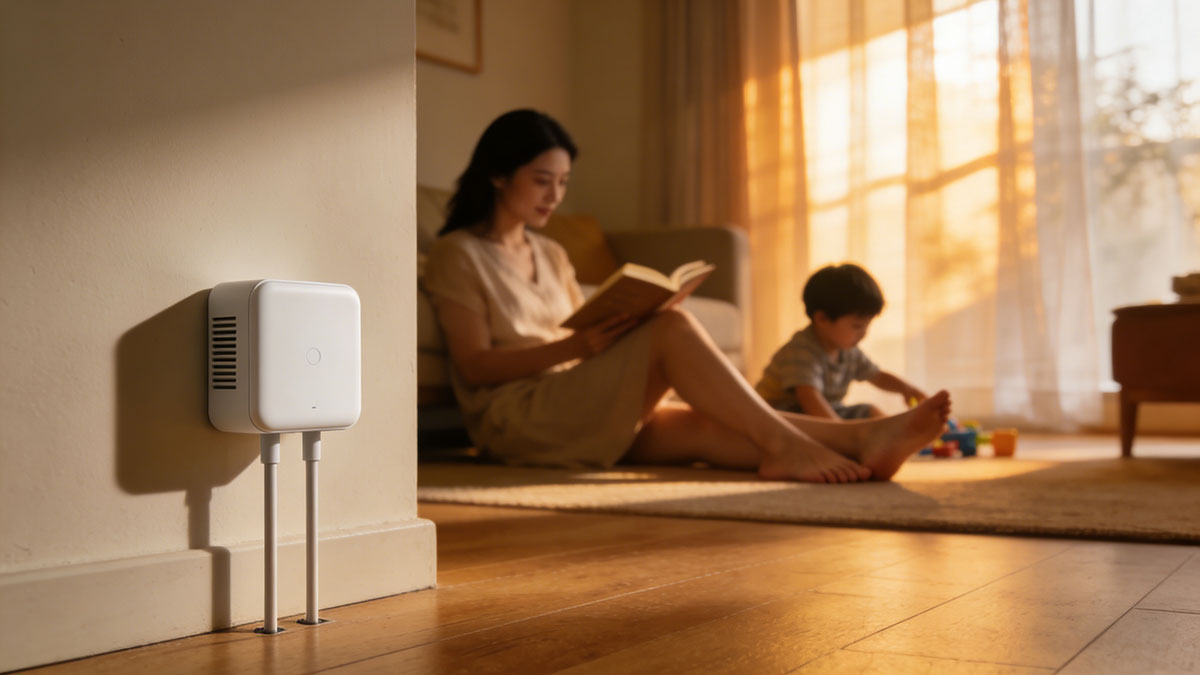
引言:为什么我们忍受了这么多年?
你有没有想过一个问题:
空调发明至今已经一百多年,分体式空调走进中国家庭也有三四十年了。我们接受了它的便利,却也习惯了它的缺点——
夏天,冷风直吹,肩膀酸、关节疼,多少人裹着毯子吹空调?
冬天,热风上浮,头热脚冷,开久了还干燥得让人难受。
化霜时,室内机要么停吹,要么吹冷风,那种“忽冷忽热”的体验,谁没经历过?
我们以为,这就是空调本来的样子。我们以为,想要更舒服,就得花大价钱装中央空调、装地暖、装“五恒系统”。
但有没有一种可能——我们一直用的那台普通空调,其实可以变得更好?
不需要拆墙,不需要换掉整台机器,不需要花几万十几万。只需要一个盒子,它就能“原地进化”。
这个盒子,叫“空调伴侣”。
第一章:空调的“三次进化”
在说这个盒子之前,我们先简单回顾一下,家用空调是怎么一路走来的。
第一次进化:窗式空调
那是空调最早的形态。一个铁盒子,一半在室内,一半在室外。它让空调第一次走进了家庭,但噪音大、安装受限。不过,它解决了“有没有”的问题。
第二次进化:分体式空调
这是我们现在最熟悉的形态。压缩机移到室外,室内机变得安静、美观。它解决了“好不好看”和“吵不吵”的问题,成为市场绝对的主流。
但这两次进化,解决的都是“外观”和“噪音”的问题。有一个根本问题,始终没有被触及——
舒适度。
无论窗式还是分体式,空调调节室温的方式只有一个:吹风。夏天吹冷风,冬天吹热风。风是有了,但人体的感受却被忽略了。
那么,第三次进化应该是什么?
答案可能出乎你的意料——它不是换一台更贵的空调,也不是再装一套地暖,而是在你现有的分体式空调基础上,增加一个盒子。
这个盒子,让空调学会了“辐射”。
这就是第三次进化:ABC空调。
第二章:一个盒子,凭什么让空调“进化”?
这个盒子,就是“空调伴侣”。它的正式名称叫“基于空调伴侣的耦合式辐射空调系统”的核心模块,发明人张志华(huawa)先生已经为其申请了国家实用新型专利(专利号:ZL 2021 2 1195781.6)。
它不大,甚至可以藏在电视柜旁边或者角落里。但它的作用,却足以让一台普通的冷暖空调脱胎换骨。
它是怎么做到的?
很简单:它让空调学会了“分身术”。
在传统空调里,所有的冷量或热量,都只能通过室内机“吹”出来。但有了空调伴侣,冷媒的流动路径被重新设计了——
冬天,高温冷媒先流进空调伴侣,把大部分热量交给地板下的管道,让地板“辐射”供暖;剩下的热量再流进室内机,吹出暖风作为补充。
夏天,低温冷媒先流进室内机,快速降温;然后带着“剩余冷量”流进空调伴侣,把冷量交给地板下的管道,实现“辐射供冷”。
简单来说,一个盒子,让空调多了一个“帮手”。
这个帮手,就是地板。从此,空调不再是一个人“单打独斗”,而是和地板“双剑合璧”。一个负责快速响应,一个负责持续舒适。
第三章:进化后的空调,到底强在哪?
加了这么一个盒子,空调到底变了什么?我们从三个维度来看。
维度一:舒适度——从“吹风”到“无风感”
这是最直观的变化。
进化前,空调只有“吹风”这一种武器。夏天冷风直吹,冬天热风上浮,怎么调都不舒服。
进化后,空调有了两种武器:对流(吹风)+ 辐射(地板)。
夏天,头顶有柔和的风,脚下有丝丝凉意,垂直温差被大大缩小,再也没有冷风直吹的刺痛感。
冬天,脚底暖洋洋的,头顶只有微微的暖风,“头热脚冷”的尴尬彻底消失。
这就是无风感空调的真正含义——不是没有风,而是风不再是唯一的、粗暴的调节方式。
维度二:能效——从“够用”到“更省”
你可能不知道,空调的能效,和两个参数密切相关:过冷度和过热度。
听起来很专业,但可以这样理解:
- 过冷度越高,冷媒在蒸发器里能吸收的热量就越多,制热就越省电。
- 过热度越高,回到压缩机的冷媒就越“纯粹”,压缩机的寿命就越长,系统就越稳定。
传统空调只有一个室内机,过冷度和过热度都是“固定”的,很难优化。
但有了空调伴侣,冷媒在进入室内机之前,已经先经过了一次换热(冬天是先给地板加热,夏天是先给地板降温)。这就相当于给冷媒“预热”或“预冷”了一次,过冷度和过热度都得到了提升。
结果就是:同样的电,能搬来更多的热(或冷)。这也是为什么ABC空调系统比传统热泵空调更节能的核心原因之一。
维度三:稳定性——从“怕冷怕热”到“极端也稳”
北方的朋友可能深有体会:冬天特别冷的时候,空气能热泵的效率会大幅下降,甚至“罢工”。这是因为低温下,冷媒在节流阀前容易“提前气化”(闪发),导致系统不稳定。
但空调伴侣通过提升过冷度,有效防止了“闪发”现象。即使室外温度极低,即使压缩机不具备昂贵的“喷气增焓”技术,系统也能稳定运行。
还有一个让北方用户头疼的问题:化霜。
传统空调化霜时,四通阀反向,室内机要么停吹,要么吹冷风,让人非常不适。但ABC空调系统有一个绝招——热量缓冲法。需要化霜时,系统可以只从地板里提取热量,用来融化室外机的霜。此时,室内机完全不用吹风,你甚至感觉不到它在化霜。地板就像一个巨大的“热量银行”,温度变化非常缓慢,你坐在屋里,脚下只是微微凉了一点,几乎察觉不到。
第四章:这个盒子,还藏着哪些“黑科技”?
除了上面说的这些,空调伴侣还有一些“隐藏技能”,可能连很多专业人士都没想过。
隐藏技能一:防液击,保护压缩机
压缩机是空调的心脏,也是最容易坏的部分。很多空调“英年早逝”,罪魁祸首就是“液击”——液态冷媒回流冲击压缩机,导致内部零件损坏。
空调伴侣通过精确控制水泵的流速,从而控制从冷媒侧提取的热量。无论冬天还是夏天,它都能确保回到压缩机的冷媒是纯粹的气体,并且温度足够高。这就好比给压缩机穿上了一件“防弹衣”,有效避免了液击风险,让空调的寿命大大延长。
隐藏技能二:特殊解冻,极端情况也能自救
想象一个极端场景:冬天遭遇长期停电,室内温度骤降,埋在地板下的水管被冻住了。当电力恢复后,普通的空调连地暖系统可能会束手无策——直接加热冻住的管道,有爆裂的风险。
但ABC空调系统有它独特的“解冻模式”:
- 先开启室内机和室外机,甚至启动电辅热,将房间的空气加热。
- 等室温上升后,热量会通过空气传导到地板,再慢慢传导到被冻住的管道。
- 当管道内的冰自然融化后,再启动空调伴侣,让热水循环起来,加速整个系统的恢复。
这个过程安全、稳妥,展现出了系统非凡的“生命力”。
第五章:这不是“黑科技”,这是“必然”
有人可能会问:这么好的东西,为什么以前没人想到?
其实,这不是“黑科技”,而是技术演进到一定阶段的必然产物。
回顾人类对居住环境的追求,我们经历了四个阶段:
- 岩洞洞居——只为遮风挡雨。
- 土屋泥房、砖瓦木房——追求稳定、安全。
- 现代房子——追求功能、舒适。
- ABC空调时代——追求“无感智慧调节”。
与之对应,我们调节体感舒适的方式,也经历了四次进阶:
- 自然调节(靠房子朝向、气流)
- 初级调节(风扇、电暖器、暖气片)
- 热量搬运(空调、空气能热泵)
- 无感智慧调节(ABC空调系统)
每一次进阶,都意味着一次理念的突破:从“统一集中”到“独立精细”,从“单一形式”到“多种形式”。
二十年后,当我们的下一代习惯了这种“无风感”的舒适环境,他们可能无法想象,我们这一代人曾经是如何忍受空调直吹的冷风,和冬天冰冷的双脚。
这,就是技术演进的力量。它悄无声息,却深刻地改变了我们的生活。
而这一切的开始,可能只是一个小小的盒子。
结语:你的空调,离进化只差一个盒子
回到最初的问题:为什么我们忍受了这么多年?
因为过去,我们没有别的选择。要么接受传统空调的缺点,要么花大价钱上更复杂的系统。
但现在,不一样了。
一个叫“空调伴侣”的盒子,让这件事变得简单。它不需要你拆墙,不需要你换掉家里的分体式空调,不需要你投入巨资。它只是在你熟悉的系统上,增加了一个模块,然后,一切都变了。
你的空调,还是那台空调。但它学会了和地板合作,学会了“无风感”的温柔,学会了在极端天气下稳定运行,学会了保护自己的“心脏”。
这不是魔法,这是进化。
而进化的起点,可能就是你下一次装修时,多问的那一句:
“我的空调,能不能配个‘伴侣’?”
Keywords:
空调,ABC空调系统,空调伴侣,无风感空调,空调采暖,空调连地暖,冷暖空调,热泵空调,空气能,热泵,五恒系统,分体式空调,辐射空调,耦合系统,能效比,过冷度,过热度,室内机,室外机,压缩机
One Box That Lets Your Traditional Air Conditioner Evolve on the Spot
Introduction: Why Have We Endured This for So Long?
Have you ever thought about this?
Air conditioners have been around for over a hundred years. Split-type air conditioners have been in Chinese homes for three or four decades. We’ve accepted their convenience, but we’ve also grown accustomed to their shortcomings—
In summer, the cold air blows directly, causing shoulder aches and joint pain. How many people wrap themselves in blankets while the AC runs?
In winter, the hot air rises, leaving heads warm and feet cold. Running it for long creates an uncomfortable dryness.
During defrost cycles, the indoor unit either stops or blows cold air—that “alternating hot and cold” experience is something we’ve all been through.
We assumed this is just how air conditioners are. We assumed that if we wanted more comfort, we’d have to spend a fortune on central AC, underfloor heating, or a “Five Constant System.”
But what if there was a way—for that ordinary air conditioner we’ve been using to actually become better?
No need to tear down walls. No need to replace the whole unit. No need to spend tens of thousands. Just one box, and it can “evolve on the spot.”
That box is called the “Air Conditioner Buddy.”
Chapter 1: The “Three Evolutions” of Air Conditioning
Before we talk about this box, let’s briefly review how household air conditioning has evolved.
First Evolution: Window Air Conditioner
This was the earliest form. A metal box, half inside, half outside. It brought air conditioning into homes for the first time, but it was noisy and limited in installation. Still, it solved the problem of “having” AC.
Second Evolution: Split-Type Air Conditioner
This is the form we’re most familiar with today. The compressor moved outside, and the indoor unit became quiet and aesthetically pleasing. It solved the problems of “appearance” and “noise,” becoming the absolute market leader.
But these two evolutions only addressed “looks” and “sound.” One fundamental problem remained untouched—
Comfort.
Whether window or split-type, air conditioners have only one way to regulate room temperature: blowing air. Cold air in summer, hot air in winter. The air moves, but human comfort gets overlooked.
So, what should the third evolution be?
The answer might surprise you. It’s not buying a more expensive air conditioner. It’s not installing underfloor heating separately. It’s adding one box to your existing split-type air conditioner.
This box teaches the air conditioner to “radiate.”
This is the third evolution: ABC Air Conditioning.
Chapter 2: How Can One Box Make an Air Conditioner “Evolve”?
This box is the “Air Conditioner Buddy.” Its formal name is the core module of the “Air-Conditioner-Buddy-Based Coupled Radiant Air Conditioning System,” invented by Mr. Zhang Zhihua (huawa), who has obtained a National Utility Model Patent for it (Patent No.: ZL 2021 2 1195781.6).
It’s small—small enough to hide beside a TV stand or in a corner. But its effect is enough to transform an ordinary cooling and heating air conditioner.
How does it do it?
Quite simply: it teaches the air conditioner to “multitask.”
In a traditional air conditioner, all cooling or heating capacity is delivered by blowing air through the indoor unit. But with the Air Conditioner Buddy, the refrigerant’s flow path is redesigned—
In winter, the high-temperature refrigerant first flows into the Air Conditioner Buddy, transferring most of its heat to the pipes under the floor for “radiant heating.” The remaining heat then flows into the indoor unit, which blows warm air as a supplement.
In summer, the low-temperature refrigerant first flows into the indoor unit for fast cooling. Then, carrying its “remaining coolness,” it flows into the Air Conditioner Buddy, transferring that coolness to the pipes under the floor for “radiant cooling.”
In short, one box gives the air conditioner an “assistant.”
That assistant is the floor. From now on, the air conditioner no longer works alone—it teams up with the floor. One handles rapid response, the other handles sustained comfort.
Chapter 3: What Makes the Evolved Air Conditioner So Powerful?
What exactly changes when you add this box? Let’s look at three dimensions.
Dimension 1: Comfort—From “Blowing Air” to “No-Draft”
This is the most noticeable change.
Before evolution, the air conditioner only had one weapon: blowing air. In summer, cold air blasts directly; in winter, hot air rises—no setting feels quite right.
After evolution, the air conditioner has two weapons: convection (blowing air) + radiation (the floor).
In summer, there’s a gentle breeze above and a subtle coolness from below. The vertical temperature difference shrinks dramatically, and the piercing sensation of direct cold air disappears.
In winter, warmth rises from your feet, with only a gentle warm air flow from above. The discomfort of “warm head, cold feet” is gone for good.
This is the true meaning of a no-draft air conditioner—not the absence of air movement, but the fact that air movement is no longer the sole, harsh method of regulation.
Dimension 2: Efficiency—From “Adequate” to “More Savings”
You may not know this, but an air conditioner’s efficiency is closely tied to two parameters: subcooling and superheat.
These sound technical, but here’s a simple way to understand them:
- Higher subcooling means the refrigerant can absorb more heat in the evaporator, making heating more efficient.
- Higher superheat means the refrigerant returning to the compressor is “purer,” extending compressor life and improving system stability.
A traditional air conditioner has only one indoor unit, so subcooling and superheat are “fixed” and hard to optimize.
But with the Air Conditioner Buddy, the refrigerant undergoes an extra heat exchange before entering the indoor unit (in winter, it first heats the floor; in summer, it first cools the floor). This essentially “pre-heats” or “pre-cools” the refrigerant, boosting both subcooling and superheat.
The result: the same amount of electricity moves more heat (or coolth) . This is a core reason why the ABC Air Conditioning System is more energy-efficient than traditional heat pump air conditioners.
Dimension 3: Stability—From “Temperature-Sensitive” to “Steady in Extremes”
For those in northern regions, you may have noticed: during severe cold, the efficiency of an air-source heat pump drops significantly, and it can even shut down. This happens because at low temperatures, the refrigerant tends to “flash evaporate” before the expansion valve, causing instability.
But the Air Conditioner Buddy, by increasing subcooling, effectively prevents this “flashing” phenomenon. Even when outdoor temperatures are extremely low, even without expensive “vapor injection” technology, the system remains stable.
Another headache for northern users: defrosting.
When a traditional air conditioner defrosts, a reversing valve changes the refrigerant flow, causing the indoor unit to either stop blowing or blow cold air—a very unpleasant experience. But the ABC Air Conditioning System has a special trick: the Thermal Buffering Method. When defrosting is needed, the system can extract heat solely from the floor to melt the frost on the outdoor unit. The indoor unit doesn’t blow air at all; you might not even notice defrosting is happening. The floor acts like a massive “heat bank”—its temperature changes very slowly, so you might only feel a slight coolness underfoot, barely perceptible.
Chapter 4: What Other “Hidden Tech” Does This Box Contain?
Beyond what we’ve discussed, the Air Conditioner Buddy has some “hidden skills” that even many professionals might not have considered.
Hidden Skill 1: Liquid Slugging Prevention, Protecting the Compressor
The compressor is the heart of an air conditioner and the component most prone to failure. A common cause of premature failure is “liquid slugging”—liquid refrigerant flowing back and impacting the compressor, damaging internal parts.
The Air Conditioner Buddy precisely controls the pump’s flow rate, thereby controlling the amount of heat extracted from the refrigerant side. Whether in winter or summer, it ensures the refrigerant returning to the compressor is pure gas and at a sufficiently high temperature. It’s like putting a “bulletproof vest” on the compressor, effectively preventing liquid slugging risk and significantly extending the air conditioner’s lifespan.
Hidden Skill 2: Special Defrosting Mode, Self-Rescue in Extreme Scenarios
Imagine an extreme scenario: a prolonged winter power outage causes indoor temperatures to plummet, freezing the water pipes buried under the floor. When power is restored, an ordinary air conditioner integrated with underfloor heating system might be helpless—directly heating the frozen pipes risks them bursting.
However, the ABC Air Conditioning System has its unique “defrost mode”:
- First, it starts the indoor and outdoor units, potentially even activating electric auxiliary heating, to warm the room’s air.
- As the room temperature rises, heat conducts through the air to the floor and slowly to the frozen pipes.
- Once the ice inside the pipes melts naturally, it then starts the Air Conditioner Buddy, circulating hot water to accelerate the system’s recovery.
This process is safe, steady, and showcases the system’s remarkable “vitality.”
Chapter 5: This Isn’t “Black Tech”—It’s Inevitable
Some might ask: If this is so good, why didn’t anyone think of it before?
Actually, this isn’t some mysterious “black tech”—it’s an inevitable outcome of technological evolution.
Looking back at human history, our pursuit of living spaces has gone through four stages:
- Cave Dwellings—Simply for shelter.
- Mud Huts, Brick and Wood Structures—Seeking stability and safety.
- Modern Houses—Pursuing functionality and comfort.
- The ABC Era—Pursuing “unobtrusive intelligent regulation.”
Correspondingly, our methods of thermal comfort regulation have also gone through four stages:
- Natural Regulation (relying on house orientation and airflow)
- Primary Regulation (fans, electric heaters, radiators)
- Heat Transfer (air conditioners, air-source heat pumps)
- Unobtrusive Intelligent Regulation (ABC Air Conditioning System)
Each advancement represents a conceptual breakthrough: from “centralized” to “decentralized,” from “single-form” to “multi-form.”
Twenty years from now, when the next generation is accustomed to this “no-draft” comfort, they may find it hard to imagine that we, in our time, endured the direct blast of cold air and the cold feet of winter.
This is the power of technological evolution. It’s quiet, yet it profoundly changes our lives.
And it all begins with a small box.
Conclusion: Your Air Conditioner Is Just One Box Away from Evolution
Back to the original question: Why have we endured this for so long?
Because until now, we had no other choice. Either accept the shortcomings of traditional air conditioners, or spend a fortune on more complex systems.
But now, things are different.
A box called the “Air Conditioner Buddy” makes it simple. It doesn’t require tearing down walls. It doesn’t require replacing your split-type air conditioner. It doesn’t require a huge investment. It just adds a module to the system you’re already familiar with—and then, everything changes.
Your air conditioner is still the same unit. But it’s learned to work with the floor. It’s learned the gentleness of being a no-draft air conditioner. It’s learned to operate stably in extreme weather. It’s learned to protect its own “heart.”
This isn’t magic. It’s evolution.
And the starting point of that evolution might just be the next time you’re renovating, when you ask one simple question:
“Can my air conditioner be paired with a ‘Buddy’?”
Keywords:
air conditioner, ABC air conditioning system, air conditioner buddy, no-draft air conditioner, air conditioner heating, air conditioner integrated with underfloor heating, cooling and heating air conditioner, heat pump air conditioner, air-source heat pump, heat pump, five constant system, split-type air conditioner, radiant air conditioning, coupled system, coefficient of performance (COP), subcooling, superheat, indoor unit, outdoor unit, compressor