
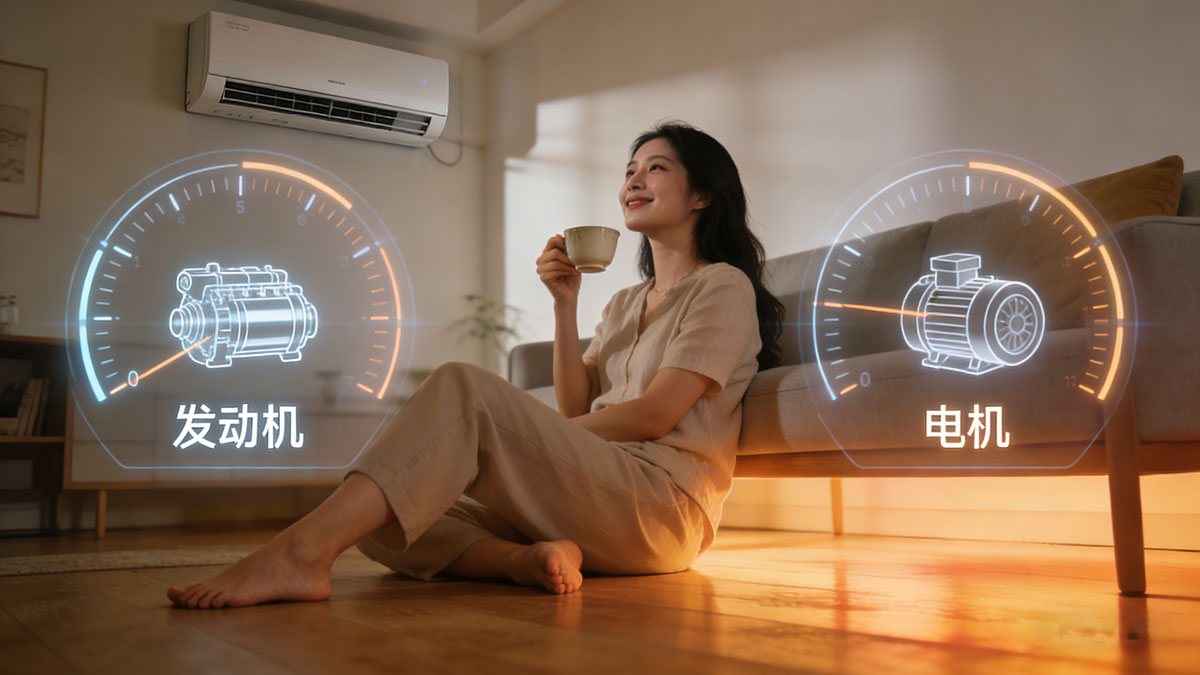
引言:汽车界的革命,空调界也该有了
如果你关注过汽车行业,一定知道“混动”这两个字意味着什么。
十年前,人们还在燃油车和纯电动车之间纠结。燃油车加油方便,但费油、排放高;纯电动车环保省钱,但续航焦虑、充电麻烦。直到“混动汽车”出现——它既有燃油车的便利,又有电动车的经济,两种模式协同工作,取长补短。于是,“省油又舒服”成了混动车的标签,也让无数消费者找到了“不用纠结”的答案。
那么问题来了:空调界,有没有自己的“混动汽车”?
有没有一种空调,既能快速制冷制热,又能让你感受不到风的刺激?
有没有一种空调,既省电,又能在极端天气下稳定运行?
有没有一种空调,不用你拆墙重装,不用你花大价钱,就能让家里的舒适度上一个台阶?
答案是:有。
它叫ABC空调系统。它就像是空调界的“混动汽车”——把两种工作模式耦合在一起,让它们协同作战,最终实现“省电又舒服”的双重目标。
第一章:传统空调,就像“纯燃油车”
先说说我们最熟悉的传统分体式空调。
它像什么?像一辆“纯燃油车”。结构简单,技术成熟,价格亲民,几乎家家户户都有一台。
但它的缺点,也像燃油车一样明显:
- 费电(费油):传统空调的能效比(COP)有天花板。夏天制冷、冬天制热,压缩机全程高负荷运转,电费账单让人心疼。
- 舒适度差(驾驶体验一般):夏天冷风直吹,肩膀酸、关节疼;冬天热风上浮,头热脚冷。就像一辆悬挂硬、噪音大的车,能把你从A点送到B点,但过程谈不上享受。
- 极端工况下“掉链子”:北方冬天太冷时,热泵空调的效率会大幅下降,甚至“罢工”。就像燃油车在高海拔地区动力不足一样。
当然,也有更高级的方案——比如中央空调、空气能水系统、地暖等。它们就像“纯电动车”,舒适度高、体验好,但价格昂贵、安装复杂,让普通家庭望而却步。
那么,有没有一种方案,能像“混动汽车”一样,把两者的优点结合起来,同时避开各自的缺点?
第二章:ABC空调,空调界的“混动方案”
有的。这就是ABC空调系统。
它的全称叫“基于空调伴侣的耦合式辐射空调系统”,由三部分组成:
- A:传统室外机(Air-source unit)
- B:空调伴侣(Buddy unit)——核心发明
- C:传统室内机(Conditioning unit)
你可以把它理解为:一台传统空调(A+C),加上一个“混动模块”(B),再连接地板下的管道。
这个“混动模块”,就是空调伴侣。它不大,甚至可以藏在角落里,但它的作用,却足以让一台普通的冷暖空调脱胎换骨。
它怎么做到的?答案是:让空调学会“两种工作模式”协同运行。
模式一:对流换热(就像混动车的“发动机”)
这就是传统空调的看家本领——通过室内机吹风,快速制冷或制热。它的优点是响应快,能在几分钟内让室温发生变化。
模式二:辐射换热(就像混动车的“电动机”)
这是空调伴侣带来的新能力——通过地板下的管道,以辐射的方式缓慢、均匀地调节温度。它的优点是舒适、无风感、无噪音。
在传统空调里,只有“模式一”在工作。而ABC空调系统,让“模式一”和“模式二”耦合在一起,协同运行。
就像混动汽车一样,系统会根据需要,自动分配两种模式的工作比例。需要快速响应时,让“发动机”(室内机)多出力;需要持续舒适时,让“电动机”(地板)多出力。
结果就是:既快又舒服,既省电又稳定。
第三章:它怎么“省电”?——比传统空调更节能的秘密
混动汽车省油,是因为它让发动机始终工作在最高效的区间,需要动力时电动机辅助,刹车时回收能量。
ABC空调省电,道理类似。
秘密就藏在两个关键词里:过冷度和过热度。
听起来很专业,但我们可以这样理解:
过冷度,就是冷媒在进入节流阀之前,被冷却的程度。过冷度越高,冷媒在蒸发器里能吸收的热量就越多。在冬天,这意味着同样的电,能搬来更多的热。
过热度,就是冷媒回到压缩机时,温度超出饱和温度的程度。过热度越高,冷媒就越“纯粹”,压缩机的运行就越稳定、越高效。在夏天,这意味着同样的电,能搬走更多的热。
传统空调只有一个室内机,过冷度和过热度都是“固定”的,很难优化。
但ABC空调系统通过空调伴侣,给冷媒增加了一次换热——
冬天:冷媒先流进空调伴侣,把大部分热量交给地板(提升过冷度),再流进室内机吹暖风。
夏天:冷媒先流进室内机吹冷风,再流进空调伴侣,把剩余冷量交给地板(提升过热度)。
这一前一后的“两次换热”,让冷媒的状态被优化到了最佳区间。结果是:系统的能效比(COP)显著提升,耗电量明显下降。
就像混动汽车在市区堵车时用纯电模式,省油又安静;高速巡航时发动机介入,动力充沛又高效。两种模式各司其职,共同实现了“省”的目标。
第四章:它怎么“舒服”?——从“吹风”到“无风感”的进化
省电很重要,但舒适度才是我们买空调的最终目的。
传统空调的舒适度问题,根源在于“只靠吹风”。无论是制冷还是制热,都只有一种方式。
而ABC空调系统,给了我们两种选择,而且它们可以同时工作。
夏天:头顶有风,脚下有凉
制冷模式下,冷媒先进入室内机,吹出凉风,快速降温;然后带着“剩余冷量”流进空调伴侣,传递给地板,实现“辐射供冷”。
你坐在房间里,头顶有微风拂过,脚下有丝丝凉意从地板传来。冷空气下沉、热空气上升的自然规律,在这里反而成了帮手——脚下的凉意让全身都感到舒适,头顶的风也不再那么刺骨。垂直温差被大大缩小,体感变得均匀、柔和。
这就是无风感空调的真正含义——不是没有风,而是风不再是唯一的、粗暴的调节方式。
冬天:脚底暖,头顶温
制热模式下,冷媒先流进空调伴侣,把大部分热量交给地板,实现“辐射供暖”;然后带着“余热”流进室内机,吹出暖风作为补充。
你坐在房间里,脚底暖洋洋的,热量从脚底升起,自然上升。头顶只有微微的暖风,再也不用忍受“头热脚冷”的尴尬。而且因为地板分担了大部分供热任务,室内机不需要“拼命”吹风,风量更小、风速更柔和,干燥感也大大减轻。
还有一个隐藏福利:无感化霜
在北方的冬天,热泵空调的室外机结霜是常事。传统空调化霜时,四通阀反向,室内机要么停吹,要么吹冷风,让人非常不适。
但ABC空调有个绝招:热量缓冲法。需要化霜时,系统可以只从地板里提取热量,用来融化室外机的霜。此时,室内机完全不用吹风,你甚至感觉不到它在化霜。地板就像一个巨大的“热量银行”,温度变化非常缓慢,你坐在屋里,脚下只是微微凉了一点,几乎察觉不到。
这就像混动汽车在等红灯时发动机自动熄火,安静又省油,而你甚至感觉不到这个切换过程。
第五章:它还有什么“隐藏技能”?
除了省电和舒服,ABC空调系统还有一些“隐藏技能”,可能连很多专业人士都没想过。
隐藏技能一:防液击,保护压缩机
压缩机是空调的心脏,也是最容易坏的部分。很多空调“英年早逝”,罪魁祸首就是“液击”——液态冷媒回流冲击压缩机,导致内部零件损坏。
空调伴侣通过精确控制水泵的流速,从而控制从冷媒侧提取的热量。无论冬天还是夏天,它都能确保回到压缩机的冷媒是纯粹的气体,并且温度足够高。这就好比给压缩机穿上了一件“防弹衣”,有效避免了液击风险,让冷暖空调的寿命大大延长。
隐藏技能二:特殊解冻,极端情况也能自救
想象一个极端场景:冬天遭遇长期停电,室内温度骤降,埋在地板下的水管被冻住了。当电力恢复后,普通的空调连地暖系统可能会束手无策——直接加热冻住的管道,有爆裂的风险。
但ABC空调系统有它独特的“解冻模式”:
- 先开启室内机和室外机,甚至启动电辅热,将房间的空气加热。
- 等室温上升后,热量会通过空气传导到地板,再慢慢传导到被冻住的管道。
- 当管道内的冰自然融化后,再启动空调伴侣,让热水循环起来,加速整个系统的恢复。
这个过程安全、稳妥,展现出了系统非凡的“生命力”。
第六章:这不仅是产品升级,更是理念进化
有人说,ABC空调系统就是给传统空调加了个“外挂”。但从更高的视角来看,这其实是空调行业的一次理念进化。
回顾家用空调的发展史,我们经历了两次形态转变:
- 第一次:窗式空调(解决了“有没有”的问题)
- 第二次:分体式空调(解决了“好不好看、吵不吵”的问题)
而第三次形态转变,正在发生——ABC空调(解决了“舒不舒服、省不省电”的问题)。
这背后,是我们对“舒适”这个词的重新定义。
过去,我们认为“舒适”就是温度合适。现在,我们知道了——舒适是无风感,是脚暖头凉,是安静,是不干燥,是恒温恒湿。
而ABC空调系统,正是为了这个目标而生。它不是简单地叠加两种功能,而是通过“耦合”的方式,让1+1>2。
就像混动汽车不是简单地在燃油车上加个电机,而是重新设计了动力系统的逻辑,让两种动力源协同工作,达到最优效果。
结语:你的下一台空调,何必是“纯燃油”?
回到文章开头的问题:空调界,有没有自己的“混动汽车”?
现在,你可以回答:有。它叫ABC空调系统。
它像混动汽车一样,省电(省油)又舒服。
它像混动汽车一样,两种模式协同工作,取长补短。
它像混动汽车一样,让你不再纠结“选哪个”——因为你两个都要。
而且,它还有一个混动汽车都比不了的优势:它不需要你换掉家里那台空调。
你只需要在装修时多埋一圈管道,再装一个空调伴侣,你熟悉的分体式空调,就原地进化成了“混动版”。
这不是科幻,这是已经实现的现实。
你的下一台空调,何必还是“纯燃油”?
Keywords:
空调,ABC空调系统,空调伴侣,无风感空调,空调采暖,空调连地暖,冷暖空调,热泵空调,空气能,热泵,五恒系统,分体式空调,辐射空调,耦合系统,能效比,过冷度,过热度,室内机,室外机,压缩机
The “Hybrid” of the Air Conditioning World: Fuel-Efficient (Electricity-Saving) and Comfortable
Introduction: A Revolution in the Auto Industry, Time for One in Air Conditioning
If you follow the automotive industry, you know what “hybrid” means.
Ten years ago, people were torn between gasoline cars and pure electric vehicles. Gasoline cars were convenient to refuel, but they consumed a lot of fuel and had high emissions. Pure electric vehicles were environmentally friendly and cost-efficient, but they came with range anxiety and charging hassles. Then came “hybrid vehicles”—combining the convenience of gasoline cars with the economy of electric vehicles, with both modes working synergistically to complement each other’s strengths. As a result, “fuel-efficient and comfortable” became the hallmark of hybrids, offering countless consumers a “no-compromise” solution.
So here’s the question: Does the air conditioning world have its own “hybrid”?
Is there an air conditioner that can cool or heat quickly while sparing you the discomfort of direct airflow?
Is there an air conditioner that saves electricity while operating stably even in extreme weather?
Is there an air conditioner that, without tearing down walls or breaking the bank, can elevate your home’s comfort to the next level?
The answer is: Yes.
It’s called the ABC Air Conditioning System. It’s like the “hybrid” of the air conditioning world—coupling two operating modes to work in synergy, ultimately achieving the dual goals of “electricity-saving and comfortable.”
Chapter 1: Traditional Air Conditioners Are Like “Pure Gasoline Cars”
Let’s start with the traditional split-type air conditioner we know best.
What is it like? It’s like a “pure gasoline car.” Simple in structure, mature in technology, affordable in price—found in almost every household.
But its drawbacks are as evident as those of a gasoline car:
- High electricity consumption (high fuel consumption) : Traditional air conditioners have a ceiling in their Coefficient of Performance (COP). Whether cooling in summer or heating in winter, the compressor runs at high load throughout, leading to painful electricity bills.
- Poor comfort (rough ride) : In summer, the cold air blows directly, causing shoulder aches and joint pain; in winter, the hot air rises, leaving heads warm and feet cold. It’s like a car with stiff suspension and high noise levels—it gets you from point A to point B, but the journey is far from enjoyable.
- Struggles in extreme conditions: In the depths of northern winters, the efficiency of a heat pump air conditioner can drop sharply, even to the point of shutting down. It’s like a gasoline car losing power at high altitudes.
Of course, there are more advanced options—central air conditioning, air-to-water heat pump systems, underfloor heating, etc. These are like “pure electric vehicles”—high comfort, great experience, but expensive and complex to install, putting them out of reach for average households.
So, is there a solution that, like a “hybrid vehicle,” combines the strengths of both while avoiding their respective drawbacks?
Chapter 2: ABC Air Conditioning—The “Hybrid Solution” for the AC World
Yes, there is. This is the ABC Air Conditioning System.
Its full name is the “Air-Conditioner-Buddy-Based Coupled Radiant Air Conditioning System,” composed of three parts:
- A: Traditional Outdoor Unit (Air-source unit)
- B: Air Conditioner Buddy (Buddy unit)—the core invention
- C: Traditional Indoor Unit (Conditioning unit)
Think of it as: a traditional air conditioner (A+C), plus a “hybrid module” (B), connected to pipes under the floor.
This “hybrid module” is the Air Conditioner Buddy. It’s small, even concealable in a corner, but its effect is enough to transform an ordinary cooling and heating air conditioner.
How does it do it? The answer is: by teaching the air conditioner to operate with two synergistic modes.
Mode 1: Convection Heat Exchange (Like a Hybrid’s “Engine”)
This is the traditional air conditioner’s specialty—using the indoor unit’s fan to blow air, providing rapid cooling or heating. Its advantage is fast response, capable of changing room temperature within minutes.
Mode 2: Radiant Heat Exchange (Like a Hybrid’s “Electric Motor”)
This is the new capability brought by the Air Conditioner Buddy—using pipes under the floor to slowly and evenly regulate temperature through radiation. Its advantages are comfort, no drafts, and no noise.
In a traditional air conditioner, only “Mode 1” operates. The ABC Air Conditioning System couples “Mode 1” and “Mode 2” together, allowing them to operate in synergy.
Just like a hybrid vehicle, the system automatically allocates the workload between the two modes based on demand. When a rapid response is needed, the “engine” (indoor unit) does more work; when sustained comfort is desired, the “electric motor” (the floor) takes over.
The result: fast and comfortable, electricity-saving and stable.
Chapter 3: How Does It “Save Electricity”?—The Secret to Being More Efficient Than Traditional AC
Hybrid vehicles save fuel because they keep the engine operating at its most efficient range, with the electric motor assisting when power is needed and recovering energy during braking.
The ABC Air Conditioning saves electricity through a similar principle.
The secret lies in two key concepts: subcooling and superheat.
While these sound technical, we can understand them simply:
Subcooling is the degree to which the refrigerant is cooled before entering the expansion valve. Higher subcooling means the refrigerant can absorb more heat in the evaporator. In winter, this means the same amount of electricity moves more heat.
Superheat is the degree to which the refrigerant’s temperature exceeds its saturation temperature when returning to the compressor. Higher superheat means the refrigerant is “purer,” leading to more stable and efficient compressor operation. In summer, this means the same amount of electricity removes more heat.
A traditional air conditioner has only one indoor unit, so subcooling and superheat are “fixed” and hard to optimize.
But the ABC Air Conditioning System, through the Air Conditioner Buddy, adds an extra heat exchange step for the refrigerant—
In winter: The refrigerant first flows into the Air Conditioner Buddy, transferring most of its heat to the floor (increasing subcooling), then flows into the indoor unit to blow warm air.
In summer: The refrigerant first flows into the indoor unit to blow cool air, then flows into the Air Conditioner Buddy, transferring its remaining cooling capacity to the floor (increasing superheat).
This “two-stage heat exchange” optimizes the refrigerant’s state to its ideal range. The result: the system’s Coefficient of Performance (COP) improves significantly, and electricity consumption drops noticeably.
It’s like a hybrid vehicle using pure electric mode in city traffic—quiet and efficient—while the engine engages during highway cruising for ample power and efficiency. Both modes play their part, together achieving the goal of “saving.”
Chapter 4: How Does It Provide “Comfort”?—The Evolution from “Blowing Air” to “No-Draft”
Saving electricity is important, but comfort is the ultimate goal when buying an air conditioner.
The comfort issue with traditional air conditioners stems from relying solely on “blowing air.” Whether cooling or heating, there’s only one method.
The ABC Air Conditioning System offers us two methods, and they can work simultaneously.
Summer: Cool Air Above, Coolness Below
In cooling mode, the refrigerant first enters the indoor unit, blowing cool air for rapid cooling. Then, carrying its “remaining coolness,” it flows into the Air Conditioner Buddy, transferring that coolness to the floor for “radiant cooling.”
Sitting in the room, you feel a gentle breeze above and a subtle coolness rising from the floor. The natural laws of cool air sinking and warm air rising actually work in your favor here—the coolness from below makes your whole body feel comfortable, and the breeze above feels less harsh. The vertical temperature difference is significantly reduced, creating a uniform and gentle sensation.
This is the true meaning of a no-draft air conditioner—not the absence of air movement, but the fact that air movement is no longer the sole, harsh method of regulation.
Winter: Warm Feet, Gentle Warmth Above
In heating mode, the refrigerant first flows into the Air Conditioner Buddy, transferring most of its heat to the floor for “radiant heating.” Then, carrying its “residual heat,” it flows into the indoor unit, blowing warm air as a supplement.
Sitting in the room, you feel cozy warmth rising from your feet. The heat ascends naturally. There’s only a gentle warm air flow from above, eliminating the discomfort of “warm head, cold feet.” And because the floor handles most of the heating load, the indoor unit doesn’t have to “work overtime” blowing air. Airflow is lower, gentler, and the sensation of dryness is significantly reduced.
Hidden Bonus: Unobtrusive Defrosting
In northern winters, frost forming on the outdoor unit of a heat pump air conditioner is common. When a traditional AC defrosts, a reversing valve changes the refrigerant flow, causing the indoor unit to either stop or blow cold air—a very unpleasant experience.
But ABC Air Conditioning has a special trick: the Thermal Buffering Method. When defrosting is needed, the system can extract heat solely from the floor to melt the frost on the outdoor unit. During this process, the indoor unit doesn’t blow air at all; you might not even notice defrosting is happening. The floor acts like a massive “heat bank”—its temperature changes very slowly, so you might only feel a slight coolness underfoot, barely perceptible.
This is like a hybrid vehicle’s engine automatically shutting off at a red light—quiet and efficient, with the driver barely noticing the transition.
Chapter 5: What Other “Hidden Skills” Does It Have?
Beyond saving electricity and providing comfort, the ABC Air Conditioning System has some “hidden skills” that even many professionals might not have considered.
Hidden Skill 1: Liquid Slugging Prevention, Protecting the Compressor
The compressor is the heart of an air conditioner and the component most prone to failure. A common cause of premature failure is “liquid slugging”—liquid refrigerant flowing back and impacting the compressor, damaging internal parts.
The Air Conditioner Buddy precisely controls the pump’s flow rate, thereby controlling the amount of heat extracted from the refrigerant side. Whether in winter or summer, it ensures the refrigerant returning to the compressor is pure gas and at a sufficiently high temperature. It’s like putting a “bulletproof vest” on the compressor, effectively preventing liquid slugging risk and significantly extending the lifespan of the cooling and heating air conditioner.
Hidden Skill 2: Special Defrosting Mode, Self-Rescue in Extreme Scenarios
Imagine an extreme scenario: a prolonged winter power outage causes indoor temperatures to plummet, freezing the water pipes buried under the floor. When power is restored, an ordinary air conditioner integrated with underfloor heating system might be helpless—directly heating the frozen pipes risks them bursting.
However, the ABC Air Conditioning System has its unique “defrost mode”:
- First, it starts the indoor and outdoor units, potentially even activating electric auxiliary heating, to warm the room’s air.
- As the room temperature rises, heat conducts through the air to the floor and slowly to the frozen pipes.
- Once the ice inside the pipes melts naturally, it then starts the Air Conditioner Buddy, circulating hot water to accelerate the system’s recovery.
This process is safe, steady, and showcases the system’s remarkable “vitality.”
Chapter 6: This Is More Than a Product Upgrade—It’s an Evolution in Philosophy
Some might say the ABC Air Conditioning System is just adding an “add-on” to a traditional air conditioner. But from a broader perspective, it represents an evolution in the philosophy of the air conditioning industry.
Looking back at the development history of household air conditioners, we’ve seen two morphological shifts:
- First Shift: Window air conditioners (solved the problem of “having” AC)
- Second Shift: Split-type air conditioners (solved the problems of “appearance and noise”)
Now, a third morphological shift is underway—ABC Air Conditioning (solving the problems of “comfort and efficiency”).
Behind this is a redefinition of what “comfort” means.
In the past, we thought “comfort” simply meant the right temperature. Now we know—comfort means no drafts, means warm feet and a cool head, means quiet, means not dry, means constant temperature and humidity.
The ABC Air Conditioning System was born for this goal. It’s not simply stacking two functions together; it’s using a “coupled” approach to achieve 1+1>2.
Just like a hybrid vehicle isn’t just an electric motor bolted onto a gasoline car—it’s a complete redesign of the powertrain logic, allowing two power sources to work synergistically for optimal results.
Conclusion: Why Should Your Next Air Conditioner Be a “Pure Gasoline”?
Back to the question at the beginning: Does the air conditioning world have its own “hybrid”?
Now, you can answer: Yes. It’s called the ABC Air Conditioning System.
Like a hybrid vehicle, it saves electricity (fuel) and is comfortable.
Like a hybrid vehicle, it operates with two synergistic modes, complementing each other’s strengths.
Like a hybrid vehicle, it frees you from the “which one to choose” dilemma—because you get both.
And it has one advantage that even hybrid vehicles can’t match: It doesn’t require you to replace the air conditioner you already have.
You just need to lay some extra pipes during renovation and install an Air Conditioner Buddy. Your familiar split-type air conditioner will evolve on the spot into a “hybrid version.”
This isn’t science fiction. It’s a reality that has already been realized.
Why should your next air conditioner still be a “pure gasoline” model?
Keywords:
air conditioner, ABC air conditioning system, air conditioner buddy, no-draft air conditioner, air conditioner heating, air conditioner integrated with underfloor heating, cooling and heating air conditioner, heat pump air conditioner, air-source heat pump, heat pump, five constant system, split-type air conditioner, radiant air conditioning, coupled system, coefficient of performance (COP), subcooling, superheat, indoor unit, outdoor unit, compressor