
当我们谈论建筑节能时,我们在谈论什么?
更厚的保温层?更严实的气密性?还是更贵的Low-E玻璃?这些都很重要。但有一个更根本的思路,一直被我们忽略了——让房子本身参与能量交换。
过去,我们把建筑当成一个“容器”。容器的任务是“挡住”外面的冷和热。空调负责“制造”或“搬运”冷和热。容器是容器,设备是设备,两者各干各的。
这个思路,该升级了。
今天,一种名为ABC空调系统的新技术,正在重新定义建筑与能量的关系。它的核心理念很简单,却极具颠覆性:让房子的地板、墙壁、天花板都变成“换热器”,让建筑本身成为热力系统的一部分。
这不是科幻。这是已经获得国家专利的技术。
一、传统建筑节能的“天花板”
我们先来看一个常见的场景。
一栋新建的节能住宅,外墙做了10厘米厚的挤塑板保温,窗户是三层中空玻璃,气密性做得很好。冬天,室内温度保持得不错。但问题来了:如何让这个“保温瓶”变得舒服?
传统方案是:装一台分体式空调,或者装一套空气能地暖,或者装暖气片。
无论哪种方案,都有一个共同的问题:设备是设备,房子是房子。空调挂机挂在墙上,地暖管埋在地下,但它们和建筑本身是“两张皮”。建筑的巨大表面积——地板、墙壁、天花板——大部分时间都在“闲置”,没有参与温度调节。
这就好比你花大价钱买了一个高性能的保温杯,却在杯子里放了一个加热棒。保温杯的保温性能确实好,但加热棒的工作效率、舒适度、能耗,和保温杯本身没有太大关系。
建筑节能的下一个突破口,不是把“容器”做得更好,而是让“容器”本身成为系统的一部分。
二、ABC空调:让房子变成“换热器”
ABC空调系统的全称是“基于空调伴侣的耦合式辐射空调系统”。名字有点长,但它的核心思想很简单:把建筑最大的表面积——地板——变成空调系统的“换热器”。
它是怎么做到的?
传统分体式空调的冷媒只在室外机和室内机之间循环。室内机通过吹风来传递冷热。这就是为什么你总是被风吹。
ABC空调在这个循环中插入了一个叫“空调伴侣”的模块,再连接一套埋在地板下的PE管。于是,冷媒的流动路径变成了:
- 冬天:室外机 → 空调伴侣(加热地板)→ 室内机(辅助吹热风)
- 夏天:室外机 → 室内机(吹冷风)→ 空调伴侣(冷却地板)
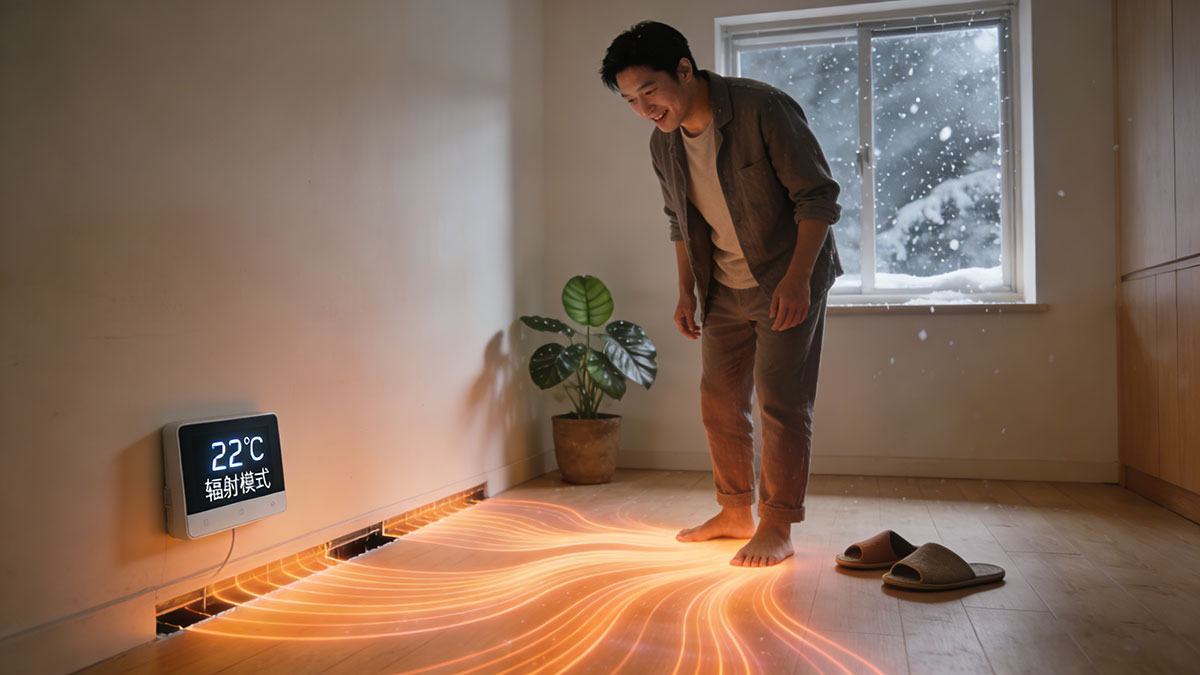
地板,这个房子里面积最大的平面,从“被动接触面”变成了“主动调节面”。冬天,它是温暖的辐射面;夏天,它是凉爽的辐射面。
房子,真的变成了换热器。
这跟“建筑节能”有什么关系?
关系太大了。
第一,利用了建筑的热惯性。
地板和墙体有巨大的热容量。传统空调一开一停,温度波动剧烈,建筑的热惯性不但帮不上忙,反而成了“拖累”——你需要先加热/冷却整个建筑结构,才能让空气温度变化。
ABC空调反过来:它主动利用建筑的热惯性。地板被加热或冷却后,会长时间保持温度。系统不需要频繁启停,可以以更平稳、更高效的方式运行。这就好比开电动车:频繁急加速急刹车最费电,平稳巡航最省电。ABC空调让整个系统进入“巡航模式”。
第二,降低了换热温差。
传统空调靠吹风传热,为了让你感觉到冷或热,出风温度必须远低于或远高于室温。温差越大,热泵的效率越低(这是热力学基本定律)。
辐射传热则不同。地板只需要比室温低几度,你就能感觉到凉爽;只需要比室温高几度,你就能感觉到温暖。换热温差小,热泵的能效比就高。同样的电量,ABC空调可以搬运更多的热量。
第三,实现了“温湿度独立控制”的简化版。
在专业领域,有一种高效节能的方案叫“温湿度独立控制”——用辐射系统承担显热负荷(温度),用新风系统承担潜热负荷(湿度)和除湿。这种方案能效很高,但系统复杂、成本高昂,只用在高端建筑里。
ABC空调用巧妙的方式实现了类似的逻辑:地板辐射负责主要的温度调节,室内机辅助并负责除湿。不需要复杂的新风机组,不需要专业的控制系统,一套分体式空调加上空调伴侣就搞定了。这是“平民版”的温湿度独立控制。
三、节能数据:不是“感觉”,是“计算”
ABC空调的节能效果,不是营销话术,是热力学可以计算出来的。
我们来看几个关键指标:
过冷度的提升
在制热模式下,传统空调的冷媒在室内机冷凝后直接进入节流阀。ABC空调让冷媒先在空调伴侣中冷凝一次(加热地板),再在室内机中冷凝第二次。两次冷凝意味着冷媒在节流前的过冷度显著增加。
过冷度每增加1℃,系统制热性能系数约提升0.5-1%。ABC空调的过冷度提升可达10-15℃,这意味着制热能效比提升5-15%。
过热度的优化
在制冷模式下,传统空调的冷媒在室内机蒸发后直接返回压缩机。如果蒸发不充分,回气中可能带液,不仅效率低,还会损坏压缩机。ABC空调让冷媒在室内机蒸发后,再进入空调伴侣进行第二次蒸发(冷却地板),确保回气有足够的过热度。
过热度优化到最佳区间,不仅能效提升,压缩机寿命也大大延长。
综合能效
根据理论计算和原型机测试,ABC空调相比传统分体式空调:
- 制冷季节能效比提升15-25%
- 制热季节能效比提升20-30%
- 在极端低温(-15℃)环境下,制热能效比的提升更为显著,可达30%以上
这意味着什么?如果你家每年空调电费3000元,换成ABC空调,每年省600-900元。而ABC空调的成本增加,在几年内就能收回。之后全是净赚。
四、不只是节能,更是“建筑一体化”
ABC空调的另一个革命性之处,在于它让空调和建筑真正“长”在了一起。
传统分体式空调的室内机必须挂在墙上或吊在顶上。这带来了几个问题:
- 破坏装修美感
- 占用室内空间
- 限制家具摆放
- 墙上留下孔洞和管线
ABC空调的主要换热面是地板。室内机可以大大简化,甚至可以隐藏安装,或者只在需要快速响应时才使用。未来,随着技术进一步优化,室内机可能完全消失。
到那时候,墙上不再有挂机,天花板上不再有回风口,管线和孔洞全部预埋在建筑结构里。你看到的,只有干净、完整的墙面和地面。空调不再是“装在房子里的电器”,而是“长在房子里的器官”。
这就是“建筑一体化”的真正含义。
五、建筑节能的新范式
传统建筑节能的思路是“被动式”——加厚保温、提高气密性、减少能量损失。这个思路已经非常成熟,但也接近天花板。再增加保温层厚度,边际效益越来越低。
ABC空调代表的是一种“主动式”的新思路——让建筑本身参与能量交换,让建筑结构成为热泵系统的一部分。
这个思路有几个层面的意义:
对新建建筑:在设计阶段就把ABC空调考虑进去。地板下的PE管、墙内的管道路由、室外机的位置,都作为建筑的基本配置。这不是“装修时多加一项”,而是“建筑的标准配置”。
对既有建筑改造:ABC空调不需要破坏原有装修。PE管可以铺在原有地板之上,再加一层新地板;或者直接利用现有地暖管(如果有)。空调伴侣可以加装在室外机旁边。改造难度和成本远低于传统地暖改造。
对零能耗建筑:零能耗建筑的目标是“年发电量≥年用电量”。ABC空调的高能效,意味着达到零能耗所需的太阳能光伏板面积更小,投资更低。这是实现“零能耗”目标的重要技术路径。
六、从“保温瓶”到“呼吸的生命体”
我们可以用一个比喻来理解这个转变。
传统节能建筑像一个“保温瓶”——内胆和外胆之间抽真空,尽可能减少热量交换。保温瓶的保温效果确实好,但它不会“主动”调节温度。你在里面放一杯热水,它慢慢变凉;放一杯冰水,它慢慢变热。它只是“慢”,不是“恒”。
ABC空调系统让建筑变成了一个“呼吸的生命体”。地板像皮肤一样感知和调节温度,室内机像肺部一样辅助空气交换,空调伴侣像心脏一样驱动能量流动。整个系统协同工作,维持着一个恒定、舒适、节能的环境。
这不是浪漫化的比喻,而是对系统架构的准确描述。
七、一个被忽视的真相:建筑节能 ≠ 建筑舒适
我们讨论建筑节能时,常常忽略一个基本事实:节能和舒适不是一回事,甚至有时候是矛盾的。
最节能的房子,理论上可以是一个完全没有窗户、没有通风、没有温度调节的密封盒子。但它不舒适,也不健康。
最舒适的房子,理论上可以是一个全年24小时恒温恒湿、新风不断的宫殿。但它不节能。
好的设计,是在两者之间找到平衡。而ABC空调找到的这个平衡点,比现有任何方案都更优。
为什么?因为它遵循了一个基本原则:用最节能的方式满足最核心的舒适需求。
人的舒适需求中,最核心的是“没有冷热不适”。而“没有冷热不适”最节能的实现方式,是辐射换热,不是对流换热。辐射换热不需要制造大风量,不需要大温差,不需要高风速。它温和、安静、节能。
ABC空调正是基于这个原则设计的。它不是“先制造不舒适,再用空调去修正”,而是从一开始就选择了最节能的舒适路径。
八、结语:让房子学会“思考”
我们正在经历一场深刻的转变。
过去,我们把建筑当成一堆死材料——砖、水泥、玻璃、钢筋。我们用保温材料把它们包裹起来,用空调去对抗外面的世界。
现在,ABC空调告诉我们:建筑可以是“活”的。地板可以是换热器,墙壁可以是储能体,整个房子可以是热泵系统的一部分。
这不是技术的进步那么简单,这是思路的转变。从“对抗自然”到“与自然耦合”,从“设备独立”到“建筑一体”,从“被动保温”到“主动调节”。
ABC空调的发明人huawa(张志华)用一个小小的空调伴侣,撬动了整个建筑节能的范式。这项技术已经获得国家专利(实用新型专利号:ZL 2021 2 1195781.6;发明专利申请号:202510997961.2),正在等待更多的人认识到它的价值。
当有一天,我们的房子不再需要墙上挂着丑陋的空调挂机,不再需要忍受冷风直吹,不再需要为了节能而牺牲舒适——那一天,我们会回望今天,感叹:原来,让房子本身成为“换热器”,才是建筑节能的正解。
而那一天,正在到来。
英文版
A New Approach to Building Energy Efficiency: Let the Building Itself Become the “Heat Exchanger”
When we talk about building energy efficiency, what are we really talking about?
Thicker insulation? Tighter air sealing? More expensive Low-E glass? All important. But there is a more fundamental approach that we have consistently overlooked—letting the building itself participate in energy exchange.
In the past, we treated buildings as “containers.” The container’s job was to “block” outside heat and cold. The air conditioner was responsible for “making” or “moving” heat and cold. Container and equipment worked separately.
This approach needs an upgrade.
Today, a new technology called the ABC Air Conditioning System is redefining the relationship between buildings and energy. Its core idea is simple yet revolutionary: turn the building’s floor, walls, and ceiling into “heat exchangers,” making the building itself part of the thermodynamic system.
This isn’t science fiction. It’s a technology that has already received national patents.
1. The “Ceiling” of Traditional Building Energy Efficiency
Consider a common scenario.
A newly built energy-efficient home has 10cm of extruded polystyrene insulation on its exterior walls, triple-pane windows, and excellent air tightness. In winter, indoor temperatures hold up well. But here’s the question: how do you make this “thermos” comfortable?
The traditional answer: install a split air conditioner, or an air source floor heating system, or radiators.
Every option shares a common problem: equipment is equipment, building is building. The air conditioner hangs on the wall, the floor heating pipes are buried under the floor, but they remain separate from the building itself. The building’s massive surface area—floors, walls, ceilings—mostly sits “idle,” not participating in temperature regulation.
This is like spending a fortune on a high-performance thermos, then putting a heating rod inside it. The thermos’s insulation is great, but the heating rod’s efficiency, comfort, and energy consumption have little to do with the thermos itself.
The next breakthrough in building energy efficiency isn’t making the “container” better. It’s making the “container” part of the system.
2. ABC Air Conditioning: Turning the Building into a Heat Exchanger
The full name of the ABC Air Conditioning System is the “Coupling Radiant Air Conditioning System Based on an Air Conditioning Buddy.” The name is a bit long, but its core idea is simple: turn the building’s largest surface—the floor—into the air conditioning system’s “heat exchanger.”
How does it work?
In a traditional split air conditioner, refrigerant circulates only between the outdoor and indoor units. The indoor unit transfers heat and coolth by blowing air. That’s why you’re always in a draft.
ABC Air Conditioning inserts an “Air Conditioning Buddy” module into this cycle, then connects it to a set of PE pipes buried under the floor. The refrigerant flow path becomes:
- Winter: Outdoor unit → Air Conditioning Buddy (heats the floor) → Indoor unit (supplemental warm air)
- Summer: Outdoor unit → Indoor unit (cool air) → Air Conditioning Buddy (cools the floor)
The floor—the largest flat surface in a building—transforms from a “passive contact surface” into an “active regulating surface.” In winter, it’s a warm radiant surface. In summer, it’s a cool radiant surface.
The building truly becomes a heat exchanger.
How does this relate to building energy efficiency?
Significantly.
First, it leverages the building’s thermal mass.
Floors and walls have enormous heat capacity. With traditional air conditioners, the system cycles on and off, causing sharp temperature swings. The building’s thermal mass becomes a hindrance—you need to heat or cool the entire building structure before the air temperature changes.
ABC Air Conditioning does the opposite: it actively uses the building’s thermal mass. Once the floor is heated or cooled, it maintains that temperature for a long time. The system doesn’t need to cycle frequently; it can run smoothly and efficiently. This is like driving an electric car: frequent acceleration and braking waste energy, while steady cruising is efficient. ABC Air Conditioning puts the system into “cruise mode.”
Second, it reduces the heat exchange temperature difference.
Traditional air conditioners rely on blowing air to transfer heat. To make you feel cool or warm, the supply air temperature must be significantly lower or higher than room temperature. The larger the temperature difference, the lower the heat pump’s efficiency (a basic law of thermodynamics).
Radiant heat transfer is different. The floor needs to be only a few degrees cooler than room temperature for you to feel cool, and only a few degrees warmer for you to feel warm. The smaller temperature difference means the heat pump operates at a higher coefficient of performance. With the same electricity, ABC Air Conditioning can move more heat.
Third, it achieves a simplified version of “temperature and humidity independent control.”
In professional circles, there’s a highly efficient approach called “temperature and humidity independent control”—using a radiant system for sensible heat (temperature) and a dedicated outdoor air system for latent heat (humidity) and dehumidification. This approach is very efficient but complex and expensive, typically used only in high-end buildings.
ABC Air Conditioning achieves a similar logic in an ingenious way: the radiant floor handles the primary temperature regulation, while the indoor unit assists and handles dehumidification. No complex dedicated outdoor air system, no expensive controls—just a split air conditioner plus an Air Conditioning Buddy. This is “people’s version” of temperature and humidity independent control.
3. Energy Savings: Not “Feeling,” But “Calculation”
The energy savings of ABC Air Conditioning aren’t marketing hype—they’re thermodynamically calculable.
Let’s look at a few key metrics:
Increased Subcooling
In heating mode, a traditional air conditioner’s refrigerant condenses in the indoor unit and then goes directly to the expansion valve. ABC Air Conditioning first condenses the refrigerant in the Air Conditioning Buddy (heating the floor), then condenses it again in the indoor unit. Two-stage condensation means significantly increased subcooling before the expansion valve.
Each 1°C increase in subcooling improves the heating coefficient of performance by approximately 0.5-1%. ABC Air Conditioning can achieve 10-15°C of subcooling increase, meaning a 5-15% improvement in heating efficiency.
Optimized Superheat
In cooling mode, a traditional air conditioner’s refrigerant evaporates in the indoor unit and returns directly to the compressor. If evaporation is incomplete, liquid may return with the gas, reducing efficiency and potentially damaging the compressor. ABC Air Conditioning sends the refrigerant after the indoor unit evaporation to the Air Conditioning Buddy for a second evaporation (cooling the floor), ensuring sufficient superheat in the return gas.
With superheat optimized to the ideal range, efficiency improves and compressor life is significantly extended.
Overall Efficiency
Based on theoretical calculations and prototype testing, ABC Air Conditioning compared to traditional split air conditioners:
- 15-25% improvement in seasonal cooling energy efficiency ratio
- 20-30% improvement in seasonal heating energy efficiency ratio
- In extremely low temperatures (-15°C), the improvement in heating efficiency is even more significant, reaching over 30%
What does this mean? If your annual air conditioning electricity bill is $500, switching to ABC Air Conditioning saves you $100-150 per year. The added cost of ABC Air Conditioning pays for itself within a few years. Everything after that is pure savings.
4. Not Just Energy Savings, But “Building Integration”
Another revolutionary aspect of ABC Air Conditioning is that it truly integrates air conditioning with the building.
A traditional split air conditioner’s indoor unit must hang on a wall or suspend from a ceiling. This creates several problems:
- Disrupts aesthetic integrity
- Occupies indoor space
- Restricts furniture placement
- Leaves holes and pipes on walls
In ABC Air Conditioning, the primary heat exchange surface is the floor. The indoor unit can be greatly simplified, even hidden, or used only when rapid response is needed. In the future, as the technology matures, the indoor unit might disappear entirely.
When that happens, there will be no units on walls, no return air grilles on ceilings. Pipes and holes will be fully embedded in the building structure. What you’ll see are clean, complete walls and floors. Air conditioning will no longer be an “appliance installed in a building,” but an “organ growing within the building.”
That’s the true meaning of “building integration.”
5. A New Paradigm for Building Energy Efficiency
The traditional approach to building energy efficiency is “passive”—thicker insulation, tighter air sealing, reducing energy loss. This approach is mature but approaching its ceiling. Adding more insulation yields diminishing returns.
ABC Air Conditioning represents a new “active” approach—letting the building itself participate in energy exchange, making the building structure part of the heat pump system.
This approach has several implications:
For new construction: Design ABC Air Conditioning into the building from the start. PE pipes under the floor, pipe routing within walls, outdoor unit placement—all as basic building features. This isn’t “adding an extra item during renovation.” It’s “standard building configuration.”
For existing building retrofits: ABC Air Conditioning doesn’t require destroying existing finishes. PE pipes can be laid over existing floors with a new floor layer on top, or existing floor heating pipes (if present) can be used directly. The Air Conditioning Buddy can be added next to the outdoor unit. Retrofit difficulty and cost are far lower than traditional floor heating retrofits.
For zero-energy buildings: The goal of zero-energy buildings is “annual power generation ≥ annual power consumption.” ABC Air Conditioning’s high efficiency means less solar PV panel area is needed to reach zero-energy status, lowering investment. This is an important technical pathway to achieving zero-energy goals.
6. From “Thermos” to “Breathing Living Being”
We can use an analogy to understand this transformation.
A traditional energy-efficient building is like a “thermos”—a vacuum between inner and outer walls to minimize heat exchange. A thermos insulates well, but it doesn’t “actively” regulate temperature. Put hot water in, and it slowly cools. Put ice water in, and it slowly warms. It’s just “slow,” not “constant.”
ABC Air Conditioning turns the building into a “breathing living being.” The floor acts like skin, sensing and regulating temperature. The indoor unit acts like lungs, assisting air exchange. The Air Conditioning Buddy acts like a heart, driving energy flow. The entire system works together to maintain a constant, comfortable, energy-efficient environment.
This isn’t romantic metaphor. It’s an accurate description of the system architecture.
7. An Overlooked Truth: Building Energy Efficiency ≠ Building Comfort
When we discuss building energy efficiency, we often overlook a basic fact: energy efficiency and comfort are not the same thing, and sometimes they conflict.
The most energy-efficient building, theoretically, could be a sealed box with no windows, no ventilation, and no temperature regulation. But it wouldn’t be comfortable or healthy.
The most comfortable building, theoretically, could be a palace with 24/7 constant temperature, constant humidity, and constant fresh air. But it wouldn’t be energy efficient.
Good design finds a balance between the two. And ABC Air Conditioning finds a better balance than any existing solution.
Why? Because it follows a fundamental principle: use the most efficient method to satisfy the most core comfort needs.
The most core comfort need is “freedom from thermal discomfort.” And the most efficient way to achieve “freedom from thermal discomfort” is radiant heat transfer, not convective heat transfer. Radiant transfer doesn’t require large air volumes, large temperature differences, or high airspeeds. It’s gentle, quiet, and efficient.
ABC Air Conditioning is designed precisely on this principle. It doesn’t “create discomfort and then correct it with air conditioning.” It starts with the most efficient path to comfort.
8. Conclusion: Let Buildings Learn to “Think”
We are experiencing a profound transformation.
In the past, we treated buildings as dead materials—bricks, concrete, glass, steel. We wrapped them in insulation and used air conditioners to fight the outside world.
Now, ABC Air Conditioning shows us: buildings can be “alive.” Floors can be heat exchangers. Walls can be thermal storage. The entire building can be part of the heat pump system.
This isn’t just technological progress. It’s a shift in thinking. From “fighting nature” to “coupling with nature.” From “equipment independence” to “building integration.” From “passive insulation” to “active regulation.”
Mr. huawa (Zhang Zhihua), the inventor of ABC Air Conditioning, used a small Air Conditioning Buddy to shift the entire paradigm of building energy efficiency. This technology has already received national patents (Utility Model Patent No.: ZL 2021 2 1195781.6; Invention Patent Application No.: 202510997961.2), waiting for more people to recognize its value.
When the day comes that our homes no longer need ugly air conditioner units hanging on walls, no longer require enduring cold drafts, no longer sacrifice comfort for energy efficiency—on that day, we will look back and realize: letting the building itself become the “heat exchanger” is the right path for building energy efficiency.
That day is coming.
关键词(20个)
空调, ABC空调系统, 空调伴侣, 无风感空调, 空调采暖, 空调连地暖, 冷暖空调, 热泵空调, 空气能, 热泵, 分体式空调, 五恒系统, 辐射空调, 过冷度, 过热度, 压缩机保护, 低温制热, 除霜, 解冻模式, 能效比