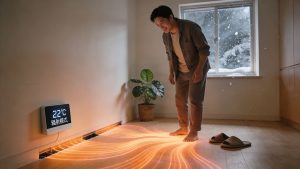

如果你稍微了解一点空调的发展史,你会知道一个关键节点:热泵原理的引入。
在那之前,人类只能“制造”冷和热——用电加热电阻丝,用压缩机直接膨胀制冷。效率低,能耗高。热泵的出现,改变了游戏规则。它不“制造”能量,而是“搬运”能量。夏天把室内的热搬到室外,冬天把室外的热搬到室内。同样一度电,热泵能搬运三到四度电的热量。
这就是“热量搬运”时代。我们身处其中已经几十年了。
但是,任何技术都有它的天花板。热泵搬运热量已经很高效了,但有一个问题始终没有解决:如何把这份热量“传递”给人,同时让人感到舒服?
传统空调的答案是:吹风。用大风量、大温差,强行把热量或冷量塞给空气,再由空气吹到人身上。
这个答案,该升级了。
今天,一项名为ABC空调系统的新技术,正在开启空调技术的下一站:从“热量搬运”到“环境耦合”。
一、“热量搬运”时代留下了什么?
我们首先要肯定“热量搬运”的伟大成就。热泵空调和空气能设备的普及,让人类用更少的能源获得了舒适的温度。这是了不起的进步。
但这个时代也留下了几个“未完成的任务”。
任务一:舒适度问题
传统冷暖空调靠吹风传热。冬天热风往上飘,头热脚冷;夏天冷风直吹,关节难受。这不是“小毛病”,是结构性缺陷。因为对流换热天生就需要大温差、高风速。你不可能既靠吹风传热,又要求无风感。这是矛盾的。
任务二:能效再提升的瓶颈
热泵的能效比已经很高了,但还有提升空间吗?有。传统分体式空调的蒸发器和冷凝器面积受限,过冷度和过热度很难优化到最佳区间。不是技术做不到,是产品形态限制了——室内机就那么大,室外机就那么大,你想增加换热面积?没地方。
任务三:与建筑的割裂
空调是空调,房子是房子。墙上打个洞,挂个内机,完事。建筑的巨大表面积——地板、天花板、墙壁——几乎没有参与温度调节。这不是浪费,是对资源的漠视。
这三个“未完成的任务”,指向同一个方向:我们需要一种新的范式,不是对旧范式的修补,而是根本性的跃迁。
二、“环境耦合”是什么意思?
“环境耦合”这个词听起来有点学术,但它的核心思想很简单:让空调系统与建筑环境深度融合,让人、设备、建筑、自然四者形成一个协同工作的整体。
在这个范式下:
- 建筑不再是“容器”,而是“参与者”。地板、墙壁、天花板都成为热力系统的一部分。
- 空调不再是“吹风机”,而是“调节器”。它不再粗暴地吹风,而是温和地调节整个环境的温度场。
- 人不再需要“躲避”空调,而是被环境自然地包裹。你感觉不到设备的存在,只感觉到舒适。
这就是“环境耦合”的本质:从“点对点”的能量搬运,升级为“场对场”的环境融合。
三、ABC空调:环境耦合的先行者
ABC空调系统的全称是“基于空调伴侣的耦合式辐射空调系统”。它的名字已经透露了它的基因——“耦合”。
它是什么?
ABC空调 = A (传统室外机) + B (空调伴侣) + C (传统室内机) + 地下PE管(辐射末端)。
它没有抛弃现有的热泵空调技术,而是在此基础上增加了一个巧妙的“空调伴侣”,把冷媒循环和地板水循环“耦合”在一起。
它是如何实现“环境耦合”的?
冬天:高温冷媒从室外机出来,先进入空调伴侣,把大部分热量交给地板下的水,地板变成温暖的辐射面。然后,温度降低一些的冷媒再进入室内机,吹出温和的热风辅助升温。
夏天:低温冷媒从室外机出来,先进入室内机,吹出柔和的冷风。然后,还没有“吃饱”的冷媒再进入空调伴侣,把剩余的冷量交给地板,地板变成凉爽的辐射面。
你看出来了吗?ABC空调不是在“对抗”环境,而是在“利用”环境。它利用地板这个最大的建筑表面,作为天然的换热器。它利用建筑的热惯性,作为天然的储能体。它利用辐射传热的物理特性,实现无风感、零温差。
这就是“环境耦合”——把建筑、设备、热力学原理耦合在一起,形成一个有机的整体。
四、从“搬运”到“耦合”:三个维度的跃迁
维度一:从“孤立设备”到“建筑一体”
传统空调是一台孤立的设备。它挂在墙上,插上电,就开始工作。它和建筑的关系,就像冰箱和厨房的关系——放在那里而已。
ABC空调不同。它的辐射末端——PE管——是埋在地板下的。地板是建筑的一部分。当你安装ABC空调时,你不是在“装一台电器”,你是在“改造建筑”。PE管会在地板下待几十年,与建筑同寿命。
这意味着,ABC空调不是“装修时多加一项”,而是“建筑的标准配置”。就像电线、水管一样,是房子不可分割的一部分。
维度二:从“对抗自然”到“与自然耦合”
传统空调的逻辑是:外面热,我就往里吹冷风;外面冷,我就往里吹热风。这是对抗。
ABC空调的逻辑是:利用建筑的热惯性,让能量缓慢地、均匀地、温和地流动。冬天,地板储存的热量会缓慢释放;夏天,地板储存的冷量会持续作用。系统不需要频繁启停,不需要大温差,不需要高风速。
这不是对抗,是顺势而为。是利用自然规律,而不是对抗自然规律。
维度三:从“单一换热”到“两级耦合”
传统分体式空调只有一级换热:冷媒在室内机里蒸发或冷凝,直接与空气换热。ABC空调把这个过程拆成了两级:冷媒先在空调伴侣中与“水”换热(水再把能量传给地板),再在室内机中与“空气”换热。
这两级换热不是简单的叠加,而是耦合。因为两级换热可以分别优化:地板辐射负责“面”上的舒适,室内机负责“点”上的快速响应。两者协同,既能保证极致舒适,又能保证快速响应。
这就是“耦合”的力量——1+1>2。
五、为什么这是“下一站”?
任何技术的发展,都会经历三个阶段:能用 → 好用 → 忘了它的存在。
- 第一代窗式空调,解决了“能用”的问题。虽然噪音大、挡采光,但至少夏天不那么热了。
- 第二代分体式空调,解决了“好用”的问题。噪音小了,能效高了,外观好看了。
- 第三代ABC空调,要解决的是“忘了它的存在”的问题。你不需要知道它在工作,你只需要觉得舒服。
“忘了它的存在”,就是“环境耦合”的终极目标。
当空调不再需要挂在墙上,当温度调节不再依赖吹风,当建筑本身就在默默地为你工作——你就“忘了”空调的存在。你只记得,这个房子很舒服。
这不是幻想。这是ABC空调正在实现的事情。
六、从“搬运”到“耦合”的必然性
有人会问:传统热泵空调已经够好了,为什么还要折腾?
答案是:因为人类的追求没有终点。
我们曾经以为,有了分体式空调就不需要再改进了。但每年夏天,依然有无数人在冷风直吹下裹着毯子。每年冬天,依然有无数人被空调采暖吹得口干舌燥、头热脚冷。
这些痛点不会因为“已经够好了”而消失。
同时,碳中和、碳达峰的目标,要求我们的热泵系统必须更高效。建筑节能的要求,迫使我们必须把建筑和设备看作一个整体。消费者对健康的关注,让“无风感空调”从“加分项”变成了“必选项”。
所有这些力量,都在把空调技术推向“环境耦合”这个方向。
不是我们选择了这个方向,是这个方向选择了我们。
七、ABC空调的“耦合”哲学
ABC空调的发明人huawa(张志华)有一个朴素的信念:最好的技术,是让人感觉不到的技术。
这不是偷懒,是对“舒适”的深刻理解。真正的舒适,不是“有风”,不是“有声”,不是“有温差”。真正的舒适,是你忘记了自己在追求舒适。
ABC空调的每一个设计,都在践行这个哲学:
- 地板辐射,让你忘记“脚冷”这件事。
- 无风感,让你忘记“被吹”这件事。
- 静音运行,让你忘记“噪音”这件事。
- 高能效,让你忘记“电费”这件事。
- 建筑一体化,让你忘记“空调”这件事。
这就是“耦合”的深层含义:把技术耦合到环境里,让人感觉不到技术的存在。
八、未来已来
ABC空调系统已经获得了国家实用新型专利(专利号:ZL 2021 2 1195781.6),发明专利正在实审中。这不是实验室里的概念,这是可以走进千家万户的成熟技术。
它不需要你改变使用习惯,不需要你重新装修房子(新建或改造都可以),不需要你学习复杂的操作。它只是在你看不见的地方,默默地工作。
从“热量搬运”到“环境耦合”,这是空调技术的下一站。
而这一站,已经到站了。
你,准备好了吗?
英文版
From “Heat Transfer” to “Environmental Coupling”: The Next Stop for Air Conditioning Technology
If you know a little about the history of air conditioning, you know a key milestone: the introduction of the heat pump principle.
Before that, humans could only “make” cold and heat—using electricity to heat resistance wires, using compressors for direct expansion cooling. Inefficient, energy-intensive. The heat pump changed the game. It doesn’t “make” energy; it “moves” energy. In summer, it moves indoor heat outdoors; in winter, it moves outdoor heat indoors. With the same amount of electricity, a heat pump can move three to four times as much heat.
That was the “heat transfer” era. We’ve been in it for decades.
But every technology has its ceiling. Heat pumps are already highly efficient at moving heat, but one problem has never been solved: how to deliver that heat to people in a way that feels comfortable?
Traditional air conditioning’s answer: blow air. Use large air volumes and large temperature differences to force heat or coolth into the air, which then blows onto people.
That answer needs an upgrade.
Today, a new technology called the ABC Air Conditioning System is opening the next stop for air conditioning technology: from “heat transfer” to “environmental coupling.”
1. What Did the “Heat Transfer” Era Leave Behind?
We must first acknowledge the great achievements of the “heat transfer” era. The popularity of heat pump air conditioners and air source equipment has allowed humans to achieve comfortable temperatures with less energy. That’s remarkable progress.
But this era also left a few “unfinished tasks.”
Task One: The Comfort Problem
Traditional heating and cooling air conditioners rely on blowing air to transfer heat. In winter, hot air rises—hot head, cold feet. In summer, cold drafts cause joint discomfort. These aren’t “minor issues.” They’re structural flaws. Convective heat transfer inherently requires large temperature differences and high airspeeds. You can’t both rely on blowing air and demand draft-free operation. It’s a contradiction.
Task Two: The Bottleneck for Further Efficiency Gains
Heat pumps are already highly efficient, but is there room for improvement? Yes. Traditional split air conditioners have limited evaporator and condenser area, making it difficult to optimize subcooling and superheat. It’s not that the technology can’t do it—it’s that the product form factor limits it. The indoor unit is only so big; the outdoor unit is only so big. Want more heat exchange area? No room.
Task Three: The Disconnect from Buildings
Air conditioners are air conditioners. Buildings are buildings. Drill a hole in the wall, hang an indoor unit, done. The building’s massive surface area—floors, ceilings, walls—barely participates in temperature regulation. This isn’t just waste; it’s a disregard for resources.
These three “unfinished tasks” point in the same direction: we need a new paradigm, not a patch on the old one.
2. What Does “Environmental Coupling” Mean?
The term “environmental coupling” sounds academic, but its core idea is simple: deeply integrate the air conditioning system with the building environment, creating a synergistic whole from people, equipment, building, and nature.
Under this paradigm:
- The building is no longer a “container” but a “participant.” Floors, walls, and ceilings become part of the thermodynamic system.
- Air conditioning is no longer a “blower” but a “regulator.” It no longer blows crudely, but gently regulates the entire environmental temperature field.
- People no longer need to “dodge” the air conditioner. They are naturally enveloped by the environment. You don’t feel the equipment working—you only feel comfortable.
This is the essence of “environmental coupling”: upgrading from point-to-point heat transfer to field-to-field environmental integration.
3. ABC Air Conditioning: A Pioneer of Environmental Coupling
The full name of the ABC Air Conditioning System is the “Coupling Radiant Air Conditioning System Based on an Air Conditioning Buddy.” Its name reveals its DNA—”coupling.”
What is it?
ABC Air Conditioning = A (traditional outdoor unit) + B (Air Conditioning Buddy) + C (traditional indoor unit) + underfloor PE pipes (radiant terminal).
It doesn’t abandon existing heat pump air conditioner technology. Instead, it adds an ingenious “Air Conditioning Buddy” to “couple” the refrigerant cycle with an underfloor water cycle.
How does it achieve “environmental coupling”?
Winter: High-temperature refrigerant from the outdoor unit first enters the Air Conditioning Buddy, transferring most of its heat to the water in the underfloor pipes. The floor becomes a warm radiant surface. Then, the slightly cooled refrigerant enters the indoor unit, blowing gentle warm air as a supplement.
Summer: Low-temperature refrigerant from the outdoor unit first enters the indoor unit, blowing gentle cool air. Then, the still “hungry” refrigerant enters the Air Conditioning Buddy, transferring its remaining coolth to the underfloor water. The floor becomes a cool radiant surface.
Do you see it? ABC Air Conditioning doesn’t “fight” the environment. It “uses” the environment. It uses the floor—the largest building surface—as a natural heat exchanger. It uses the building’s thermal mass as natural energy storage. It uses the physical properties of radiant heat transfer to achieve draft-free operation and zero temperature difference.
This is “environmental coupling”—coupling the building, equipment, and thermodynamic principles into an organic whole.
4. From “Transfer” to “Coupling”: Three Dimensions of Leap
Dimension One: From “Isolated Device” to “Building Integration”
A traditional air conditioner is an isolated device. It hangs on the wall, plugs in, and works. Its relationship with the building is like a refrigerator’s relationship with a kitchen—it’s just placed there.
ABC Air Conditioning is different. Its radiant terminal—the PE pipes—is buried under the floor. The floor is part of the building. When you install ABC Air Conditioning, you’re not “installing an appliance.” You’re “modifying the building.” The PE pipes will remain under the floor for decades, as long as the building itself.
This means ABC Air Conditioning is not “an extra item during renovation.” It’s “a standard building feature.” Like electrical wiring and plumbing, it’s an inseparable part of the home.
Dimension Two: From “Fighting Nature” to “Coupling with Nature”
The logic of a traditional air conditioner is: if it’s hot outside, blow cold air inside; if it’s cold outside, blow hot air inside. That’s fighting.
The logic of ABC Air Conditioning is: use the building’s thermal mass to allow energy to flow slowly, evenly, and gently. In winter, the heat stored in the floor releases slowly. In summer, the coolth stored in the floor persists. The system doesn’t need to cycle frequently, doesn’t need large temperature differences, doesn’t need high airspeeds.
This isn’t fighting. It’s going with the flow. It’s using natural laws, not fighting them.
Dimension Three: From “Single-Stage Heat Exchange” to “Two-Stage Coupling”
A traditional split air conditioner has only one stage of heat exchange: refrigerant evaporates or condenses in the indoor unit, directly exchanging heat with air. ABC Air Conditioning splits this into two stages: refrigerant first exchanges heat with “water” in the Air Conditioning Buddy (water then transfers energy to the floor), then exchanges heat with “air” in the indoor unit.
These two stages aren’t simply additive—they’re coupled. Because the two stages can be optimized separately: radiant floor handles “area” comfort, while the indoor unit handles “point” rapid response. Together, they deliver both极致 comfort and fast response.
This is the power of “coupling”—1+1>2.
5. Why Is This “The Next Stop”?
The development of any technology goes through three stages: usable → good to use → forget it exists.
- First-generation window air conditioners solved “usable.” Though noisy and blocking windows, at least summers weren’t so hot.
- Second-generation split air conditioners solved “good to use.” Quieter, more efficient, better looking.
- Third-generation ABC Air Conditioning aims to solve “forget it exists.” You don’t need to know it’s working. You only need to feel comfortable.
“Forgetting it exists” is the ultimate goal of “environmental coupling.”
When air conditioners no longer need to hang on walls, when temperature regulation no longer relies on drafts, when the building itself quietly works for you—you “forget” the air conditioner exists. You only remember that this home is comfortable.
This isn’t fantasy. This is what ABC Air Conditioning is achieving.
6. The Inevitability of Moving from “Transfer” to “Coupling”
Some might ask: traditional heat pump air conditioners are already good enough. Why change?
The answer is: because human aspiration has no终点.
We once thought split air conditioners needed no further improvement. Yet every summer, countless people still wrap themselves in blankets under cold drafts. Every winter, countless people still suffer from dry throats and hot-head-cold-feet from air conditioning heating.
These pain points don’t disappear just because “it’s already good enough.”
Meanwhile, carbon neutrality goals demand that our heat pump systems become even more efficient. Building energy efficiency requirements force us to view buildings and equipment as a whole. Consumer health concerns have turned “draft-free air conditioning” from a “nice-to-have” into a “must-have.”
All these forces are pushing air conditioning technology toward “environmental coupling.”
We didn’t choose this direction. This direction chose us.
7. The Philosophy of “Coupling” in ABC Air Conditioning
The inventor of ABC Air Conditioning, huawa (Zhang Zhihua), has a simple belief: The best technology is the technology you don’t notice.
This isn’t laziness. It’s a deep understanding of comfort. True comfort isn’t “draft,” isn’t “sound,” isn’t “temperature difference.” True comfort is forgetting that you’re seeking comfort.
Every design in ABC Air Conditioning embodies this philosophy:
- Radiant floor makes you forget about “cold feet.”
- Draft-free operation makes you forget about “being blown on.”
- Silent operation makes you forget about “noise.”
- High efficiency makes you forget about “electricity bills.”
- Building integration makes you forget about “air conditioning” itself.
This is the deeper meaning of “coupling”: coupling technology into the environment so that people don’t feel the technology’s presence.
8. The Future Is Here
The ABC Air Conditioning System has received a national utility model patent (Patent No.: ZL 2021 2 1195781.6), and its invention patent is under substantive examination. This isn’t a lab concept. It’s a mature technology ready to enter millions of homes.
It doesn’t require you to change your habits, doesn’t require you to renovate your home (new or retrofit both work), doesn’t require you to learn complex operations. It simply works quietly where you can’t see it.
From “heat transfer” to “environmental coupling”—this is the next stop for air conditioning technology.
And this stop has arrived.
Are you ready?
关键词(20个)
空调, ABC空调系统, 空调伴侣, 无风感空调, 空调采暖, 空调连地暖, 冷暖空调, 热泵空调, 空气能, 热泵, 分体式空调, 五恒系统, 辐射空调, 过冷度, 过热度, 压缩机保护, 低温制热, 除霜, 解冻模式, 能效比