
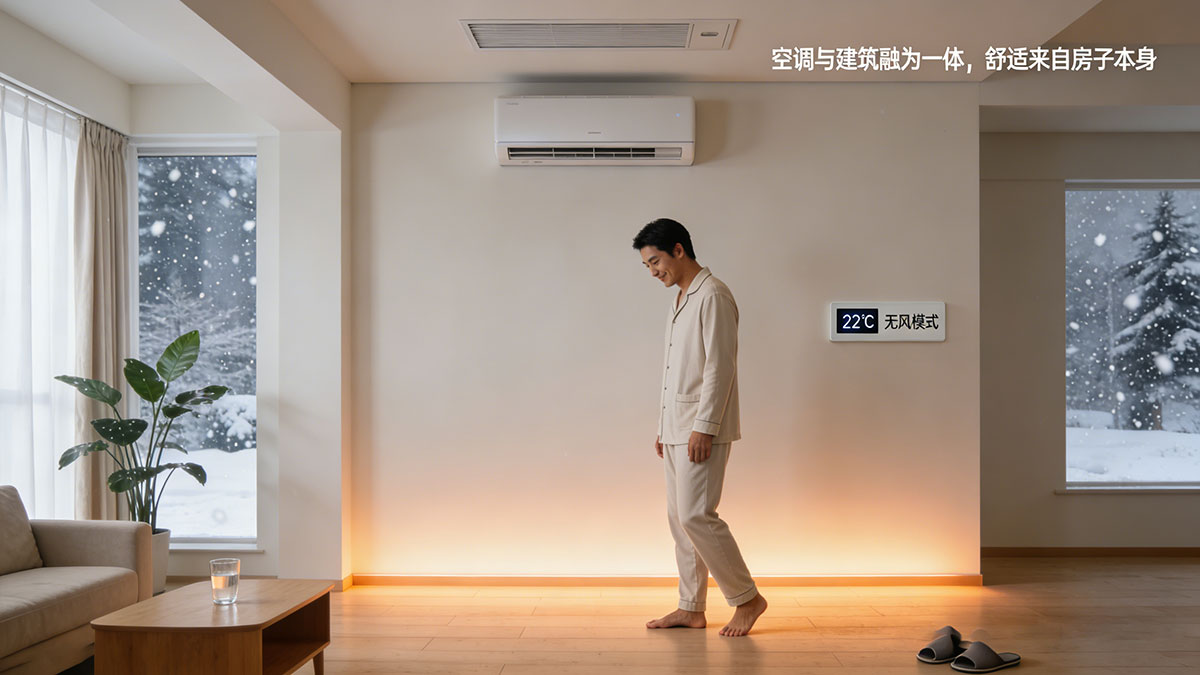
当我们谈论未来的房子,我们在谈论什么?
是更大的面积?更智能的家电?还是更环保的材料?这些都很重要。但有一个问题,远比这些更基础、更本质——那就是“舒适”。
一个房子,无论装修得多豪华、面积有多大,如果住进去冬天脚冷、夏天头热、空调直吹得脖子疼,那它就不是一个好房子。
在过去,我们把“空调”和“房子”当作两件事。房子是房子,空调是后来“装”进去的电器。墙上打个洞,挂个内机,外面放个外机,就算完事。这种“事后补救”的方式,注定了舒适度是有天花板的。
今天,一场深刻的变革正在发生。一种名为ABC空调系统的新型冷暖空调技术,正在重新定义房子与温度调节的关系。它不再是“装在房子里的电器”,而是“长在房子里的器官”。未来,ABC空调将成为建筑的标准配置,就像水管、电线、窗户一样,成为房子不可分割的一部分。
一、为什么传统空调“装”不进未来建筑?
要理解为什么ABC空调会成为建筑的“标配”,我们首先要看清传统分体式空调的局限。
局限一:它是“挂”在墙上的,不是“长”在房子里的
传统空调的室内机必须挂在墙上或吊在顶上。这意味着:
- 它破坏了装修的整体美感
- 它占用了室内空间
- 它决定了家具的摆放位置(你不能把柜子挡在出风口前)
一个真正好的建筑,应该是“人适应空间”,而不是“空间适应机器”。
局限二:它依赖“吹风”,与建筑物理矛盾
传统空调靠吹风来传递温度。但建筑物理告诉我们:最舒适的传热方式是辐射,不是对流。阳光照在身上暖暖的,地板踩上去凉凉的——这些是辐射。而空调的冷风热风,是对流。对流必然带来风速、噪音、温差、干燥。
当一种技术与人的本能舒适背道而驰时,不是人的问题,是技术的问题。
局限三:它无法利用建筑的热惯性
建筑有一个被忽视的特性:热惯性。厚实的墙壁、地板,可以储存热量或冷量,像一个巨大的“温度电池”。传统空调开关一停,温度马上波动,完全浪费了建筑的这个天然优势。
ABC空调正是为了弥补这三大局限而诞生的。
二、ABC空调:从“电器”到“建筑器官”
ABC空调系统的全称是“基于空调伴侣的耦合式辐射空调系统”。它的构成非常简单,却带来了本质的变化:
- A = 传统室外机(Air-source unit)
- B = 空调伴侣(Buddy unit)——核心发明
- C = 传统室内机(Conditioning unit)
- + 埋在地板下的PE管(辐射末端)
为什么说它是“建筑器官”?因为它不再是一个独立的、可随意拆卸的电器,而是与建筑结构深度融合的系统。
融合点一:地板变成了“温度调节器”
在ABC空调中,地板下的PE管与空调伴侣相连。冬天,热水在管中流动,地板变成巨大的辐射供暖面;夏天,冷水在管中流动,地板变成巨大的辐射供冷面。
地板,这个建筑中面积最大的平面,从“被动接触面”变成了“主动调节面”。你不需要刻意去找“出风口”,因为你脚下的整个地板都在为你工作。
融合点二:墙体不再需要“打洞挂机”
由于地板承担了主要的制冷和制热任务,室内机可以大大简化,甚至可以隐藏安装,或者只作为辅助使用。未来,随着技术进一步优化,室内机甚至可能完全消失。
这意味着,墙面被解放了。你可以随心所欲地设计墙面、摆放家具,不再受空调位置的限制。
融合点三:建筑的热惯性被“激活”
地板和墙体有巨大的热容量。ABC空调利用这个特性,把建筑本身变成了一个“储能体”。系统以温和、持续的方式工作,温度波动被建筑“熨平”。你感受到的,是一条平直的、恒定的舒适曲线,而不是忽冷忽热的过山车。
三、为什么说ABC空调是“标配”?五个不可替代的价值
价值一:无风感——告别“空调病”
这是ABC空调最直观的价值。因为大部分冷量或热量是通过地板辐射传递的,而不是通过吹风。没有风,就没有直吹;没有直吹,就没有脖子僵硬、关节酸痛、口干舌燥。
这不是“更舒服一点”,而是一种完全不同的舒适层次。习惯了无风感空调的人,很难再接受被冷风直吹的日子。
价值二:零温差——告别“头热脚冷”
传统空调采暖,热风往上飘,头顶25℃,地板15℃。你的头在烤,脚在冻。ABC空调通过地暖辐射,热量从脚底升起。中医讲“寒从脚下生”,脚暖了,全身就暖了。
夏天也一样。冷量从地板向上辐射,整个空间的温度均匀分布,没有“冷气下沉”导致的局部过冷。
价值三:高能效——省电一半以上
热泵空调本身就是高效的,因为它搬运热量而不是制造热量。ABC空调通过两级换热的设计,进一步提升了过冷度(制热时)和过热度(制冷时),让单位电量的“搬运能力”达到极致。
简单说:同样的电,ABC空调比传统空调搬更多的热量(或冷量)。这意味着,你的电费账单会显著下降。
价值四:静音——没有“嗡嗡声”
传统空调的噪音来自两个地方:室外机的压缩机和室内机的风机。ABC空调的室内机可以以极低的风速运行(甚至不运行),因为主要负荷由地板承担。你听到的,只有安静。
想象一下,夜晚睡觉时,没有空调的嗡嗡声,只有均匀的温度包围着你。这就是ABC空调带来的睡眠质量提升。
价值五:与建筑同寿命——一次安装,几十年受益
传统分体式空调的使用寿命大约8-10年。坏了就换,换了再装。每次更换都要重新打孔、接管、破坏装修。
ABC空调中,埋在地板下的PE管寿命长达50年以上,与建筑基本同寿命。室外机和空调伴侣可以单独更换、升级。你不需要为了换空调而撬开地板、破坏装修。这是一次投入,几十年受益。
四、从“事后补救”到“前置设计”
过去,我们的习惯是:先盖房子,再买空调。空调是“事后补救”的产物。
未来,这个顺序会反过来:在设计房子的时候,就把ABC空调考虑进去。地板下要预留PE管的空间,墙体要预留管道路由,室外机的位置要合理规划……
这不是“装修时多加一项”,而是“建筑的基本配置”。
我们可以类比一下:
- 一百年前,房子没有电线的概念。后来,电线成了建筑的标配。
- 五十年前,房子没有网线的概念。后来,网线成了建筑的标配。
- 今天,房子还没有“辐射空调系统”的概念。但很快,它也会成为标配。
这不是预测,这是趋势。就像热泵空调正在逐步取代纯电暖器一样,ABC空调正在逐步取代传统分体式空调。
五、形态进化:家用空调的三次跃迁
从历史的角度看,家用空调经历了三次形态跃迁:
| 代际 | 形态 | 特点 | 问题 |
|---|---|---|---|
| 第一代 | 窗式空调 | 一体机,解决了“有没有” | 噪音大,挡采光,安装受限 |
| 第二代 | 分体式空调 | 室内机+室外机,解决了“吵不吵” | 仍有风感,温差大,破坏装修 |
| 第三代 | ABC空调 | A+B+C+地下辐射管,解决“舒服不舒服” | —— |
每一次跃迁,都是对“舒适”定义的重新书写。第一代让你有了空调,第二代让你不那么吵,第三代让你感觉不到空调的存在——这才是真正的舒适。
六、极端情况下的“建筑智慧”
ABC空调不仅仅让你舒服,它还很“聪明”。
场景一:冬天除霜不吹冷风
传统热泵空调在冬天除霜时,四通阀换向,室内机会吹出冷风。ABC空调可以只从地板里“借”热量来除霜,室内机不参与。因为地板热容量巨大,你甚至感觉不到它在除霜。
场景二:停电后管道结冰,自动解冻
冬天长时间停电,地暖管可能结冰。ABC空调有专门的“解冻模式”:先让室内机制热,提高室温;热量慢慢传导到地板,让管道自然解冻;待冰完全融化后,空调伴侣再启动,恢复正常运行。
这不是“附加功能”,而是系统级的智慧。
七、从“人适应机器”到“机器适应人”
传统空调的逻辑是:我吹风,你躲开。你不想被吹?那你坐远一点,或者把风叶调高一点。这是“人适应机器”。
ABC空调的逻辑是:你不需要知道我在工作,你只需要觉得舒服。这是“机器适应人”。
这个转变,看似简单,实则是理念的根本不同。
未来,当我们的孩子长大,他们可能会问:“你们以前为什么要忍受冷风直吹?”就像我们今天问:“古人为什么要住高墙深院?”
八、结语:未来已来,只是分布不均
科幻作家威廉·吉布森说过:“未来已来,只是分布不均。”
ABC空调系统就是这样。它已经存在,已经获得国家专利(实用新型专利号:ZL 2021 2 1195781.6;发明专利申请号:202510997961.2),已经在一些先锋家庭中运行。它正在等待更多的人认识到:房子不应该是冷冰冰的盒子,而应该是一个懂你、照顾你的“生命体”。
未来,当你买房子的时候,售楼员不会问你“要不要装空调”,而是会告诉你:“我们这房子标配ABC空调,地暖辐射,无风感,零温差。”
那一天,不会太远。
而你,今天就可以成为第一批体验者。
英文版
The “Standard Feature” of Future Homes: Why ABC Air Conditioning Will Become Part of the Building Itself
When we talk about the homes of the future, what are we really talking about?
Larger floor plans? Smarter appliances? More sustainable materials? All important. But one question is more fundamental, more essential than any of these: comfort.
No matter how luxurious the renovation or how large the space, if a home leaves you with cold feet in winter, a hot head in summer, and a sore neck from direct air conditioning drafts, it is not a good home.
In the past, we treated “air conditioners” and “homes” as two separate things. The house was the house; the air conditioner was an appliance later “installed” into it. Drill a hole in the wall, hang an indoor unit, place an outdoor unit outside, and that was it. This “afterthought” approach inevitably placed a ceiling on achievable comfort.
Today, a profound transformation is underway. A new type of heating and cooling air conditioning technology, known as the ABC Air Conditioning System, is redefining the relationship between buildings and temperature regulation. It is no longer an “appliance installed in a home,” but an “organ growing within the building.” In the future, ABC Air Conditioning will become a standard building feature, as integral to a home as its plumbing, electrical wiring, and windows.
1. Why Traditional Air Conditioners Can’t Be “Built Into” Future Homes
To understand why ABC Air Conditioning will become the “standard feature,” we must first recognize the limitations of traditional split air conditioners.
Limitation One: It Hangs on the Wall, It Doesn’t Grow in the Building
A traditional air conditioner’s indoor unit must be mounted on a wall or suspended from the ceiling. This means:
- It disrupts the aesthetic integrity of the decor.
- It occupies valuable indoor space.
- It dictates furniture placement (you can’t block the vent with a cabinet).
A truly good building should allow “people to adapt to the space,” not “space to adapt to the machine.”
Limitation Two: It Relies on Drafts, Conflicting with Building Physics
Traditional air conditioners rely on blowing air to transfer temperature. But building physics tells us that the most comfortable heat transfer method is radiation, not convection. The warmth of sunlight on your skin, the coolness of a floor under your feet—that’s radiation. The cold or hot drafts from an air conditioner are convection. Convection inevitably brings airspeed, noise, temperature differences, and dryness.
When a technology contradicts our instinctive understanding of comfort, the problem isn’t with people—it’s with the technology.
Limitation Three: It Cannot Leverage a Building’s Thermal Mass
Buildings have a neglected property: thermal mass. Thick walls and floors can store heat or coolness, acting like a giant “temperature battery.” With a traditional air conditioner, the temperature fluctuates as soon as the compressor cycles off, completely wasting this natural architectural advantage.
ABC Air Conditioning was born precisely to address these three limitations.
2. ABC Air Conditioning: From “Appliance” to “Building Organ”
The full name of the ABC Air Conditioning System is the “Coupling Radiant Air Conditioning System Based on an Air Conditioning Buddy.” Its composition is simple, yet it brings a fundamental change:
- A = Traditional outdoor unit (Air-source unit)
- B = Air Conditioning Buddy (Buddy unit) — the core invention
- C = Traditional indoor unit (Conditioning unit)
- + PE pipes buried under the floor (radiant terminal)
Why is it called a “building organ”? Because it is no longer an independent, removable appliance, but a system deeply integrated with the building’s structure.
Integration Point One: The Floor Becomes a Temperature Regulator
In ABC Air Conditioning, the PE pipes under the floor connect to the Air Conditioning Buddy. In winter, hot water flows through the pipes, turning the floor into a massive radiant heating surface. In summer, chilled water flows, turning the floor into a massive radiant cooling surface.
The floor—the largest planar surface in a building—transforms from a “passive contact surface” into an “active regulating surface.” You no longer need to seek out an “air vent” because the entire floor beneath you is working for your comfort.
Integration Point Two: Walls No Longer Need Holes for Hanging Units
Because the floor handles the primary heating and cooling load, the indoor unit can be greatly simplified, even hidden or used only as a supplement. As the technology matures, the indoor unit might even disappear entirely.
This liberates the walls. You can design your walls and arrange your furniture freely, no longer constrained by air conditioner placement.
Integration Point Three: The Building’s Thermal Mass Gets Activated
Floors and walls have tremendous heat capacity. ABC Air Conditioning leverages this property, turning the building itself into an “energy storage body.” The system operates gently and continuously, and temperature fluctuations are “smoothed out” by the building’s mass. What you experience is a flat, constant, comfortable curve, not a rollercoaster of hot and cold.
3. Why is ABC Air Conditioning a “Standard Feature”? Five Irreplaceable Values
Value One: Draft-Free — Say Goodbye to “Air Conditioner Disease”
This is ABC Air Conditioning’s most intuitive value. Because most cooling or heating is delivered through radiant floors, not blowing air. No draft means no direct airflow; no direct airflow means no stiff necks, achy joints, or parched throats.
This isn’t “slightly more comfortable.” It’s a completely different level of comfort. Once accustomed to draft-free air conditioning, it’s hard to go back to enduring cold drafts.
Value Two: Zero Temperature Difference — Say Goodbye to “Hot Head, Cold Feet”
With traditional air conditioning for heating, hot air rises—25°C at head level, 15°C at the floor. Your head bakes while your feet freeze. ABC Air Conditioning uses radiant floor heating, allowing warmth to rise from your feet. Traditional Chinese medicine says “cold enters from the feet.” When your feet are warm, your whole body is warm.
The same applies in summer. Coolth radiates upward from the floor, creating a uniformly comfortable temperature throughout the space, without localized overcooling.
Value Three: High Efficiency — Save More Than Half on Electricity
Heat pump air conditioners are inherently efficient because they transfer heat rather than generating it. ABC Air Conditioning further enhances this by using two-stage heat exchange, increasing the degree of subcooling (in heating mode) and the degree of superheat (in cooling mode), maximizing the “transfer capacity” per unit of electricity.
Simply put: with the same electricity, ABC Air Conditioning transfers significantly more heat (or coolth) than a traditional air conditioner. This means a noticeably lower electricity bill.
Value Four: Silent — No More “Humming”
The noise from a traditional air conditioner comes from two places: the outdoor unit’s compressor and the indoor unit’s fan. In ABC Air Conditioning, the indoor unit can run at very low speeds (or not at all) because the primary load is handled by the floor. What you hear is… silence.
Imagine sleeping at night without the hum of an air conditioner, just uniform temperature enveloping you. That’s the sleep quality improvement ABC Air Conditioning delivers.
Value Five: Building-Lifespan Durability — Install Once, Benefit for Decades
A traditional split air conditioner has a lifespan of about 8-10 years. When it fails, you replace it. Each replacement requires new holes, new piping, and disrupts your decor.
In ABC Air Conditioning, the PE pipes buried under the floor have a lifespan of over 50 years—essentially the life of the building. The outdoor unit and Air Conditioning Buddy can be replaced or upgraded independently. You don’t need to tear up your floor or ruin your renovation just to replace your air conditioner. This is a single investment that pays dividends for decades.
4. From “Afterthought” to “Designed-In”
In the past, our habit was: build the house first, then buy the air conditioner. The air conditioner was an “afterthought.”
In the future, this order will reverse. The ABC Air Conditioning system will be considered during the home’s design phase. Space for PE pipes under the floor, routing for piping within walls, optimal placement for the outdoor unit…
This isn’t “adding an extra item during renovation.” It’s “a basic building feature.”
Consider an analogy:
- 100 years ago, homes had no concept of electrical wiring. Then wiring became standard.
- 50 years ago, homes had no concept of network cabling. Then cabling became standard.
- Today, homes still have no concept of “radiant air conditioning systems.” But soon, they will.
This isn’t a prediction; it’s a trend. Just as heat pump air conditioners are gradually replacing pure electric heaters, ABC Air Conditioning is gradually replacing traditional split air conditioners.
5. Morphological Evolution: Three Leaps of Residential Air Conditioners
From a historical perspective, residential air conditioners have undergone three morphological leaps:
| Generation | Form | Feature | Problem Solved |
|---|---|---|---|
| First | Window AC | Unitary unit, solved “having or not having” | Noisy, blocks windows, installation limits |
| Second | Split AC | Indoor + outdoor units, solved “noisy or quiet” | Still drafty, temperature differences, disrupts decor |
| Third | ABC AC | A+B+C+underfloor radiant pipes, solves “comfortable or not” | — |
Each leap has rewritten the definition of “comfort.” The first generation gave you an air conditioner. The second made it quieter. The third makes you unaware of its presence—and that is true comfort.
6. The Building’s “Intelligence” in Extreme Situations
ABC Air Conditioning isn’t just about comfort; it’s also remarkably “smart.”
Scenario One: Defrosting Without Cold Drafts in Winter
When a traditional heat pump air conditioner defrosts in winter, the four-way valve reverses, and the indoor unit blows cold air. ABC Air Conditioning can simply “borrow” heat from the floor for defrosting, without involving the indoor unit. Because the floor’s thermal mass is enormous, you might not even notice the defrost cycle.
Scenario Two: Automatic Thawing After Power-Outage Freezing
If a winter power outage causes underfloor pipes to freeze, ABC Air Conditioning has a dedicated “Thaw Mode”: the indoor unit first runs in heating mode to raise room temperature; heat slowly conducts to the floor and pipes, allowing natural thawing; once the ice has completely melted, the Air Conditioning Buddy restarts normal operation.
This isn’t an “add-on feature.” It’s system-level intelligence.
7. From “People Adapting to the Machine” to “The Machine Adapting to People”
The logic of a traditional air conditioner is: I blow air, you dodge it. Don’t want to be blown on? Sit further away, or adjust the louver up. That’s “people adapting to the machine.”
The logic of ABC Air Conditioning is: You don’t need to know I’m working. You just need to feel comfortable. That’s “the machine adapting to people.”
This shift, seemingly simple, represents a fundamental difference in philosophy.
In the future, when our children grow up, they might ask: “Why did you used to put up with cold drafts?” Just as we ask today: “Why did the ancients live in high-walled, deep-courtyard houses?”
8. Conclusion: The Future is Already Here, It’s Just Not Evenly Distributed
Science fiction writer William Gibson once said, “The future is already here — it’s just not very evenly distributed.”
The ABC Air Conditioning System is exactly that. It already exists. It has already received national patents (Utility Model Patent No.: ZL 2021 2 1195781.6; Invention Patent Application No.: 202510997961.2). It is already running in pioneering homes. It is waiting for more people to recognize that a home should not be a cold, inert box, but a living being that understands and cares for you.
In the future, when you go to buy a home, the salesperson won’t ask you “if you want to install air conditioning.” They will tell you: “This home comes standard with ABC Air Conditioning—radiant floor, draft-free, zero temperature difference.”
That day is not far away.
And you can be among the first to experience it, today.
关键词(20个)
空调, ABC空调系统, 空调伴侣, 无风感空调, 空调采暖, 空调连地暖, 冷暖空调, 热泵空调, 空气能, 热泵, 分体式空调, 五恒系统, 辐射空调, 过冷度, 过热度, 压缩机保护, 低温制热, 除霜, 解冻模式, 能效比