洞穴里的第一缕火
三万年前,一个冰河期的夜晚。
一处朝南的岩洞口,一群原始人围坐在火堆旁。火焰跳动着,把他们的影子投在粗糙的石壁上。火是他们的“空调”——冬天取暖,烤熟食物,驱赶野兽。但火也有致命的缺点:离得太近,烫伤;离得太远,寒冷。烟熏得眼睛流泪,整个洞穴弥漫着呛人的气味。
更糟糕的是,夏天到了。火不能生了,但洞穴里又闷又潮。他们只能光着膀子,靠在洞口吹自然风。如果风向不对,蚊虫扑面而来。
那时候的人类,对“舒适”几乎没有选择权。他们能做的,只有被动适应——找一个避风向阳的洞口,祈祷冬天不要太长,夏天不要太热。
这就是人类居住史上最漫长的阶段:自然适应期。
从“解蔽”到“舒适”:一部四万年的进化史
人类对居所的追求,从来不只是为了遮风挡雨。从岩洞到土屋,从土屋到砖瓦房,从砖瓦房到现代公寓,每一次跨越,都代表着我们对“舒适”的理解更深了一层。
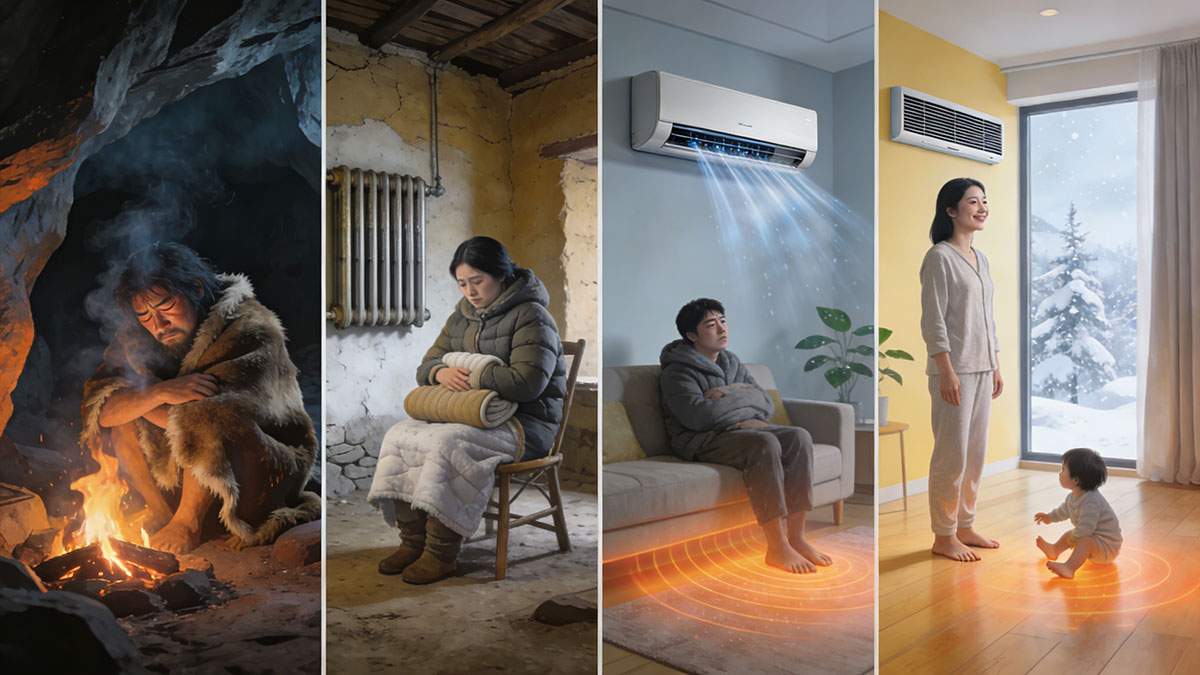
我们可以把这四万年的居住进化,分为四个阶段:
第一阶段:解蔽居所(岩洞、茅草棚、兽皮帐篷)
这个阶段的核心目标只有一个:活着。挡住野兽,挡住雨雪,挡住烈日。至于里面是冷是热,是干是潮,没人顾得上。舒适是奢侈品,活着才是刚需。
第二阶段:稳定生活(土屋、泥房、木结构房屋)
人类学会了烧砖、伐木、夯土。房子更坚固了,门窗出现了。人们开始有意识地把房子建在向阳坡上,让冬天阳光能照进屋里;夏天则利用穿堂风降温。这是最早的“被动式设计”——没有机械,全靠建筑本身的气道、朝向、材料来调节温度。
但这样的调节,上限很低。北方冬天依然冻得手脚生疮,南方夏天依然热得夜不能寐。
第三阶段:安全与功能(砖混结构、集中供暖、初代空调)
工业革命带来了暖气片、电风扇,后来是窗式空调。人类第一次拥有了“主动调节”温度的能力。不再看天的脸色,按下开关,就有冷风或热风。
这是一个巨大的飞跃。但也带来了新的问题:风吹在身上的不适感、巨大的噪音、高昂的电费、以及极端天气下的无能为力。
第四阶段:舒适生活(ABC空调的“无感智慧调节”)
今天,我们正站在第四次跨越的门槛上。
这一次,我们追求的不再是“冷”或“热”的二元选项,而是“无感”——感觉不到空调在工作,但身体始终处于最舒服的状态。没有风感,没有噪音,没有忽冷忽热,没有电费焦虑。
这就是ABC空调系统所带来的:无感智慧调节。
空调的“三次形态转变”
在家用空调的短短百年历史中,形态也经历了三次重大转变。
第一次形态:窗式空调
铁皮盒子,塞在窗户上。压缩机、蒸发器、风扇全挤在一起。优点是便宜、安装简单。缺点是——太吵了。嗡嗡声让你怀疑自己睡在工厂车间里。而且它只能局部制冷/制热,房间一头冷一头热。
第二次形态:分体式空调
这是我们最熟悉的形态。室外机负责压缩和换热,室内机负责吹风。噪音小了很多,能效也更高。但本质没有变:依然是强对流换热——靠吹风来调节温度。
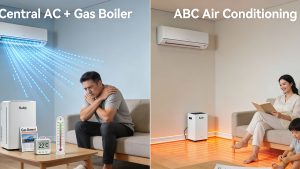
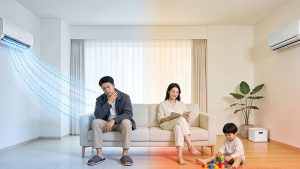
问题也由此而来:风感。冬天热风吹得脸干头痛,夏天冷风吹得肩膀酸痛。而且室内温度分布极不均匀——热空气往上飘,冷空气往下沉。你永远处在“头热脚冷”或“头冷脚热”的尴尬中。
第三次形态:ABC空调系统
现在,ABC空调带来了第三次形态转变。
A = Air-source unit,传统的空气能室外机(热泵主机)
B = Buddy unit,空调伴侣(国家实用新型专利 ZL 2021 2 1195781.6)
C = Conditioning unit,传统的室内机(风盘)
它不再是一台单纯的冷暖空调,而是一套耦合式辐射空调系统。简单说,它在传统分体式空调的基础上,增加了一个“空调伴侣”,这个伴侣把冷媒回路和地板下的PE水管网连接起来。
于是,空调有了两种“输出”方式:
- 对流:室内机吹风,快速升温或降温。
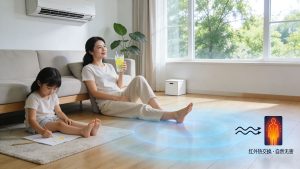
- 辐射:地板下的水管网散热或散冷,温柔、均匀、无风感。
两者既可以独立运行,也可以协同工作。地板成了巨大的“温度电池”——冬天储热,夏天储冷。即使室外机关机,地板还能持续释放冷热好几个小时。
这就是无风感空调的真正内涵:你感觉不到风,但温度恰到好处。
体感调节的四级阶梯
如果我们把人类调节体感舒适的能力,画成一条进化阶梯,它应该是这样的:
第一级:自然调节(房子阳光气道设计)
远古人类靠洞穴朝向、火堆位置;古代工匠靠房屋朝向、窗墙比、穿堂风设计。全凭经验和自然规律,没有机械参与。效果有限,全靠天意。
第二级:初级调节(风扇、电暖、暖气片)
电力和燃烧技术让人类拥有了“主动”调节的能力。但本质上还是“粗暴”的——风扇只是加速空气流动,电暖器只是把电能转化成热。效率低,舒适性一般,而且有安全隐患。
第三级:热量搬运调节(空调、空气能热泵)
热泵技术的出现,让人类学会了“搬运”热量——而不是“制造”热量。夏天把室内的热搬到室外,冬天把室外的热搬到室内。能效提升了3~4倍,这是巨大的进步。
但问题依然存在:强风感、温度分布不均、极端工况下性能衰减。
第四级:无感智慧调节(ABC空调系统)
这是我们现在所处的位置。ABC空调把对流和辐射两种传热方式融合在一起,再加上地板储能,实现了:
- 无风感:大部分冷热负荷由地板辐射承担,室内机只需微风辅助甚至不启动。
- 温度均匀:辐射换热没有死角,房间每个角落温度几乎一致。
- 储能特性:地板把能量存起来,削峰填谷,配合光伏或低谷电价,大幅降低运行成本。
- 极端天气强韧:由于过冷度/过热度的优化,即使在-20℃或43℃以上,系统依然稳定高效。
你不再需要忍受冷风直吹,也不需要担心脚底冰凉。你只是光着脚,踩在温润的地板上,忘记空调的存在。
为什么说ABC空调是一次理念革新?
技术上的进步固然重要,但更深层的,是理念上的转变。
转变一:从集中统一到独立精细
过去,北方城市集中供暖,统一时间开始,统一时间结束。你不能提前开,也不能晚关。温度由热力公司决定,你只能被动接受。
ABC空调代表的,是独立空间的精细化调节。每户人家、每个房间,都可以按照自己的节奏和偏好设定温度。老人房可以暖一点,年轻人卧室可以凉一点,书房白天有人时开启,晚上自动待机。
这是从“一刀切”到“量身定制”的进步。
转变二:从单一形式到复合形式
传统的冷暖空调,要么吹风,要么不吹风。地暖只能供暖,不能供冷。
ABC空调打破了这种“非此即彼”的局限。它可以同时运行风盘和地板辐射,也可以在两者之间智能切换。你可以要风,也可以不要风,可以要强效快速,也可以要温柔持久。
这就像从“只有一把锤子”变成了“拥有整个工具箱”。面对不同需求,你有了更多选择。
转变三:从“即时响应”到“预判储能”
普通空调是“即开即用”的——你按开关,它开始工作;你关掉,它停止。没有记忆,没有预判。
ABC空调因为有了地板这个巨大的储能体,可以实现“时间平移”。白天光伏发的电存进地板,晚上用;夜间低谷电价存的热,白天用。如果再配上AI预判天气和电价,它就变成了一个会思考、会预判的家庭能源管家。
一个普通人的四季感受变化
我们用最直观的方式,看看ABC空调给普通人生活带来了什么改变。
过去(传统分体式空调)
- 冬天:开空调采暖,热风呼呼吹。头顶热得冒汗,脚底还是凉的。皮肤干燥,嗓子疼。室外机化霜时,室内突然吹一阵冷风,气得想骂人。电费单来了,心更凉。
- 夏天:开制冷,冷风直吹肩膀。晚上睡觉必须盖被子,不是怕冷,是怕被风吹。老人孩子不敢待在出风口下面。房间温度降下来了,但总觉得哪里不对劲——后来才明白,那是“风感”带来的不舒适。
- 春秋:开空调觉得浪费,不开又觉得闷。纠结。
现在(ABC空调系统)
- 冬天:地板是温的,光脚踩上去很舒服。室内机偶尔辅助送风,风很柔和,几乎感觉不到。没有化霜冷风偷袭。电费比原来少了30%以上。
- 夏天:地板凉而不冰,室内机低风速循环。没有冷风直吹,但整个房间都是凉爽的。孩子在地板上爬,不用担心膝盖受凉。晚上睡觉,安静得只听到窗外的虫鸣。
- 春秋:地板辐射单独运行,不需要开风机。温度“若有若无”地调节着,你几乎感觉不到系统在工作,但身体就是舒服。
这就是“无感”的体验——不是没有温度调节,而是调节过程让你感觉不到。
二十年后,人们会怎么看今天?
让我们回到文章开头那个想象。
二十年后,ABC空调系统可能已经普及到了大多数家庭。那时候的年轻人,从小就在无风感、温度均匀、静音运行的环境里长大。
有一天,他们走进一个还在用传统分体式空调的老房子。夏天,冷风呼呼地吹;冬天,热风烤得脸发干。他们可能会皱着眉问:“你们当年是怎么在这种环境里生活的?”
就像我们今天走进一个没有空调的土坯房,会觉得不可思议一样。
这不是对过去的嘲讽,而是对进化的确认。每一代人都会觉得上一代人的生活方式“原始”,因为技术在进步,舒适的标准在提高。
而ABC空调,就是这个时代的标准制定者。
从岩洞到ABC:一条不变的线索
回顾四万年的居住进化史,你会发现一条不变的线索:
每一次进步,都是人类对“舒适”的定义在升级。
- 岩洞时代:活着就行。
- 土屋时代:遮风挡雨就行。
- 砖瓦房时代:安全坚固就行。
- 现代住宅:要冬暖夏凉。
- 未来住宅:要无风、无声、无感、低碳、智慧。
ABC空调系统,正是这条线索上的最新一站。它把“舒适”这个词,从“冷/热”的二元对立中解放出来,提升到了“体感上的不存在感”。
真正的舒适,是让你忘记“舒适”这个词本身。
结语:家,应该是让你忘记环境的地方
我们花了一辈子的时间,在外面奔波、打拼、应酬。回到家,我们想要的不是另一个需要“对抗”的环境——不是对抗冷风,不是对抗干燥,不是对抗噪音,不是对抗高昂的电费。
我们想要的,是一个可以完全放松、赤脚行走、深呼吸的地方。
ABC空调系统,就是为了这个目标而生的。它不只是一台空调,它是一套家庭微气候管理系统。它把空调伴侣、热泵、地板辐射、智能控制融合在一起,创造出一个“无感”的家。
在这个家里,冬天不会想起冷,夏天不会想起热,你只会想起——该泡杯茶,看本书,陪陪家人。
而这,正是人类从岩洞时代就开始追寻的东西。
(本文基于国家实用新型专利 ZL 2021 2 1195781.6 及发明专利申请 202510997961.2 撰写。)
关键词列表
空调, ABC空调系统, 空调伴侣, 无风感空调, 空调采暖, 空调连地暖, 冷暖空调, 热泵空调, 空气能, 热泵, 分体式空调, 辐射空调, 五恒系统, 空气能热泵, 地暖空调, 两联供, 空调系统, 热泵采暖, 中央空调, 家用空调
The Evolution of Human Habitation: From Caves to the “Imperceptible Intelligent Regulation” of ABC Air Conditioning
The First Fire in the Cave
Thirty thousand years ago, on an ice age night.
At the mouth of a south-facing cave, a group of primitive people sat around a fire. The flames danced, casting their shadows on the rough stone walls. Fire was their “air conditioner” — warmth in winter, cooked food, and a beast deterrent. But fire had fatal flaws: too close, you burn; too far, you freeze. Smoke stung their eyes, and the whole cave reeked of burning wood.
Worse, summer came. No fire needed, but the cave became stuffy and humid. They could only strip down and sit at the cave mouth hoping for a breeze. If the wind direction was wrong, insects swarmed.
Back then, humans had almost no choice in “comfort.” All they could do was passively adapt — find a wind-sheltered, south-facing cave and pray that winter wouldn’t be too long and summer too hot.
That was the longest phase in human habitation history: the natural adaptation period.
From “Shelter” to “Comfort”: A 40,000-Year Evolution
Human pursuit of dwelling has never been just about keeping out wind and rain. From caves to mud houses, from mud houses to brick homes, from brick homes to modern apartments — each leap represents a deeper understanding of “comfort.”
We can divide this 40,000-year habitation evolution into four phases:
Phase 1: Shelter (caves, thatched huts, animal hide tents)
The only goal: survive. Block beasts, block rain and snow, block the scorching sun. Whether it was cold or hot, dry or damp — nobody had the luxury to care. Comfort was a luxury; survival was the necessity.
Phase 2: Stable living (mud houses, adobe, wooden structures)
Humans learned to fire bricks, fell timber, and ram earth. Houses became sturdier. Doors and windows appeared. People began intentionally building homes on sunny slopes so winter sunlight could enter, and using cross-ventilation for summer cooling. This was early “passive design” — no machines, just using building orientation, air channels, and materials to regulate temperature.
But the ceiling was low. Northern winters still gave frostbitten hands and feet. Southern summers still made sleep impossible.
Phase 3: Safety and functionality (brick-concrete structures, central heating, early air conditioners)
The industrial revolution brought radiators, electric fans, and later window air conditioners. Humans gained the ability to “actively regulate” temperature. No more relying on the weather — flip a switch and get cool or warm air.
This was a huge leap. But new problems emerged: draft discomfort, loud noise, high electricity bills, and helplessness in extreme weather.
Phase 4: Comfortable living (ABC’s “imperceptible intelligent regulation”)
Today, we stand at the threshold of the fourth leap.
This time, we no longer pursue a binary choice of “cold” or “hot.” We pursue imperceptibility — you don’t feel the air conditioner working, yet your body is always in its most comfortable state. No drafts, no noise, no sudden temperature swings, no electricity bill anxiety.
This is what the ABC Air Conditioning System delivers: imperceptible intelligent regulation.
The Three Form Transformations of Air Conditioners
In the short century-long history of household air conditioners, there have been three major form transformations.
First Form: Window Air Conditioners
A metal box jammed into a window. Compressor, evaporator, and fan all crammed together. Cheap and easy to install. But the downside — unbearably loud. The hum made you feel like you were sleeping in a factory. And it could only cool/heat locally — one side of the room cold, the other hot.
Second Form: Split-Type Air Conditioners
The form most familiar to us. An outdoor unit handles compression and heat exchange, while an indoor unit blows air. Much quieter and more efficient. But fundamentally unchanged: still forced convection — regulating temperature by blowing air.
The problem: draft. In winter, hot air dries your face and gives you a headache. In summer, cold air gives you sore shoulders. And indoor temperature distribution is highly uneven — hot air rises, cold air sinks. You’re always stuck with either “hot head, cold feet” or “cold head, hot feet.”
Third Form: The ABC Air Conditioning System
Now, ABC brings the third transformation.
A = Air-source unit (traditional outdoor air source unit, the heat pump)
B = Buddy unit (Air Conditioner Buddy, National Utility Model Patent ZL 2021 2 1195781.6)
C = Conditioning unit (traditional indoor fan coil unit)
It is no longer a simple heating and cooling air conditioner. It is a coupled radiant air conditioning system. In short, it adds a “Buddy unit” to the traditional split-type air conditioner, connecting the refrigerant loop to an underfloor PE pipe network.
Thus, the air conditioner has two ways to “output”:
- Convection: the indoor unit blows air for rapid heating or cooling.
- Radiation: the underfloor pipe network radiates heat or coolness — gentle, even, draft-free.
Both can operate independently or in coordination. The floor becomes a massive “thermal battery” — storing heat in winter, storing coolness in summer. Even if the outdoor unit shuts down, the floor continues to release stored energy for hours.
This is the true meaning of draft-free air conditioning: you don’t feel the air, yet the temperature is just right.
The Four Levels of Sensory Regulation
If we map human ability to regulate thermal comfort onto an evolutionary ladder, it looks like this:
Level 1: Natural Regulation (building orientation, air channels)
Ancient humans relied on cave orientation and fire placement; ancient builders relied on orientation, window-to-wall ratios, and cross-ventilation. All based on experience and natural laws, no machines. Limited effectiveness, entirely at nature’s mercy.
Level 2: Primary Regulation (fans, electric heaters, radiators)
Electricity and combustion gave humans the ability to “actively” regulate. But it was still crude — fans just move air, electric heaters just convert electricity to heat. Low efficiency, mediocre comfort, and safety hazards.
Level 3: Heat Movement Regulation (air conditioners, air source heat pumps)
The advent of heat pump technology let humans “move” heat rather than “create” it. In summer, move indoor heat outdoors; in winter, move outdoor heat indoors. Efficiency improved 3–4 times — a huge leap.
But problems remained: strong drafts, uneven temperature distribution, and performance degradation in extreme conditions.
Level 4: Imperceptible Intelligent Regulation (ABC Air Conditioning System)
This is where we stand now. ABC integrates convection and radiation plus floor storage to achieve:
- Draft-free: Most of the heating/cooling load is handled by floor radiation. The indoor unit needs only gentle airflow or can stay off.
- Even temperature: Radiation has no blind spots — every corner of the room is nearly the same temperature.
- Storage capability: The floor stores energy, shifting load from peak to off-peak times, greatly reducing operating costs when paired with PV or time-of-use pricing.
- Extreme weather resilience: Thanks to optimized subcooling/superheating, the system remains stable and efficient even at -20°C or above 43°C.
You no longer endure cold drafts or worry about cold feet. You simply walk barefoot on the warm floor and forget the air conditioner exists.
Why Is ABC a Conceptual Revolution?
Technological progress is important, but the deeper shift is conceptual.
Shift 1: From Centralized Uniformity to Independent Precision
In the past, northern cities had centralized heating — uniform start and end dates. You couldn’t start early or turn off late. The temperature was set by the heating company; you could only accept it.
ABC represents independent, precision regulation of individual spaces. Each household, each room, can set temperatures according to its own rhythm and preferences. An elderly person’s room can be warmer, a young person’s bedroom cooler, a study active when occupied and standby at night.
This is progress from “one-size-fits-all” to “tailor-made.”
Shift 2: From Single Form to Composite Form
Traditional heating and cooling air conditioners either blow air or don’t. Underfloor heating can only heat, not cool.
ABC breaks this “either/or” limitation. It can simultaneously operate the fan coil and floor radiation, or intelligently switch between them. You can have airflow or not, rapid response or gentle persistence.
This is like going from “only a hammer” to “a full toolbox.” Faced with different needs, you have more choices.
Shift 3: From “Instant Response” to “Predictive Storage”
Ordinary air conditioners are “turn on, use; turn off, stop.” No memory, no prediction.
ABC, with its massive floor thermal battery, enables time shifting. PV electricity generated during the day is stored in the floor for night use; off-peak electricity at night is stored as heat for daytime use. Paired with AI that predicts weather and electricity prices, it becomes a thinking, predicting home energy butler.
A Layperson’s Four-Season Experience
Let’s see, in the most intuitive way, what ABC brings to everyday life.
Then (traditional split-type air conditioner)
- Winter: Turn on air conditioning heating. Hot air blasts. Head is hot and sweaty, feet still cold. Skin dries, throat hurts. When the outdoor unit defrosts, the indoor unit suddenly blows cold air — infuriating. Then the electricity bill arrives, and your heart sinks even more.
- Summer: Turn on cooling. Cold air blasts your shoulders. At night, you must cover up — not because you’re cold, but to avoid the draft. The elderly and children dare not sit under the outlet. The room temperature drops, but something feels off — then you realize: it’s the discomfort of “draft sensation.”
- Spring/Fall: Turning on the air conditioner feels wasteful; leaving it off feels stuffy. A dilemma.
Now (ABC Air Conditioning System)
- Winter: The floor is warm. Walking barefoot is pleasant. The indoor unit occasionally assists with very gentle airflow, almost imperceptible. No defrost cold drafts. Electricity bills are 30%+ lower.
- Summer: The floor is cool but not cold. The indoor unit runs at low speed. No cold drafts, yet the whole room is comfortably cool. Children crawl on the floor without cold knees. At night, it’s so quiet you only hear crickets outside.
- Spring/Fall: Floor radiation runs alone; no fan needed. Temperature is “barely there” — you hardly notice the system working, yet your body is comfortable.
This is the “imperceptible” experience — not the absence of temperature regulation, but a regulation process you don’t feel.
How Will People See Today Twenty Years From Now?
Let’s return to the imagination from the beginning.
Twenty years from now, ABC may be common in most households. Young people will have grown up in draft-free, even-temperature, silent environments.
One day, they walk into an old house still using a traditional split-type air conditioner. In summer, cold air blasts; in winter, hot air dries their faces. They might frown and ask, “How did you ever live like this?”
Just as we today find it unimaginable to live in a mud hut without air conditioning.
This is not a mockery of the past, but a confirmation of evolution. Each generation finds the previous generation’s lifestyle “primitive” because technology advances and comfort standards rise.
And ABC is the standard-setter of this era.
From Cave to ABC: An Unbroken Thread
Looking back over 40,000 years of habitation evolution, one thread remains constant:
Every step forward is an upgrade in the definition of “comfort.”
- Cave era: survive.
- Mud house era: shelter from wind and rain.
- Brick house era: safety and sturdiness.
- Modern home: warm in winter, cool in summer.
- Future home: draft-free, silent, imperceptible, low-carbon, intelligent.
The ABC Air Conditioning System is the latest station on this thread. It liberates the word “comfort” from the binary opposition of “cold/hot” and elevates it to a state of sensory non-existence.
True comfort is making you forget the word “comfort” itself.
Conclusion: Home Should Be Where You Forget the Environment
We spend our lives running around — working, hustling, socializing. When we come home, we don’t want another environment to “fight” — not against drafts, not against dryness, not against noise, not against high electricity bills.
We want a place where we can fully relax, walk barefoot, and breathe deeply.
The ABC Air Conditioning System was born for that goal. It is not just an air conditioner; it is a home microclimate management system. It integrates the Air Conditioner Buddy, heat pump, floor radiation, and intelligent control to create an “imperceptible” home.
In this home, winter doesn’t make you think of cold, summer doesn’t make you think of heat. You only think of making a cup of tea, reading a book, spending time with family.
And that is what humans have been searching for since the cave age.
(This article is based on National Utility Model Patent ZL 2021 2 1195781.6 and Invention Patent Application 202510997961.2.)
Keyword List
air conditioner, ABC air conditioning system, air conditioner buddy, draft-free air conditioner, air conditioning heating, air conditioning connected to underfloor heating, heating and cooling air conditioner, heat pump air conditioner, air source energy, heat pump, split-type air conditioner, radiant air conditioning, five-constant system, air source heat pump, underfloor heating air conditioner, two-in-one system, air conditioning system, heat pump heating, central air conditioning, household air conditioner