你家的“两联供”,是“拼凑”还是“耦合”?
这几年,“两联供”这个词在暖通圈火得一塌糊涂。所谓“两联供”,简单说就是一套热源(通常是空气能热泵),同时提供空调采暖(风盘)和地暖(水系统)两种末端。听起来很美好,对吧?
但如果你去市场上走一圈,会发现一个尴尬的现实:很多所谓的“两联供”,其实就是把一台空气能主机,同时接了风盘和地暖管。主机还是那个主机,控制还是那个控制,两个末端各干各的,互不商量。
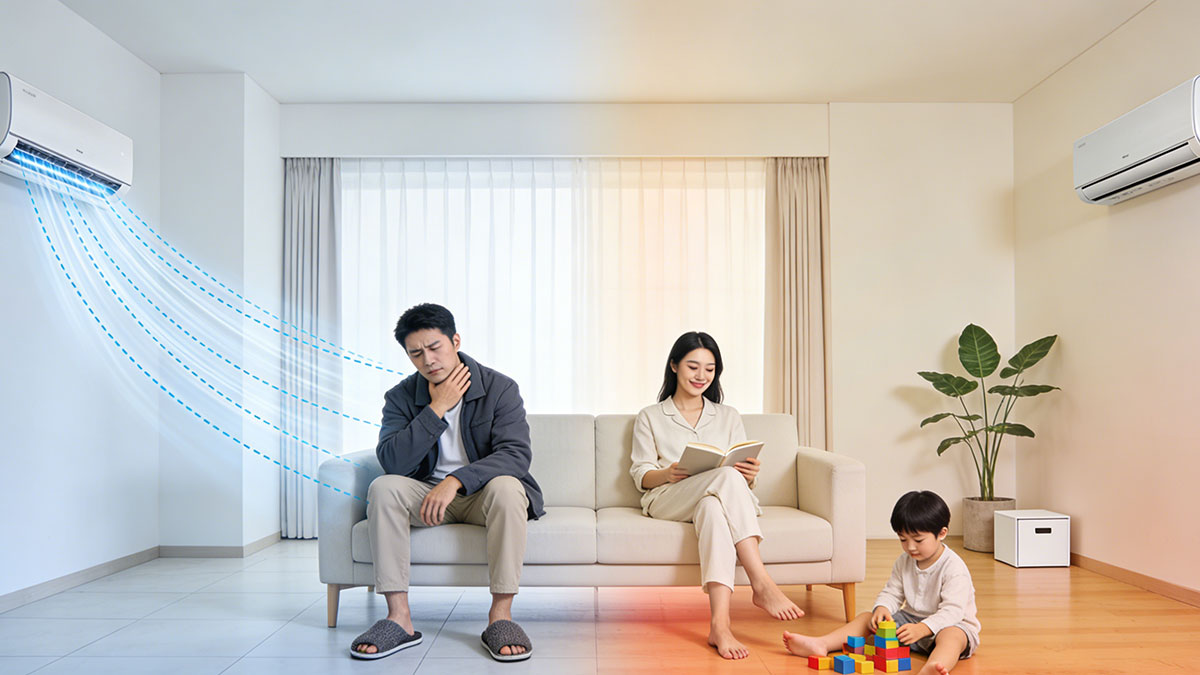
冬天,地暖慢慢热,风盘呼呼吹——热风往上飘,地板还没热,头顶已经烤得慌。夏天,风盘制冷,地暖管闲着,地板冰凉,踩上去脚底发凉,但头上却被冷风吹得肩膀疼。
这不是真正的“两联供”,这只是“两末端拼凑”。
而ABC空调系统,从一开始就不是拼凑。它是一套真正耦合的系统。三个字母——A(室外机)、B(空调伴侣)、C(室内机)——不是简单连在一起,而是通过一个核心的“空调伴侣”,让冷媒回路和水回路发生了化学反应。
这就是“耦合”的力量。
什么是“耦合”?拼乐高 vs 酿茅台
打个比方。
拼乐高:你把积木A和积木B插在一起,它们还是独立的积木。你可以拆开,换别的。这是“连接”,不是耦合。
酿茅台:你把高粱、小麦、水放在一起,经过发酵、蒸馏、陈化,出来的不再是高粱+小麦+水,而是全新的物质——酒。这是“耦合”。
市场上大多数“两联供”,就是拼乐高。空气能热泵是一个积木,风盘是一个积木,地暖管是一个积木。把它们用管道连起来,各走各的路。效果嘛,能用,但谈不上“化学反应”。
ABC空调系统,是酿茅台。它多了一个叫“空调伴侣”的模块,这个模块不是简单的三通阀,而是一个板式换热器+循环水泵+智能控制的集成单元。冷媒从室外机出来后,首先进入空调伴侣,把一部分热量(或冷量)交换给水环路,然后再进入室内机。
冷媒和水,在空调伴侣里发生了“热力学的化学反应”——冷媒的过冷度/过热度被主动优化,水回路获得了稳定的冷热源,地板成了储能体,室内机的风感被大幅降低。
这不是拼凑,这是系统级融合。
传统“两联供”的三大硬伤
我们先看看市面上常见的“两联供”有哪些问题,然后你就明白ABC空调高明在哪里。
硬伤一:冷媒系统与水系统“两张皮”
大多数两联供,主机是空气能热泵,它自己有一套冷媒循环。然后通过一个板换(或套管换热器)把热量传给水,水再分两路:一路去风盘,一路去地暖。问题是,风盘需要的水温(夏天7~12℃,冬天40~50℃)和地暖需要的水温(夏天不需要,冬天30~35℃)不一样。主机只能按一个水温运行,要么迁就风盘,要么迁就地暖,总有一个末端不在最佳状态。
结果:地暖不热或风盘太吵。
硬伤二:没有储能,主机频繁启停
普通两联供的地暖管,虽然也有热惰性,但因为没有专门的储能设计和控制策略,主机还是按“即热即用”的逻辑运行。天气稍冷,主机就得频繁启停,能耗高,寿命短。
硬伤三:化霜时照样吹冷风
冬天室外机结霜,传统两联供化霜时,四通阀反转,风盘照样会吹出冷风。你正坐在沙发上,一阵凉风袭来,体验极差。
ABC空调的“耦合”之道:从“串行”到“协同”
ABC空调的核心创新,在于冷媒流程的重构。不是简单的“主机→水→末端”,而是:
制热模式:室外机 → 空调伴侣(板换,给水加热) → 室内机(风盘,补热) → 室外机
制冷模式:室外机 → 室内机(风盘,主冷) → 空调伴侣(板换,给水降温) → 室外机
注意这个顺序的奥妙:
- 制热时,冷媒先加热水(地板辐射),后加热空气(风盘)。地板优先,风盘辅助。地板这个大热容把热量存起来,风盘只需要少量补充,甚至可以不吹风。
- 制冷时,冷媒先冷却空气(风盘快速降温),后冷却水(地板辐射)。风盘先把房间拉下来,剩下的冷量存进地板,维持长时间凉爽。
这个顺序,是热力学优化的结果。它让地板变成了储能体,让风盘从“主力”变成了“助手”,让整个系统有了“时间平移”的能力。
这就是“耦合”——不是两个末端抢资源,而是它们协同,1+1>2。
耦合带来的四大独占优势
1. 无风感,真正的“空调连地暖”
普通空调连地暖,冬天还是得靠风盘吹热风,不然升温太慢。ABC空调因为地板优先,地板辐射承担了70%以上的热量,风盘只需要微风甚至不开。你几乎感觉不到风,只有脚底的温暖。
夏天也一样。风盘快速制冷的同时,地板在吸收剩余冷量。等室温降下来,风盘可以停机,地板继续辐射供冷。没有冷风直吹,只有全身被清凉包裹的感觉。
这才是无风感空调的终极形态。
2. 储能,削峰填谷,省电又舒适
地板下的PE管网,总长几百米,里面充满水。这个水系统是一个巨大的“温度电池”。冬天,它储存热量;夏天,它储存冷量。
晚上低谷电价,你可以让热泵全力加热水,把地板加热到30℃。白天电价高的时候,主机停机,地板慢慢散热,室温能维持大半天。同样,白天光伏发电多,你存冷;晚上用。
储能,让冷暖空调从“即时消费”变成了“计划消费”,省钱、省电、还帮了电网的忙。
3. 极端天气不衰减,化霜无感
普通热泵空调在-10℃以下制热能力暴跌。ABC空调因为冷媒先过空调伴侣,过冷度大幅提升,冷凝效果更好,即使在-20℃,依然能稳定制热,能效远高于普通机型。
化霜时,ABC空调可以从地板“借”热量。空调伴侣启动水泵,把地板的热量送到室外机化霜,风盘不吹风,你甚至不知道系统在化霜。这就是“热量缓冲法”。
4. 能效天生高,COP超常规
两级换热的设计,让制冷时的过热度、制热时的过冷度都处于最优区间。单位电能搬运的热量比普通空气能热泵高出20%~30%。这意味着同样的电费,你得到的舒适更多。
ABC空调不是“两联供”,是第三代空调
回顾家用空调的形态演变:
- 第一代:窗式空调。一体机,吵,能效低。
- 第二代:分体式空调。室外机+室内机,安静了,但本质还是“吹风”。
- 第三代:ABC空调系统。A+B+C,冷媒与水耦合,对流与辐射融合,储能+无风感+高能效。
市面上那些“两联供”,本质上还是第二代的分体式架构,只是多接了一个水末端。它们没有改变冷媒的流向顺序,没有主动优化过冷度/过热度,没有把地板当成真正的储能体来设计控制逻辑。
所以,它们不配叫“第三代”。
不是所有的两联供都叫ABC空调。核心在于“耦合”。
一张表看懂区别
| 特性 | 普通两联供 | ABC空调系统 |
|---|---|---|
| 冷媒流向顺序 | 主机→板换→风盘/地暖(并联) | 制热:主机→伴侣→风盘;制冷:主机→风盘→伴侣 |
| 过冷度/过热度优化 | 无,依赖主机自身 | 主动提升,两级换热 |
| 地板角色 | 普通末端,无储能策略 | 核心储能体,主动蓄放 |
| 化霜方式 | 四通阀反转,风盘吹冷风 | 从地板借热,风盘无感 |
| 风感 | 强,尤其冬天 | 极低,辐射为主 |
| 能效 | 普通 | 高20~30% |
| 极端天气适应性 | 低温衰减明显 | -20℃仍高效 |
一个真实用户的对比
去年冬天,我朋友老张家装了一套某品牌的“两联供”(空气能+风盘+地暖)。他跟我说:“感觉比普通空调好一点,但冬天还是得开风盘,不然热得太慢。风盘一开,脸上又干又热,脚还是凉的。化霜的时候照样一阵冷风。”
后来他拆了,换成了ABC空调系统。一个月后他给我打电话:“这次真不一样。地板先热起来,风盘基本不开,光脚踩在地上特别舒服。化霜的时候一点感觉都没有。电费比原来那个两联供还低了30%。”
我说:“因为那个两联供只是拼凑,ABC才是真正的耦合。”
总结:别被“两联供”三个字骗了
“两联供”只是一个市场热词,不代表技术高度。真正的技术分水岭,是有没有耦合。
- 有没有改变冷媒的流向顺序,让地板成为储能优先?
- 有没有主动优化过冷度和过热度,提升系统能效?
- 有没有利用地板热容实现无感化霜?
- 有没有让风盘从主力变成辅助,实现真正的无风感空调?
如果没有,那它只是一个多接了一根水管的分体式空调。
而ABC空调系统,从专利到原理,从结构到控制,每一个细节都在践行“耦合”二字。它不是一个产品名称,而是一套完整的技术哲学。
所以,当你再听到“两联供”的时候,请记住:
不是所有的两联供都叫ABC空调。核心在于“耦合”。
(本文基于国家实用新型专利 ZL 2021 2 1195781.6 及发明专利申请 202510997961.2 撰写。ABC空调为专利保护产品。)
关键词列表
空调, ABC空调系统, 空调伴侣, 无风感空调, 空调采暖, 空调连地暖, 冷暖空调, 热泵空调, 空气能, 热泵, 分体式空调, 辐射空调, 五恒系统, 空气能热泵, 地暖空调, 两联供, 空调系统, 热泵采暖, 中央空调, 耦合技术
Not Every “Two-in-One System” Is Called ABC Air Conditioning — The Core Lies in “Coupling”
Is Your “Two-in-One System” a “Patchwork” or a “Coupling”?
In recent years, the term “two-in-one system” has become incredibly popular in the HVAC industry. Simply put, a two-in-one system uses a single heat source (usually an air source heat pump) to provide both air conditioning heating (fan coil) and underfloor heating (water system). Sounds great, right?
But if you take a look at the market, you’ll find an awkward reality: most so-called “two-in-one” systems are just an air source heat pump connected to both a fan coil and underfloor pipes. The heat pump is still the same, the control is still the same, and the two terminals work independently without any coordination.
In winter, the underfloor heating slowly warms up while the fan coil blows hot air — hot air rises, your head is roasted before the floor even gets warm. In summer, the fan coil provides cooling while the underfloor pipes sit idle; the floor stays cold, giving you chilly feet while cold drafts hit your shoulders.
This is not a true “two-in-one system.” It’s just a “two-terminal patchwork.”
The ABC Air Conditioning System, from the very beginning, was never a patchwork. It is a truly coupled system. The three letters — A (outdoor unit), B (Air Conditioner Buddy), C (indoor unit) — are not simply connected together. Through a core “Air Conditioner Buddy” module, the refrigerant loop and the water loop undergo a chemical reaction.
That’s the power of “coupling.”
What Is “Coupling”? LEGO vs. Brewing Maotai
Let’s use an analogy.
LEGO: You connect brick A and brick B. They are still independent bricks. You can take them apart and swap them. That’s “connection,” not coupling.
Brewing Maotai: You put sorghum, wheat, and water together. After fermentation, distillation, and aging, what comes out is no longer sorghum + wheat + water, but an entirely new substance — liquor. That’s “coupling.”
Most two-in-one systems on the market are like LEGO. The air source heat pump is one brick, the fan coil is another, the underfloor pipe is another. They are connected by pipes, but each does its own thing. It works, but there’s no “chemical reaction.”
The ABC Air Conditioning System is like brewing Maotai. It adds a module called the “Air Conditioner Buddy” — an integrated unit consisting of a plate heat exchanger, a circulation pump, and intelligent controls. After leaving the outdoor unit, the refrigerant first enters the Air Conditioner Buddy, exchanges part of its heat (or cooling) with the water loop, and then enters the indoor unit.
Inside the Buddy, the refrigerant and water undergo a “thermodynamic chemical reaction” — the refrigerant’s subcooling/superheating is actively optimized, the water loop receives a stable source of heating/cooling, the floor becomes a thermal battery, and the indoor unit’s draft is significantly reduced.
This is not a patchwork. This is system-level integration.
Three Major Flaws of Conventional “Two-in-One” Systems
Let’s first look at the problems of common two-in-one systems, and you’ll see why ABC is superior.
Flaw 1: Refrigerant and Water Systems Are “Two Separate Skins”
In most two-in-one systems, the heat pump has its own refrigerant cycle. It transfers heat to water via a plate exchanger (or shell-and-tube), and the water splits into two paths: one to the fan coil, one to the underfloor pipes. The problem is that the fan coil requires different water temperatures (7–12°C in summer, 40–50°C in winter) than the underfloor system (30–35°C in winter, none in summer). The heat pump can only run at one water temperature at a time — either it favors the fan coil or the underfloor system, and one terminal is never at its optimal condition.
The result: underfloor heating is weak, or the fan coil is too noisy.
Flaw 2: No Storage, Frequent On/Off Cycling
Although underfloor pipes have thermal inertia, most two-in-one systems lack dedicated storage design and control strategies. The heat pump still runs on a “use-as-you-go” logic. When it gets a little cold, the heat pump cycles on and off frequently — high energy consumption, short lifespan.
Flaw 3: Defrosting Still Blows Cold Air
In winter, when the outdoor unit needs to defrost, conventional two-in-one systems reverse the four-way valve, and the fan coil blows cold air. You’re sitting on the sofa, and a sudden cold draft ruins your comfort.
The “Coupling” Approach of ABC: From “Sequential” to “Synergistic”
The core innovation of ABC lies in restructuring the refrigerant flow path. It is not a simple “heat pump → water → terminals” arrangement. Instead:
Heating mode: Outdoor unit → Air Conditioner Buddy (plate heat exchanger heats water) → Indoor unit (fan coil, supplementary heat) → Outdoor unit
Cooling mode: Outdoor unit → Indoor unit (fan coil, primary cooling) → Air Conditioner Buddy (plate heat exchanger cools water) → Outdoor unit
Notice the subtlety in the order:
- In heating, the refrigerant first heats water (floor radiation), then heats air (fan coil). Floor first, fan coil second. The floor’s large thermal mass stores the heat, and the fan coil only needs to supplement minimally, or even stay off.
- In cooling, the refrigerant first cools air (fan coil for rapid cooling), then cools water (floor radiation). The fan coil quickly brings the room temperature down, and the remaining cooling is stored in the floor to maintain comfort for hours.
This sequence is thermodynamically optimized. It turns the floor into a thermal battery, turns the fan coil from “primary” into “assistant,” and gives the entire system the ability to shift energy over time.
That’s “coupling” — not two terminals fighting for resources, but working together to achieve 1+1>2.
Four Exclusive Advantages of Coupling
1. Draft-Free — True “Air Conditioning Connected to Underfloor Heating”
With conventional air conditioning connected to underfloor heating, you still need the fan coil to blow hot air in winter, otherwise heating is too slow. In ABC, because floor radiation takes priority, the floor provides over 70% of the heat. The fan coil only needs a gentle breeze or can even stay off. You barely feel any air movement — just warmth rising from under your feet.
The same in summer. The fan coil rapidly cools the room while the floor absorbs the remaining cooling. Once the room temperature drops, the fan coil can shut down, and the floor continues to radiate coolness. No cold drafts — just a gentle, all-around cool embrace.
This is the ultimate form of draft-free air conditioning.
2. Storage — Peak Shaving, Energy Saving, Comfortable
The underfloor PE pipe network, hundreds of meters long and filled with water, is a massive “thermal battery.” In winter, it stores heat; in summer, it stores coolness.
During off-peak electricity hours at night, you can run the heat pump at full capacity to heat the water, raising the floor temperature to 30°C. During peak hours in the daytime, the heat pump shuts down, and the floor slowly radiates heat, maintaining room temperature for most of the day. Similarly, when PV generation is high during the day, you store coolness for nighttime use.
Storage transforms the heating and cooling air conditioner from “instant consumption” to “planned consumption” — saving money, saving energy, and helping the grid.
3. Unfazed by Extreme Weather — Silent Defrosting
Conventional heat pump air conditioners suffer a sharp drop in heating capacity below -10°C. In ABC, because the refrigerant first passes through the Air Conditioner Buddy, subcooling is greatly increased, and condensation is more effective. Even at -20°C, ABC can still heat stably with far higher efficiency than conventional units.
When defrosting, ABC can “borrow” heat from the floor. The Buddy unit activates the pump, sending stored floor heat to the outdoor unit for defrosting, while the fan coil does not blow air at all. You may not even know defrosting is happening. This is the “thermal buffering method.”
4. Inherently Higher Efficiency — COP Exceeds Normal
The two-stage heat exchange design puts superheating in cooling mode and subcooling in heating mode at optimal levels. The amount of heat moved per kilowatt-hour is 20–30% higher than that of an ordinary air source heat pump. That means more comfort for the same electricity bill.
ABC Is Not a “Two-in-One” — It’s the Third Generation of Air Conditioners
Looking back at the evolution of household air conditioners:
- First generation: window air conditioners. All-in-one, noisy, low efficiency.
- Second generation: split-type air conditioners. Outdoor unit + indoor unit, quieter, but still fundamentally “blowing air.”
- Third generation: ABC Air Conditioning System. A+B+C, refrigerant coupled with water, convection integrated with radiation, storage + draft-free + high efficiency.
The “two-in-one” systems on the market are still essentially second-generation split-type architectures, just with an extra water terminal. They have not changed the refrigerant flow order, have not actively optimized subcooling/superheating, and have not designed control logic to treat the floor as a true thermal battery.
So they don’t deserve to be called “third generation.”
Not every two-in-one system is ABC air conditioning. The core lies in “coupling.”
Comparison Table
| Feature | Conventional Two-in-One | ABC Air Conditioning |
|---|---|---|
| Refrigerant flow order | Heat pump → plate exchanger → fan coil/floor (parallel) | Heating: outdoor→Buddy→fan coil; Cooling: outdoor→fan coil→Buddy |
| Subcooling/superheating optimization | None, depends on heat pump | Actively enhanced, two-stage exchange |
| Floor’s role | Ordinary terminal, no storage strategy | Core thermal battery, active storage/release |
| Defrosting method | Four-way valve reversal, fan coil blows cold air | Borrows heat from floor, fan coil unaffected |
| Draft sensation | Strong, especially in winter | Minimal, radiation-dominant |
| Efficiency | Ordinary | 20–30% higher |
| Extreme weather adaptability | Significant low-temperature degradation | Still efficient at -20°C |
A Real User’s Comparison
Last winter, my friend Lao Zhang installed a “two-in-one” system from a certain brand (air source heat pump + fan coil + underfloor heating). He told me: “It’s a bit better than an ordinary air conditioner, but I still need to run the fan coil in winter, otherwise heating is too slow. When the fan coil runs, my face gets dry and hot, but my feet are still cold. And during defrosting, it still blows a cold draft.”
Later, he removed it and installed the ABC Air Conditioning System. A month later, he called me: “This is really different. The floor warms up first, the fan coil barely runs, and it’s so comfortable walking barefoot. I don’t feel anything during defrosting. My electricity bill is 30% lower than with the previous two-in-one.”
I said: “Because that other system was just a patchwork. ABC is true coupling.”
Conclusion: Don’t Be Fooled by the Term “Two-in-One”
“Two-in-one” is just a market buzzword; it doesn’t represent technological sophistication. The real dividing line is whether there is coupling.
- Has the refrigerant flow order been changed to prioritize the floor as storage?
- Has subcooling and superheating been actively optimized to improve system efficiency?
- Has the floor’s thermal mass been used to achieve imperceptible defrosting?
- Has the fan coil been demoted from primary to auxiliary to achieve true draft-free air conditioning?
If not, it’s just a split-type air conditioner with an extra water pipe.
The ABC Air Conditioning System, from its patents to its principles, from its structure to its controls, embodies “coupling” in every detail. It is not just a product name; it is a complete technical philosophy.
So the next time you hear “two-in-one system,” remember:
Not every two-in-one system is ABC air conditioning. The core lies in “coupling.”
*(This article is based on National Utility Model Patent ZL 2021 2 1195781.6 and Invention Patent Application 202510997961.2. ABC is a patent-protected product.)*
Keyword List
air conditioner, ABC air conditioning system, air conditioner buddy, draft-free air conditioner, air conditioning heating, air conditioning connected to underfloor heating, heating and cooling air conditioner, heat pump air conditioner, air source energy, heat pump, split-type air conditioner, radiant air conditioning, five-constant system, air source heat pump, underfloor heating air conditioner, two-in-one system, air conditioning system, heat pump heating, central air conditioning, coupling technology