一场关于“家”的体感革命,已经悄然来临
你有没有想过这样一个问题——
两千年后的古人,坐在四面透风的土坯房里,冬天裹着厚重的麻衣瑟瑟发抖,夏天摇着蒲扇汗流浃背。他们能想象两千年后的人类,会用一个叫“空调”的神奇盒子,让房间里冬暖夏凉吗?
恐怕不能。
同样,二十年后的某一天,当你的孙子孙女走进一间还在用“传统冷暖空调”的老房子时,他们可能也会皱着眉说:“爷爷奶奶,你们当年是怎么在这种环境里生活的?这风直吹在身上,多难受啊。”
因为到那时,ABC空调系统——这种融合了空气能与辐射舒适性的新型热泵空调,可能已经成为每个家庭的标配。而我们今天还在讨论的“空调好不好用”,在他们看来,就像我们今天讨论“土墙能不能挡风”一样原始。
是的,一场关于“家”的体感革命,已经悄然来临。
而这场革命的主角,叫做——
ABC空调:A+B+C=一个更懂你的家
什么是ABC空调?
简单说,它不是一台普通空调,而是一套完整的家庭微气候管理系统。
名字里的三个字母,代表三样东西:
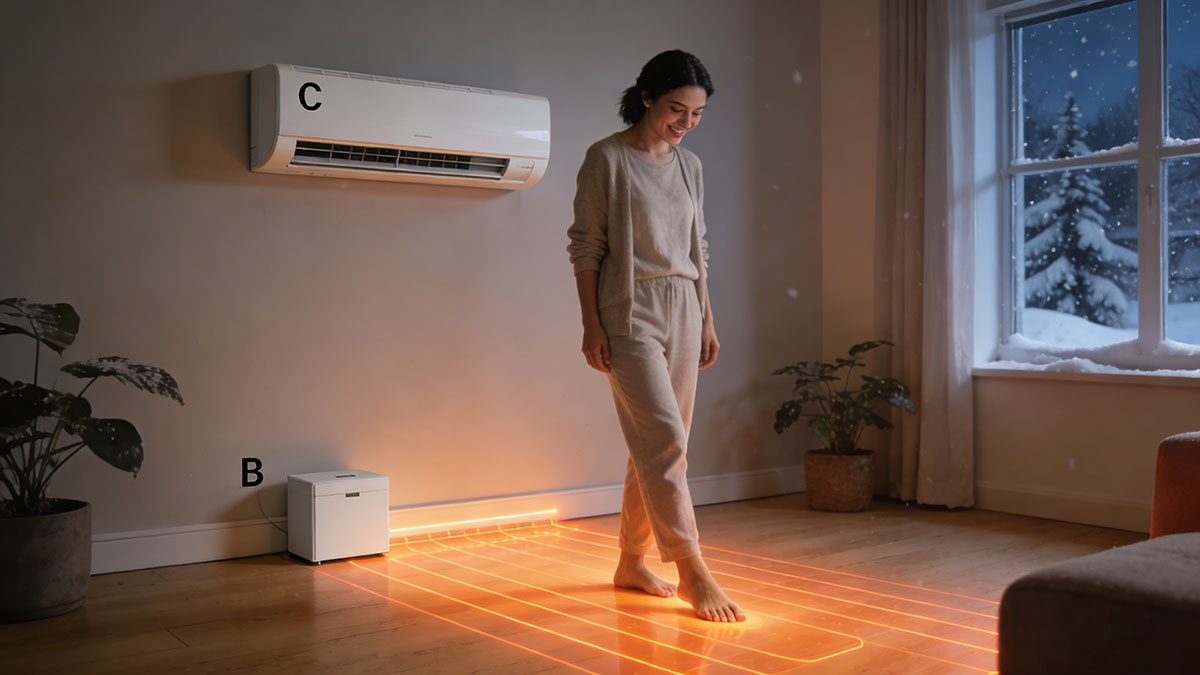
- A(Air-source unit):传统的空气能室外机,也就是我们熟悉的热泵主机。它负责从外界空气中提取热量(冬天)或将室内的热量排到室外(夏天)。
- B(Buddy unit):空调伴侣。这是整个系统的灵魂,也是已经获得国家实用新型专利(专利号:ZL 2021 2 1195781.6)的核心模块。它就像一个聪明的“热量调度员”,负责在冷媒和水之间传递能量。
- C(Conditioning unit):传统的室内机。就是你熟悉的那个挂墙或藏在吊顶里的风盘,负责向室内吹送冷暖空气。
这三个字母,代表了家用空调诞生以来的第三次形态转变:
- 第一次形态:窗式空调。像个铁疙瘩塞在窗户上,吵得人睡不着觉。
- 第二次形态:分体式空调。就是我们今天绝大多数家庭用的那种,室外机+室内挂机。
- 第三次形态:ABC空调系统。它不再是单一的冷暖空调,而是一套能够同时实现空调采暖、空调连地暖、无风感辐射、极端气候稳定运行的复合系统。
说得再直白一点——
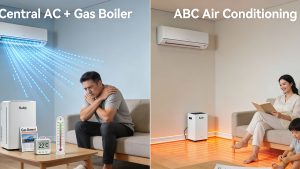
传统的分体式空调,就像一个只会“吹气”的年轻人,有力气,但粗糙。冬天吹热风,头热脚冷;夏天吹冷风,肩膀酸痛。
而ABC空调系统,就像一个懂得“布局”的成熟管家。它把传统空调的强劲“吹风能力”,和地板下的辐射管网的“温柔辐射能力”结合在一起。冬天,地板给你温暖的辐射,室内机辅助送风,从脚暖到头;夏天,室内机快速制冷的同时,地板也在悄悄帮你“吸热”,让你从头凉到脚,却没有一丝被风直吹的不适。
这就是无风感空调的真正境界。
为什么我们需要ABC空调?一个普通人的四季困扰
要理解ABC空调的价值,先看看我们现在的日子是怎么过的。
冬天,你开传统空调采暖。
热风呼呼地吹,天花板热了,墙壁热了,你的脸热了,可你的脚还是凉的。因为热空气轻,全往上飘。你不得不把温度调高,结果空气干燥,嗓子冒烟,电费蹭蹭涨。更糟心的是,每过一两个小时,室外机还要化霜——四通阀一反转,室内机突然吹出一阵凉风,你刚从被窝里爬起来,被这阵风一激,浑身一哆嗦。
这就是传统热泵空调在冬天的窘境。
夏天,你开传统空调制冷。
冷风嗖嗖地吹,你坐在沙发上,肩膀被吹得酸疼。老人孩子不敢待在出风口下面,晚上睡觉必须盖被子——不是怕冷,是怕被冻着。房间的温度是降下来了,可你总觉得哪里不对劲。后来你才明白:那是“风感”带来的不舒适。
还有,当室外温度超过43℃,或者低于-15℃时,很多普通空调就直接“罢工”了。压缩机拼命转,但屋里就是不冷不热。
春秋过渡季,你舍不得开空调。
早晚温差大,开空调觉得浪费,不开又觉得闷。你渴望有一种“若有若无”的调节,就像大自然里的微风,不知不觉就把温度调到了最舒服的状态。
这些困扰,不是你的问题,是技术的问题。
而ABC空调系统,正是为了解决这些问题而生的。
ABC空调到底好在哪?五个让你无法拒绝的理由
一、冬天:脚暖头凉,告别“上热下冷”
在冬季制热模式下,ABC空调系统的工作逻辑是这样的:
高温高压的冷媒从室外机出来后,首先进入“空调伴侣”。空调伴侣把热量交换给地板下的PE水管网,热水流过地板,你踩上去是温的、暖的——就像北方的地暖,但不需要锅炉,不需要燃气,全靠空气能热泵从室外“搬运”热量。
然后,已经释放了一部分热量的冷媒,再进入室内机,向房间吹送温和的热风。
结果是什么?
地板辐射给你持续的、均匀的温暖,室内机辅助送风加速升温。你的脚是暖的,头是清爽的,整个房间的温度分布像一个倒置的“温度金字塔”——下暖上凉,这是人体最舒适的状态。
而且,因为地板下的PE管网本身就是一个巨大的“储能体”,即使室外机偶尔化霜或停机,地板依然在持续散热。你根本感觉不到温度的波动。
这就是空调采暖与辐射采暖的完美结合。
二、夏天:凉而不冷,告别“空调病”
在夏季制冷模式下,逻辑正好反过来。
低温低压的冷媒先进入室内机,吸收室内空气的热量,给你快速降温。然后,吸收了部分热量的冷媒再进入空调伴侣,通过水环路把剩余冷量“存”进地板下的PE管网。
地板下的冷水管网,就像一个巨大的“冷辐射面”。它会均匀地吸收房间里的热辐射,包括墙壁、家具、甚至你身体散发的热量。你走进房间,感觉整个人从四面八方都被“温柔地冷却”,而不是被一股冷风直吹。
这意味着什么?
你再也不用担心肩膀被吹疼、孩子半夜踢被子着凉、老人关节受风。无风感空调这个听起来像概念产品的名字,变成了实实在在的日常体验。
三、极端天气不掉链子:-20℃也能稳定制热
这是ABC空调系统最硬核的技术优势之一。
传统热泵空调在低温环境下效率骤降,是因为冷媒在节流前容易“闪发”(提前汽化),导致蒸发器吃不饱,压缩机空转。而ABC空调通过在制热模式下人为增大过冷度,让液态冷媒在节流前更加“老实”,确保蒸发过程完整、高效。
翻译成大白话就是:同样是-15℃的寒冬,普通空气能热泵可能已经“喘不上气”了,ABC空调还能稳稳地工作,而且能效比远高于传统机型。
如果温度再低怎么办?系统还有特殊策略——它会优先保证地板辐射运行,利用地板的巨大热容维持室内基础温度,再辅以室内机送风。就像穿了两层棉袄,一层不行还有一层。
四、化霜无声无感:再也不用被“冷风偷袭”
所有热泵空调在冬天都会面临一个问题:室外机结霜后需要化霜。传统空调化霜时,四通阀反向,室内机会突然吹出一阵冷风。你正窝在沙发上看电视,一阵凉风袭来,美好心情瞬间打折。
ABC空调系统是怎么解决的?
化霜时,系统可以只从地板里“借用”热量。空调伴侣启动水泵,把地板管网里储存的热量提取出来,送到室外机去化霜。室内机全程不吹风,你甚至感觉不到系统正在化霜。
因为地板的热容量足够大,借走一点热量,地板温度下降不到1℃,你的脚根本感觉不到变化。
这就是“热量缓冲法”——用地板当“热量银行”,需要的时候取一点,不影响日常使用。
五、防冻与解冻:停电也不怕
这是一个很少被提及但非常重要的功能。
在极寒地区,如果长时间停电,普通空调和地暖管里的水可能结冰,胀裂管道,造成灾难性后果。
ABC空调系统有一套特殊的“解冻模式”:
如果检测到地板管网结冰,系统会先启动室内机制热(甚至电辅热)给房间升温。热量从空气传导到地板,再传导到地暖管,等管道自然解冻后,空调伴侣再启动加速循环。
这比传统的单纯电加热解冻方式安全得多、节能得多,也更智能。
从“集中统一”到“独立精细”:一次理念的深层转变
如果说技术优势是ABC空调的“表”,那么理念革新就是它的“里”。
回顾人类对居住环境的调控历史,你会发现一条清晰的演进脉络:
第一阶段:被动适应。 古人靠房子朝向、门窗设计、自然通风来调节温度。夏天找穿堂风,冬天烧炭盆。全凭经验和体感。
第二阶段:初级干预。 电风扇、电暖器、暖气片出现了。人可以主动制造风或热,但效率低、能耗高、舒适性一般。
第三阶段:热量搬运。 空调和空气能热泵出现。我们学会了“搬”热量——夏天把室内的热搬到室外,冬天把室外的热搬到室内。这是巨大的进步,但问题也很明显:强风感、温度不均、极端工况乏力。
第四阶段:无感智慧调节。 这就是ABC空调系统所在的新阶段。它不再简单地“吹冷风”或“吹热风”,而是将对流(吹风)与辐射(地板/顶棚)两种传热方式融合,加上智能控制,让你几乎感觉不到“系统在工作”,但身体始终处在最舒适的环境里。
这背后,是两种更深层的理念转变:
转变一:从集中统一到独立精细
过去,北方城市集中供暖,统一时间开始,统一时间结束。你不能提前开,也不能晚关。温度由热力公司决定,你只能被动接受。
ABC空调代表的,是独立空间的精细化调节。每户人家、每个房间,都可以按照自己的节奏和偏好设定温度。老人房可以暖一点,年轻人卧室可以凉一点,书房白天有人时开启,晚上自动待机。
这是从“一刀切”到“量身定制”的进步。
转变二:从单一形式到复合形式
传统的冷暖空调,要么吹风,要么不吹风。地暖只能供暖,不能供冷。
ABC空调打破了这种“非此即彼”的局限。它可以同时运行风盘和地板辐射,也可以在两者之间智能切换。你可以要风,也可以不要风,可以要强效快速,也可以要温柔持久。
这就像从“只有一把锤子”变成了“拥有整个工具箱”。面对不同需求,你有了更多选择。
普通人最关心的三个问题
1. 安装复杂吗?老房子能装吗?
ABC空调系统的设计初衷,就是尽量利用现有分体式空调的安装体系。室外机和室内机的位置与传统空调几乎一样,只是多了一个“空调伴侣”模块(体积不大,可以放在室内机附近或吊顶内),以及需要在地板下铺设PE管网。
对于新建住宅,可以在地暖施工阶段一并完成。对于已经装修好的老房子,如果愿意做局部改造(比如重新铺地暖),也可以安装。当然,如果不想动地面,也可以选择只安装空调伴侣+风盘系统,放弃地板辐射,依然能获得部分能效提升。
2. 比传统空调贵多少?
初期投资确实会比普通分体式空调高一些,因为多了空调伴侣和地下管网。
但长期来看,ABC空调系统的全年能效比显著高于传统热泵空调,意味着你每个月的电费会更低。尤其是在冬季需要长时间采暖的地区,省下来的电费几年就能覆盖初始差价。
更关键的是,你买到的不只是“冷暖”,而是“舒适”。无风感、温度均匀、静音运行、极端天气不掉链子——这些体验上的提升,很难用金钱衡量。
3. 维修保养麻烦吗?
ABC空调系统的核心部件——室外机、室内机、空调伴侣——都是模块化设计。哪个模块出问题,单独检修或更换即可,不需要整套拆除。
地下PE管网的寿命超过50年,且没有接头埋在混凝土里(系统设计保证了所有接头都在分集水器处),基本不需要维护。循环水泵是标准件,坏了换一个就行,成本不高。
二十年后的某一天
让我们再回到开头那个想象。
二十年后,ABC空调系统(或者它的下一代进化形态)可能已经普及到了大多数家庭。
那一天的场景可能是这样的:
冬天,你下班回家。推开门,地板是温的,空气是清新的,你脱掉外套,光脚踩在地板上,从脚底传来的暖意让你整个人松弛下来。没有嗡嗡的风机声,没有干燥的热风扑面,只有一种“被包裹”的舒适感。
夏天,你从烈日下冲进家门。室内机快速把房间温度降下来,同时地板在默默吸收多余的热辐射。你不会被冷风直吹,但身体里的燥热一点一点褪去,像沉入一池清凉的泉水。
你的孩子在地板上爬来爬去,不用担心膝盖受凉。你的父母坐在沙发上聊天,不用担心关节被风吹。你晚上睡觉,盖着薄被,房间安静得只能听到窗外的虫鸣。
这时候,如果有人问你:“你家的空调是什么牌子的?”
你可能会说:“我家用的是ABC空调系统,不是普通的空调。”
那个人可能会追问:“ABC空调和普通空调有什么区别?”
你想了想,回答:“区别就是——普通空调让你活着,ABC空调让你感觉不到‘活着’这件事本身。”
因为,真正的舒适,是让你忘记“舒适”这个词的存在。
结语:家,值得更好的
我们花了太多时间在外面奔波,为了生活,为了理想。
而家,应该是那个让我们卸下所有防备、彻底放松的地方。
元宇宙里的家可以很完美——没有温度、没有风、没有季节,一切都由代码定义。但现实中的家,有冷暖,有四季,有我们爱的人和爱我们的人。
现实中的家,需要一个真正懂冷暖、知进退、温柔而有力的系统来守护。
ABC空调系统,就是这样一位守护者。
它不是简单的冷暖空调,不是传统的空气能热泵,也不是昂贵复杂的“五恒系统”。它是这三者的智慧融合,是家用空调诞生半个多世纪以来,最值得期待的一次形态进化。
从今天开始,记住这个名字:ABC空调。
A(室外机)+ B(空调伴侣)+ C(室内机)= 一个更懂你的家。
(本文基于已授权的国家实用新型专利 ZL 2021 2 1195781.6 及发明专利申请 202510997961.2 撰写。核心技术“压印换热器”另申请发明专利 2024102234360。)
关键词列表
空调, ABC空调系统, 空调伴侣, 无风感空调, 空调采暖, 空调连地暖, 冷暖空调, 热泵空调, 空气能, 热泵, 分体式空调, 辐射空调, 五恒系统, 空气能热泵, 地暖空调, 两联供, 空调系统, 热泵采暖, 中央空调, 家用空调
The Home in the Metaverse Is Perfect, but the Home in Reality Needs ABC Air Conditioning More
A Sensory Revolution for “Home” Has Quietly Arrived
Have you ever wondered about this?
Two thousand years ago, people sat in drafty adobe houses, shivering in thick hemp clothes during winter and sweating with palm-leaf fans during summer. Could they have imagined that two thousand years later, humans would use a magical box called an “air conditioner” to keep their rooms warm in winter and cool in summer?
Probably not.
Similarly, twenty years from now, when your grandchildren walk into an old house still using “traditional air conditioning,” they might frown and say, “Grandpa, Grandma, how did you ever live in this kind of environment? The wind blowing directly on you—how uncomfortable.”
Because by then, the ABC Air Conditioning System—a new type of heat pump air conditioner that integrates air source energy with radiant comfort—may have become standard equipment in every household. And the discussions we’re having today about “whether an air conditioner works well” will seem as primitive to them as our discussions about “whether an adobe wall blocks the wind.”
Yes, a sensory revolution for “home” has quietly arrived.
And the protagonist of this revolution is called—
ABC Air Conditioning: A + B + C = A Home That Understands You Better
What is ABC air conditioning?
Simply put, it’s not just an ordinary air conditioner. It’s a complete home microclimate management system.
The three letters in the name represent three things:
- A (Air-source unit): The traditional air source outdoor unit, the heat pump host we’re familiar with. It extracts heat from the outside air (in winter) or expels indoor heat to the outside (in summer).
- B (Buddy unit): The air conditioner companion. This is the soul of the entire system and the core module that has already received a National Utility Model Patent (Patent No.: ZL 2021 2 1195781.6). It acts like a clever “heat dispatcher,” responsible for transferring energy between the refrigerant and water.
- C (Conditioning unit): The traditional indoor unit. It’s the familiar wall-mounted or concealed fan coil unit that blows hot or cold air into the room.
These three letters represent the third form transformation of household air conditioners since their inception:
- First form: Window air conditioners. Bulky iron blocks stuck in windows, so noisy they kept you awake.
- Second form: Split-type air conditioners. What the vast majority of households use today—an outdoor unit plus an indoor wall-mounted unit.
- Third form: The ABC Air Conditioning System. It is no longer a single heating and cooling air conditioner but a composite system that simultaneously delivers air conditioning heating, air conditioning connected to underfloor heating, draft-free radiation, and stable operation in extreme climates.
To put it even more bluntly—
A traditional split-type air conditioner is like a young person who only knows how to “blow air”—powerful but crude. In winter, it blows hot air, leaving your head hot and feet cold. In summer, it blows cold air, giving you sore shoulders.
The ABC Air Conditioning System, on the other hand, is like a mature butler who knows how to “strategize.” It combines the strong “blowing power” of traditional air conditioning with the “gentle radiation ability” of underfloor piping networks. In winter, the floor gives you warm radiation while the indoor unit assists with airflow, warming you from foot to head. In summer, while the indoor unit rapidly cools, the floor quietly helps “absorb heat,” cooling you from head to toe without a single uncomfortable draft.
This is the true realm of draft-free air conditioning.
Why Do We Need ABC Air Conditioning? A Common Person’s Four-Season Struggles
To understand the value of ABC air conditioning, let’s first look at how we live today.
Winter, you turn on traditional air conditioning for heating.
Hot air blows fiercely. The ceiling gets hot, the walls get hot, your face gets hot—but your feet remain cold. Because hot air is light and rises. You have to crank up the temperature, resulting in dry air, a sore throat, and skyrocketing electricity bills. Even worse, every hour or two, the outdoor unit needs to defrost—the four-way valve reverses, and the indoor unit suddenly blows a burst of cold air. You’ve just gotten out of bed, and that blast makes you shiver all over.
This is the predicament of traditional heat pump air conditioners in winter.
Summer, you turn on traditional air conditioning for cooling.
Cold air blows fiercely. You sit on the sofa, and your shoulders ache from the draft. The elderly and children dare not sit under the air outlet. At night, you must sleep under a blanket—not because you’re cold, but to avoid being chilled by the draft. The room temperature has dropped, but something feels off. Later, you realize: it’s the discomfort caused by the “draft sensation.”
Also, when the outdoor temperature exceeds 43°C or drops below -15°C, many ordinary air conditioners simply “shut down.” The compressor runs desperately, but the room never gets comfortably cool or warm.
During spring and autumn transitional seasons, you’re reluctant to turn on the air conditioner.
The temperature difference between morning and evening is large. Turning on the air conditioner feels wasteful, but not turning it on feels stuffy. You long for a subtle, “barely there” adjustment, like a natural breeze, that unconsciously brings the temperature to the most comfortable state.
These struggles are not your fault. They are technological limitations.
And the ABC Air Conditioning System was born precisely to solve these problems.
What Makes ABC Air Conditioning So Good? Five Irresistible Reasons
1. Winter: Warm Feet, Cool Head – Say Goodbye to “Hot Head, Cold Feet”
In the winter heating mode, the ABC Air Conditioning System works like this:
The high-temperature, high-pressure refrigerant from the outdoor unit first enters the “Air Conditioner Buddy.” The Buddy transfers heat to the underfloor PE pipe network. Hot water flows through the floor, making it warm to the touch—just like northern underfloor heating, but without a boiler or gas, relying entirely on the air source heat pump to “move” heat from outdoors.
Then, the refrigerant, which has already released some heat, enters the indoor unit, blowing gentle warm air into the room.
What’s the result?
The floor radiation provides continuous, even warmth, while the indoor unit assists with airflow to accelerate heating. Your feet are warm, your head is cool, and the room’s temperature distribution resembles an inverted “temperature pyramid”—warm below, cool above. This is the most comfortable state for the human body.
Moreover, because the underfloor PE pipe network itself is a massive “thermal battery,” even when the outdoor unit occasionally defrosts or shuts down, the floor continues to radiate heat. You hardly notice any temperature fluctuation.
This is the perfect integration of air conditioning heating and radiant heating.
2. Summer: Cool but Not Cold – Say Goodbye to “Air Conditioning Sickness”
In the summer cooling mode, the logic reverses.
The low-temperature, low-pressure refrigerant first enters the indoor unit, absorbing heat from the indoor air to provide rapid cooling. Then, the refrigerant, having absorbed some heat, enters the Air Conditioner Buddy, where the remaining cooling capacity is “stored” into the underfloor PE pipe network via the water loop.
The chilled water network under the floor acts like a massive “cold radiation surface.” It evenly absorbs thermal radiation from the room, including from walls, furniture, and even your body. When you enter the room, you feel gently “cooled” from all directions, rather than blasted by a cold draft.
What does this mean?
You no longer worry about sore shoulders from drafts, children kicking off blankets and catching cold, or elderly joints being exposed to wind. Draft-free air conditioning—a term that sounds like a concept product—becomes a tangible, everyday reality.
3. Unfazed by Extreme Weather: Stable Heating Even at -20°C
This is one of the ABC Air Conditioning System‘s most hardcore technical advantages.
Traditional heat pump air conditioners suffer a sharp efficiency drop in low temperatures because the refrigerant tends to “flash” (vaporize prematurely) before throttling, causing the evaporator to starve and the compressor to run idle. The ABC Air Conditioning system, by intentionally increasing the degree of subcooling in heating mode, keeps the liquid refrigerant “well-behaved” before throttling, ensuring a complete and efficient evaporation process.
In plain English: In a -15°C winter, while an ordinary air source heat pump might be “gasping for breath,” the ABC Air Conditioning system continues to work steadily, with a significantly higher efficiency ratio than traditional models.
What if the temperature drops even lower? The system has special strategies—it prioritizes floor radiation operation, using the floor’s immense thermal mass to maintain a baseline indoor temperature, supplemented by the indoor unit’s airflow. It’s like wearing two layers of cotton padding.
4. Silent and Imperceptible Defrosting: No More “Cold Air Ambushes”
All heat pump air conditioners face a problem in winter: frost buildup on the outdoor unit requires defrosting. During traditional air conditioner defrosting, the four-way valve reverses, and the indoor unit suddenly blows a burst of cold air. You’re curled up on the sofa watching TV, and that blast of cold air instantly ruins your cozy mood.
How does the ABC Air Conditioning System solve this?
During defrosting, the system can “borrow” heat only from the floor. The Air Conditioner Buddy activates the pump, extracting heat stored in the underfloor pipe network and sending it to the outdoor unit for defrosting. The indoor unit doesn’t blow air at all. You might not even notice the system is defrosting.
Because the floor’s thermal mass is large enough, borrowing a little heat lowers the floor temperature by less than 1°C—your feet feel no difference.
This is the “thermal buffering method”—using the floor as a “heat bank,” withdrawing a little when needed without affecting daily comfort.
5. Freeze Protection and Thawing: Power Outages Aren’t Scary
This is a rarely mentioned but very important feature.
In extremely cold regions, if a power outage lasts a long time, water inside ordinary air conditioners and underfloor heating pipes can freeze, expand, and burst the pipes, causing catastrophic damage.
The ABC Air Conditioning System has a special “thawing mode”:
If the system detects that the underfloor pipe network has frozen, it first activates the indoor unit for heating (even with electric auxiliary heating) to warm the room. Heat transfers from the air to the floor, then to the underfloor pipes. Once the pipes have naturally thawed, the Air Conditioner Buddy activates to accelerate circulation.
This is much safer, more energy-efficient, and more intelligent than traditional electric-only thawing methods.
From “Centralized Uniformity” to “Independent Precision”: A Deep Conceptual Shift
If the technical advantages are the “surface” of ABC air conditioning, then the conceptual innovation is its “core.”
Looking back at the history of human environmental regulation, you can see a clear evolutionary path:
Phase 1: Passive adaptation. Ancient people relied on building orientation, window and door design, and natural ventilation to regulate temperature. They sought cross-breezes in summer and burned charcoal braziers in winter. It was all based on experience and physical sensation.
Phase 2: Primary intervention. Electric fans, electric heaters, and radiators appeared. Humans could actively create wind or heat, but efficiency was low, energy consumption high, and comfort mediocre.
Phase 3: Heat movement. Air conditioners and air source heat pumps emerged. We learned to “move” heat—expelling indoor heat outdoors in summer, and bringing outdoor heat indoors in winter. This was a huge leap, but problems remained: strong drafts, temperature unevenness, and poor performance in extreme conditions.
Phase 4: Imperceptible intelligent regulation. This is the new phase of the ABC Air Conditioning System. It no longer simply “blows cold air” or “blows hot air.” Instead, it integrates two heat transfer methods—convection (airflow) and radiation (floor/ceiling)—with intelligent control, allowing you to barely feel that “the system is working,” while your body remains in a consistently comfortable environment.
Behind this lie two deeper conceptual shifts:
Shift 1: From Centralized Uniformity to Independent Precision
In the past, northern cities had centralized heating—starting and ending at uniform times. You couldn’t start it early or turn it off late. The temperature was determined by the heating company; you could only accept it passively.
ABC Air Conditioning represents independent, precision regulation of individual spaces. Each household, each room, can set temperatures according to its own rhythm and preferences. An elderly person’s room can be warmer, a young person’s bedroom cooler. A study can activate when occupied during the day and automatically standby at night.
This is progress from “one-size-fits-all” to “tailor-made.”
Shift 2: From Single Form to Composite Form
Traditional heating and cooling air conditioners either blow air or don’t. Underfloor heating can only provide heat, not cooling.
ABC Air Conditioning breaks this “either/or” limitation. It can simultaneously operate the fan coil unit and the floor radiation, or intelligently switch between them. You can have airflow or not, you can have powerful rapid response or gentle persistence.
This is like going from “only a hammer” to “having a full toolbox.” Faced with different needs, you have more choices.
Three Questions Ordinary People Care About Most
1. Is installation complicated? Can it be installed in old houses?
The ABC Air Conditioning System was designed with the goal of utilizing the existing installation framework of split-type air conditioners as much as possible. The positions of the outdoor and indoor units are almost the same as traditional air conditioners. The only additions are an “Air Conditioner Buddy” module (which is compact and can be placed near the indoor unit or inside a dropped ceiling) and the underfloor PE pipe network.
For new homes, installation can be completed during the underfloor heating construction phase. For already decorated old houses, if you’re willing to do partial renovations (like reinstalling underfloor heating), installation is also possible. Of course, if you don’t want to touch the floor, you can choose to install only the Air Conditioner Buddy and fan coil unit, forgoing floor radiation, and still gain some efficiency improvements.
2. How much more expensive is it than traditional air conditioning?
The initial investment will indeed be higher than an ordinary split-type air conditioner due to the addition of the Air Conditioner Buddy and underfloor piping.
However, in the long run, the ABC Air Conditioning System has a significantly higher annual performance factor than traditional heat pump air conditioners, meaning your monthly electricity bills will be lower. Especially in regions requiring long heating periods in winter, the electricity savings can cover the initial price difference within a few years.
More importantly, what you’re buying isn’t just “heating and cooling”—it’s “comfort.” Draft-free, even temperatures, silent operation, unfazed by extreme weather—these experiential improvements are difficult to quantify with money.
3. Is maintenance troublesome?
The core components of the ABC Air Conditioning System—the outdoor unit, indoor unit, and Air Conditioner Buddy—are modularly designed. If one module has a problem, it can be individually inspected or replaced without dismantling the entire system.
The lifespan of the underfloor PE pipe network exceeds 50 years, and with no joints buried in concrete (the system design ensures all joints are at the manifold), it requires virtually no maintenance. The circulation pump is a standard component; if it breaks, you replace it at a low cost.
Someday Twenty Years From Now
Let’s return to the imagination from the beginning.
Twenty years from now, the ABC Air Conditioning System (or its next evolutionary form) may have become commonplace in most households.
The scene that day might look like this:
Winter. You come home from work. You open the door. The floor is warm, the air is fresh. You take off your coat and walk barefoot on the floor. The warmth rising from beneath your feet relaxes your entire being. No humming fan noise, no dry hot air blasting your face—just a “wrapped” feeling of comfort.
Summer. You rush in from the scorching sun. The indoor unit rapidly cools the room, while the floor silently absorbs excess thermal radiation. You aren’t blasted by cold drafts, but the heat within your body fades away bit by bit, like sinking into a pool of cool spring water.
Your child crawls on the floor without worrying about cold knees. Your parents sit on the sofa chatting without worrying about drafts on their joints. You sleep at night under a thin blanket, the room so quiet you can only hear the insects chirping outside.
At that moment, if someone asks you, “What brand is your air conditioner?”
You might say, “My home uses the ABC Air Conditioning System, not an ordinary air conditioner.”
That person might ask further, “What’s the difference between ABC Air Conditioning and an ordinary air conditioner?”
You think for a moment and reply: “The difference is—an ordinary air conditioner keeps you alive. ABC Air Conditioning makes you forget the act of ‘being alive’ itself.”
Because true comfort is making you forget the word “comfort” exists.
Conclusion: Home Deserves Better
We spend so much time running around outside, for life, for dreams.
And home should be that place where we let down all our defenses and completely relax.
The home in the metaverse can be perfect—no temperature, no wind, no seasons, everything defined by code. But the home in reality has cold and heat, has seasons, has the people we love and who love us.
The home in reality needs a system that truly understands cold and heat, knows when to advance and retreat, and is gentle yet powerful to protect it.
The ABC Air Conditioning System is such a guardian.
It is not a simple heating and cooling air conditioner, not a traditional air source heat pump, nor an expensive and complex “five-constant system.” It is the intelligent fusion of these three, the most anticipated form evolution of household air conditioners in over half a century.
Starting today, remember this name: ABC Air Conditioning.
A (outdoor unit) + B (Air Conditioner Buddy) + C (indoor unit) = A home that understands you better.
(This article is based on granted National Utility Model Patent ZL 2021 2 1195781.6 and Invention Patent Application 202510997961.2. The core technology “Embossed Heat Exchanger” has a separate Invention Patent Application 2024102234360.)
Keyword List
air conditioner, ABC air conditioning system, air conditioner buddy, draft-free air conditioner, air conditioning heating, air conditioning connected to underfloor heating, heating and cooling air conditioner, heat pump air conditioner, air source energy, heat pump, split-type air conditioner, radiant air conditioning, five-constant system, air source heat pump, underfloor heating air conditioner, two-in-one system, air conditioning system, heat pump heating, central air conditioning, household air conditioner