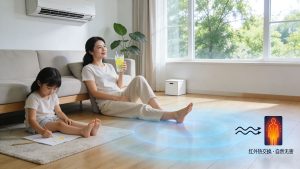
当阳光照进现实,我们该如何温暖一个家?
在全球“双碳”目标的大背景下,零碳住宅从概念走向现实的速度,比我们想象的更快。光伏板铺满了屋顶,储能电池挂上了墙壁,电动汽车停进了车库——一切看起来都很美好。
但是,有一个问题始终没有被真正解决:
房子的冷暖,怎么办?
夏天,光伏发电最旺盛的正午,家里却空无一人,空调白白把电送给电网,低价卖掉;晚上家人回来了,光伏下班了,却要从电网高价买电来制冷。冬天,光伏发的那点电根本带不动传统的电阻采暖或普通热泵,结果还是得烧煤、烧气。
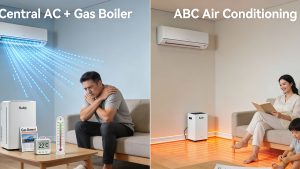
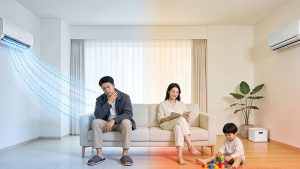
更糟心的是,普通空调吹得人头昏脑涨,脚底冰凉;空气能热泵一到-10℃就“气喘吁吁”,能效暴跌。
这就是今天“光伏家庭”的尴尬——发出来的电和用能的需求,在时间上错位;用能的方式和舒适的期待,在体验上错位。
要解决这对矛盾,需要的不是更便宜的光伏板,也不是更大的电池,而是一台真正能与光伏“对话”的空调。
这台空调,叫做ABC空调系统。
从“光伏发电”到“光伏用能”:关键的拼图是空调
在讲ABC空调之前,我们先看一组数据:
一个普通的三口之家,空调和采暖占家庭总用电量的 40%~60% 。如果是北方农村或者长江流域,冬天用空气能热泵采暖,这个比例甚至更高。
也就是说,家庭要实现“零碳”,最大的挑战不是照明、不是冰箱、不是电视,而是冷暖。
光伏发出来的电,如果不能被高效地用在冷暖上,那么要么浪费(低价上网),要么靠储能电池(成本高昂,寿命有限)。而传统空调和热泵,恰恰是最不适合直接匹配光伏的电器——
- 它们需要稳定的功率输入,而光伏是波动的;
- 它们没有储能能力,电发出来就得立刻用掉,否则就浪费;
- 它们在部分负荷下效率不高,而光伏经常是“中午多、早晚少”;
- 它们在极端天气下(极热、极寒)性能衰减,而极端天气恰恰是光伏发电最不稳定的时期。
于是,一个看似矛盾实则合理的结论浮现出来:
零碳住宅的真正瓶颈,不是光伏,而是空调。
而打破这个瓶颈的钥匙,就是ABC空调系统——一台天生为“光伏+储能+舒适”而生的热泵空调。
ABC空调:一台会“储能的空调”
什么是ABC空调系统?我们再用最简单的语言复习一次。
A = Air-source unit,传统的空气能室外机(热泵主机)
B = Buddy unit,空调伴侣(国家实用新型专利 ZL 2021 2 1195781.6)
C = Conditioning unit,传统的室内机(风盘)
普通空调,冷媒只走一条路:室外机 ↔ 室内机。
ABC空调,冷媒多了一条路:室外机 → 空调伴侣 → 室内机(制热时),或者室外机 → 室内机 → 空调伴侣(制冷时)。
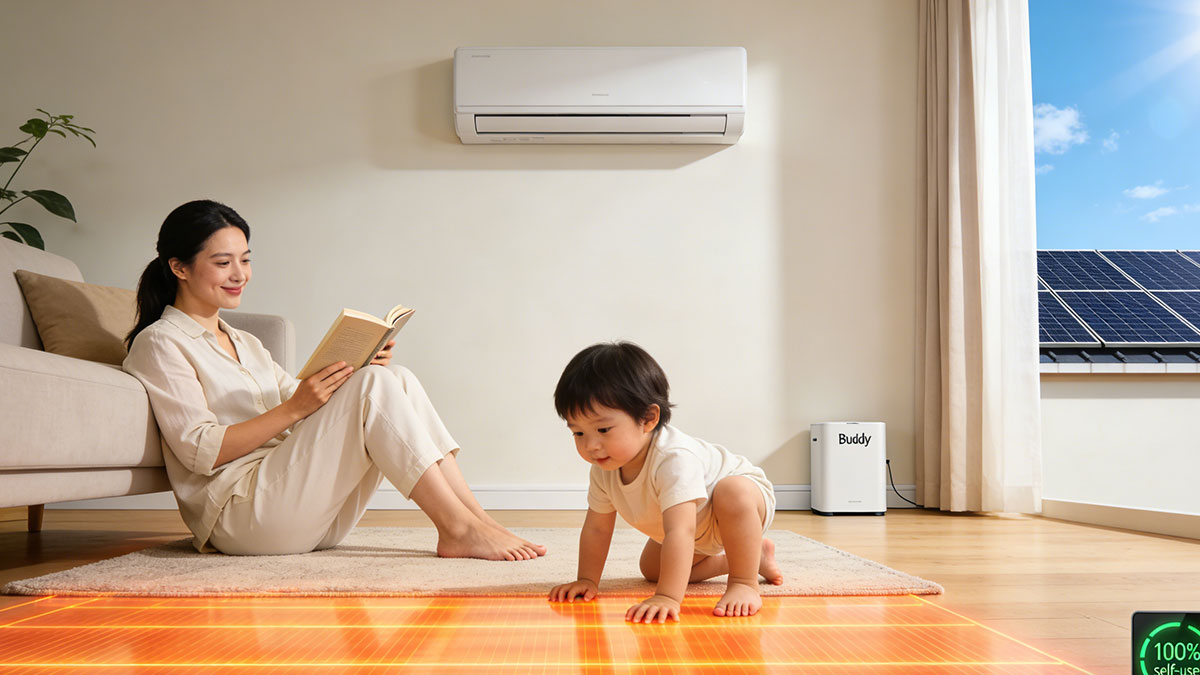
而空调伴侣连接着铺在地板下的PE水管网。
就这么一个看似简单的改变,带来了三个革命性的能力:
1. 地板变成了“温度电池”
普通空调没有储能能力。开,就冷/热;关,就恢复。
ABC空调的地板辐射末端,本身就是巨大的储能体。冬天,热水流过地板,地板升温,即使室外机停机,地板还能持续散热好几个小时。夏天,冷水流过地板,地板降温,同样可以长时间保持凉爽。
这个“地板电池”的热容量,相当于 10~20 kWh 的电化学储能电池,但成本只有后者的十分之一,寿命超过50年,而且不占用额外的空间。
2. 能效天生就高
由于空调伴侣的存在,系统在制热时过冷度大幅提升,在制冷时过热度优化到最佳区间。结果是:同样一度电,ABC空调比普通热泵空调多搬 20%~30% 的热量。
这意味着,同样一块光伏板发的电,用ABC空调能换来更多的冷暖。
3. 极端天气不腿软
普通空气能热泵在-10℃以下,制热能力断崖式下跌。ABC空调因为过冷度大、冷凝面积等效增加,即使在-20℃,依然能稳定制热,能效远高于普通机型。
这在冬季阴天、光伏发电不足的时候尤其重要——有限的电能,要发挥出最大的供暖效果。
光伏 + ABC:一张完美的“时间-能量”拼图
现在,我们把光伏和ABC空调放在一起,看看会发生什么奇妙的化学反应。
场景一:夏季白天
正午12点,阳光暴烈,光伏发电达到巅峰——5kW。但家里没有人,不需要制冷。
普通空调:要么不开,电白白上网(每度电只卖3毛钱);要么开,但人不在,浪费。
ABC空调:系统自动进入“储能制冷”模式。空调伴侣启动,水泵循环,冷量不往室内机送(或者少量送),而是全部存进地板下的冷水管网。地板温度从26℃降到22℃,像一个巨大的“冷库”。这个过程持续2~3小时,消耗约4~5度电,全部来自光伏自发电。
傍晚6点,家人回家。室外依然炎热,但地板已经储存了充足的冷量。室内机只需低风量辅助循环,整个房间立刻凉爽宜人。此时光伏已经下班,但ABC空调几乎不用从电网取电,因为地板里的冷量足够支撑到深夜。
结果:光伏自用率从30%提升到80%以上,晚上几乎零电费。
场景二:冬季白天
冬天,光伏发电量可能只有夏天的1/3,但供暖需求却很大。普通热泵空调在低温下能效低,光伏电根本不够用。
ABC空调怎么做?它首先利用地板辐射供暖,水温只需要35℃(传统暖气片要70℃),热泵在低温热水工况下能效极高(COP可达4.0以上)。光伏发的每一度电,都能产生4度电当量的热量。
同时,地板本身蓄热。白天光伏发电时,系统把地板加热到28℃~30℃,即使下午4点后光伏没电了,地板还在持续放热,一直暖到半夜。深夜低谷电价时,再少量补电维持。
结果:整个冬季,光伏满足供暖用电的70%~90%,真正接近零碳供暖。
场景三:极端天气 + 电网波动
冬天寒潮来袭,连续阴天,光伏几乎为零。普通空气能热泵可能直接停机或效率极低。
ABC空调凭借其低温强热能力,依然可以以较高的COP运行。同时,系统可以自动切换策略:优先保证地板辐射供暖(因为辐射对人体的舒适贡献最高),用有限的电能维持基础室温。如果短时停电,地板的热惯性可以让房间在2~3小时内降温不超过2℃。
如果电网有峰谷电价,ABC空调还可以在夜间低谷电价时提前储热,白天高峰时段几乎不耗电。
结果:不仅零碳,还省钱,还能应对电网不稳定。
为什么说这是“终极方案”?
1. 它解决了光伏最大的痛点——自用率
光伏自用率低,是因为发电和用电时间错配。ABC空调通过地板储能,把“时间错配”变成了“时间平移”。白天发的电,变成地板里的热或冷,晚上用。不需要昂贵的电池,就能实现光伏电力的“时移”。
2. 它比电池更划算、更耐用
一个10kWh的家用储能电池,成本约1.5~2万元,寿命8~10年。而ABC空调的地板辐射系统,增加的PE管和分集水器成本不过3000~5000元,寿命超过50年,而且不占用额外空间。从全生命周期看,储能成本只有电池的十分之一。
3. 它让“零碳”变得有收益
很多家庭装光伏,是因为有补贴或能卖电。但卖电价格越来越低,未来可能低至0.1~0.2元/度。而用ABC空调自己消纳光伏电,节约的电费按0.5~0.8元/度计算,经济性远超卖电。自发自用,才是光伏的真正价值。
4. 它同时实现了“舒适”与“低碳”
过去,低碳往往意味着牺牲舒适——少开空调,多穿衣服。但ABC空调不是这样。无风感空调的体验、脚暖头凉的辐射舒适、极低噪音的运行,让用户在不牺牲任何生活质量的前提下,实现了低碳。这才是可持续的零碳路径。
从“节能产品”到“能源系统”的跃迁
ABC空调不仅仅是一台冷暖空调,它本质上是家庭能源互联网的调度枢纽。
当光伏发电富余时,它把电能转化为地板的冷/热储存起来;当光伏不足时,它释放储存的冷/热;当电网电价低时,它储热/冷;当电网电价高时,它用储存的能量维持室温。
如果再进一步,ABC空调还可以与智能电表、天气预报、用户行为习惯联动,实现全自动的能源优化。它甚至可以作为“虚拟电厂”的一部分,在电网需要时主动减少用电或反向供电(通过提前储热/冷实现负荷转移)。
这就是为什么我们说:光伏+ABC,是零碳住宅的终极能源解决方案。
它把三个原本各自为战的要素——光伏发电、建筑储能、高效热泵——整合成了一个有机的整体。它不是加法,而是乘法。
一个普通家庭的真实账本
假设一个120平米的住宅,位于长江流域(夏热冬冷),年冷暖用电约6000度。安装5kW光伏,年发电约5000度。
方案一:普通空调 + 光伏余电上网
- 光伏自用率约30%,自用1500度(节省电费约900元),余电3500度上网(收入约350元)。
- 年电费支出:6000度 × 0.6元/度 = 3600元,减去光伏收益1250元,实际支出2350元。
- 舒适度:普通,有风感,冬天头热脚冷。
方案二:ABC空调 + 光伏 + 地板储能
- 光伏自用率提升到80%,自用4000度(节省电费2400元),余电1000度上网(收入约100元)。
- 因ABC空调能效比普通空调高25%,年冷暖用电从6000度降至4800度。
- 年电费支出:4800度 × 0.6元/度 = 2880元,减去光伏收益2500元,实际支出380元。
- 舒适度:无风感,脚暖头凉,四季如春。
结论:每年电费从2350元降到380元,节省近2000元。同时,家里再也不用忍受空调直吹的痛苦。
未来已来,只是尚未普及
二十年前,人们觉得家用光伏是天方夜谭;十年前,人们觉得储能电池太贵;今天,光伏已经走进了千家万户,电池也在快速降价。
而ABC空调系统,正站在同样的历史节点上。它不是科幻,它已经有了国家专利,已经完成了原理验证,已经具备了量产的条件。它所需要的,只是让更多人知道:原来空调还可以这样。
正如我们两千年来的居住演变——从洞穴到土房,从土房到砖瓦,从砖瓦到现代化的高楼——每一次跨越,都是对“舒适”与“能量”关系的重新理解。
今天,我们正站在第四次跨越的门槛上:从“热量搬运”到“无感智慧调节”,从“用能”到“储用一体”。
而光伏+ABC,就是这次跨越的终极答案。
结语:阳光下的家,应该是温暖且温柔的
光伏板吸收太阳的能量,ABC空调用这能量,温柔地呵护着家中的每一个人。
没有强风,没有干燥,没有忽冷忽热。地板是温的,空气是静的,电费是低的,碳排放是近乎为零的。
这不是未来,这是现在就可以拥有的现实。
记住这个名字:ABC空调系统。
A(室外机)+ B(空调伴侣)+ C(室内机)= 零碳住宅的终极拼图。
(本文基于国家实用新型专利 ZL 2021 2 1195781.6 及发明专利申请 202510997961.2 撰写。)
关键词列表
空调, ABC空调系统, 空调伴侣, 无风感空调, 空调采暖, 空调连地暖, 冷暖空调, 热泵空调, 空气能, 热泵, 分体式空调, 辐射空调, 零碳住宅, 光伏储能, 空气能热泵, 地暖空调, 两联供, 热泵采暖, 虚拟电厂, 建筑节能
Photovoltaics + ABC: The Ultimate Energy Solution for Zero-Carbon Homes
When Sunlight Meets Reality, How Do We Warm a Home?
Against the backdrop of global carbon neutrality goals, zero-carbon homes are moving from concept to reality faster than we imagine. Photovoltaic panels cover rooftops, battery storage units hang on walls, and electric vehicles park in garages—everything looks promising.
But there is one problem that has never been truly solved:
What about heating and cooling?
At noon in summer, when PV generation peaks, the house is empty. The air conditioner sends electricity to the grid at a low price. In the evening, when the family returns, the PV has stopped working, and they have to buy expensive grid electricity for cooling. In winter, the limited PV electricity can barely drive traditional resistance heating or ordinary heat pumps, so people still burn coal or gas.
Worse, ordinary air conditioners blow air that gives you a headache and leaves your feet cold. Air source heat pumps struggle when the temperature drops below -10°C, with efficiency plummeting.
This is the dilemma of today’s “PV home” — a mismatch between power generation and energy demand, and a disconnect between energy use and comfort expectations.
To solve this contradiction, we don’t need cheaper PV panels or larger batteries. We need an air conditioner that can truly “talk” to PV.
That air conditioner is called the ABC Air Conditioning System.
From “PV Generation” to “PV Utilization”: The Missing Piece Is Air Conditioning
Before we explain ABC air conditioning, let’s look at some data:
In an average three-person household, air conditioning and heating account for 40%–60% of total electricity consumption. In northern rural areas or the Yangtze River region, where air source heat pumps are used for winter heating, this percentage is even higher.
This means that the biggest challenge for a zero-carbon home is not lighting, not refrigerators, not TVs — it’s heating and cooling.
If the electricity generated by PV cannot be efficiently used for heating and cooling, it is either wasted (sold to the grid at low prices) or stored in expensive batteries with limited lifespans. Traditional air conditioners and heat pumps are precisely the least suitable appliances for direct PV integration —
- They require stable power input, while PV output fluctuates.
- They have no storage capability; electricity must be used immediately or wasted.
- They have low efficiency at partial loads, while PV output often peaks at noon and drops in the morning/evening.
- Their performance degrades in extreme weather, precisely when PV generation is most unreliable.
Thus, a paradoxical but logical conclusion emerges:
The real bottleneck for zero-carbon homes is not PV — it’s air conditioning.
And the key to breaking this bottleneck is the ABC Air Conditioning System — a heat pump air conditioner born for “PV + storage + comfort.”
ABC Air Conditioning: An Air Conditioner That Stores Energy
What is the ABC Air Conditioning System? Let’s review it in the simplest terms.
A = Air-source unit (traditional outdoor heat pump unit)
B = Buddy unit (Air Conditioner Buddy, National Utility Model Patent ZL 2021 2 1195781.6)
C = Conditioning unit (traditional indoor fan coil unit)
In a conventional air conditioner, the refrigerant flows only one way: outdoor unit ↔ indoor unit.
In ABC air conditioning, the refrigerant has an additional path: outdoor unit → Buddy unit → indoor unit (heating mode), or outdoor unit → indoor unit → Buddy unit (cooling mode).
The Buddy unit connects to a PE pipe network embedded under the floor.
This seemingly simple change brings three revolutionary capabilities:
1. The Floor Becomes a “Thermal Battery”
Conventional air conditioners have no storage capacity. When on, they heat/cool; when off, they stop.
The floor radiation terminal of ABC air conditioning is itself a massive thermal storage medium. In winter, hot water flows through the floor, warming it. Even if the outdoor unit shuts down, the floor continues to radiate heat for hours. In summer, chilled water cools the floor, providing long-lasting coolness.
This “floor battery” has a thermal capacity equivalent to 10–20 kWh of electrochemical storage, yet costs only a fraction, lasts over 50 years, and takes up no extra space.
2. Inherently Higher Efficiency
Thanks to the Buddy unit, the system achieves significantly higher subcooling in heating mode and optimized superheating in cooling mode. The result: with the same kilowatt-hour, ABC air conditioning moves 20%–30% more heat than an ordinary heat pump air conditioner.
That means the same PV panel generates more heating/cooling when paired with ABC.
3. Unfazed by Extreme Weather
Ordinary air source heat pumps suffer a sharp drop in heating capacity below -10°C. ABC air conditioning, with its increased subcooling and equivalent condensing area, maintains stable heating even at -20°C, with far better efficiency than conventional models.
This is critical on overcast winter days when PV generation is low — every kilowatt-hour must deliver maximum heating effect.
PV + ABC: A Perfect Time-Energy Puzzle
Now let’s put PV and ABC together and see the magic.
Scenario 1: Summer Daytime
Noon, scorching sun, PV generation peaks at 5kW. But no one is home. Cooling is not needed.
Conventional air conditioner: either off (electricity sold cheaply) or on (wasted).
ABC Air Conditioning: The system automatically enters “storage cooling” mode. The Buddy unit activates the pump, and instead of sending all cooling to the indoor unit, most of it is stored in the chilled water pipe network under the floor. The floor temperature drops from 26°C to 22°C, acting like a giant cold reservoir. This lasts 2–3 hours, consuming about 4–5 kWh, all from PV self-generation.
At 6 PM, the family returns. The outdoor heat is still intense, but the floor has stored ample cooling. The indoor unit only needs low fan speed to circulate. The room is instantly comfortable. The PV has stopped, but ABC air conditioning draws almost nothing from the grid, as the floor’s coolness lasts well into the night.
Result: PV self-consumption rate rises from 30% to over 80%, with near-zero evening electricity bills.
Scenario 2: Winter Daytime
In winter, PV generation may be only one-third of summer’s, but heating demand is high. Ordinary heat pump air conditioners have low efficiency at low temperatures, and PV electricity is insufficient.
What does ABC Air Conditioning do? It prioritizes floor radiant heating, requiring water temperature of only 35°C (compared to 70°C for traditional radiators). The heat pump operates at extremely high efficiency (COP above 4.0) under low-temperature water conditions. Every kilowatt-hour from PV produces 4 kWh-equivalent of heat.
Moreover, the floor stores heat. During the day, the system heats the floor to 28–30°C. Even after 4 PM when PV stops, the floor continues radiating heat well into the night. Late at night, a small top-up using off-peak grid electricity maintains warmth.
Result: Over winter, PV meets 70–90% of heating electricity demand, approaching zero-carbon heating.
Scenario 3: Extreme Weather + Grid Fluctuations
A winter cold snap with continuous overcast days leaves PV output near zero. An ordinary air source heat pump may shut down or operate at very low efficiency.
ABC air conditioning, with its low-temperature heating capability, continues running at a respectable COP. The system can automatically switch strategy: prioritize floor radiation (which contributes most to comfort) and use limited electricity to maintain baseline indoor temperature. If a short power outage occurs, the floor’s thermal inertia keeps the room temperature from dropping more than 2°C over 2–3 hours.
If the grid has time-of-use pricing, ABC can pre-store heat during cheap nighttime hours and consume almost no electricity during expensive peak hours.
Result: Not only zero-carbon but also cost-saving and resilient to grid instability.
Why Is This the “Ultimate Solution”?
1. It Solves PV’s Biggest Pain Point — Self-Consumption Rate
Low PV self-consumption is due to a time mismatch between generation and usage. ABC air conditioning, through floor storage, turns “time mismatch” into “time shifting.” Daytime PV electricity becomes stored heat or coolness in the floor, available at night. No expensive battery needed — time-shifting of PV electricity is achieved.
2. It’s Cheaper and More Durable Than Batteries
A 10kWh home battery costs about 1,500–2,000 USD and lasts 8–10 years. The floor radiation system added to ABC air conditioning — PE pipes and manifolds — costs only 300–500 USD and lasts over 50 years, taking up no extra space. Over its lifecycle, the storage cost is about one-tenth that of a battery.
3. It Makes “Zero-Carbon” Profitable
Many households install PV because of subsidies or feed-in tariffs. But feed-in prices are dropping and may fall to 0.01–0.02 USD/kWh. Using ABC air conditioning to self-consume PV electricity saves 0.05–0.08 USD/kWh (retail electricity price). Self-consumption, not selling, is the true value of PV.
4. It Simultaneously Delivers Comfort and Low Carbon
In the past, low carbon often meant sacrificing comfort — using less air conditioning, wearing more clothes. ABC air conditioning is different. Draft-free comfort, radiant warmth from the floor, whisper-quiet operation — users achieve low carbon without compromising their quality of life. That’s the only sustainable path to zero-carbon.
From “Energy-Efficient Product” to “Energy System”
ABC air conditioning is not just a heating and cooling air conditioner; it is fundamentally the dispatch hub of a home energy internet.
When PV generation is surplus, it converts electricity into stored heat/cool in the floor. When PV is insufficient, it releases stored heat/cool. When grid electricity prices are low, it stores heat/cool. When prices are high, it uses stored energy to maintain comfort.
Going further, ABC can integrate with smart meters, weather forecasts, and user behavior patterns for fully automated energy optimization. It can even act as part of a “virtual power plant,” reducing demand or shifting load when the grid needs it (by pre-storing heat/cool).
That’s why we say: PV + ABC is the ultimate energy solution for zero-carbon homes.
It integrates three previously separate elements — PV generation, building thermal storage, and high-efficiency heat pump — into one organic whole. This is not addition; it’s multiplication.
A Real Household’s Numbers
Consider a 120 m² home in the Yangtze River region (hot summer, cold winter), with annual heating/cooling electricity consumption of 6,000 kWh. Install 5kW of PV, annual generation about 5,000 kWh.
Option 1: Ordinary air conditioner + PV surplus fed to grid
- PV self-consumption rate ~30%, self-use 1,500 kWh (saving ~$135), surplus 3,500 kWh fed to grid (income ~$35).
- Annual electricity cost: 6,000 kWh × $0.09/kWh = $540, minus PV benefit $170 = $370 net cost.
- Comfort: ordinary, drafty, hot head and cold feet in winter.
Option 2: ABC air conditioner + PV + floor storage
- PV self-consumption rate increases to 80%, self-use 4,000 kWh (saving $360), surplus 1,000 kWh fed to grid (income $10).
- Due to ABC’s 25% higher efficiency, annual heating/cooling consumption drops from 6,000 kWh to 4,800 kWh.
- Annual electricity cost: 4,800 kWh × $0.09 = $432, minus PV benefit $370 = $62 net cost.
- Comfort: draft-free, warm feet cool head, spring-like all year.
Conclusion: Annual electricity cost drops from $370 to $62, saving over $300. Plus, no more suffering from direct drafts.
The Future Is Here, Just Not Evenly Distributed
Twenty years ago, residential PV seemed like science fiction. Ten years ago, batteries were too expensive. Today, PV is on millions of rooftops, and batteries are rapidly falling in price.
The ABC Air Conditioning System stands at the same historic juncture. It is not science fiction. It has national patents, proven principles, and is ready for mass production. All it needs is for more people to know: air conditioning can be this way.
Just as our living environments have evolved over two millennia — from caves to mud houses, from mud houses to brick, from brick to modern high-rises — each leap has been a new understanding of the relationship between “comfort” and “energy.”
Today, we stand at the threshold of the fourth leap: from “heat moving” to “imperceptible intelligent regulation,” from “energy using” to “integrated storage and use.”
And PV + ABC is the ultimate answer for this leap.
Conclusion: A Home Under the Sun Should Be Warm and Gentle
PV panels absorb the sun’s energy, and ABC air conditioning uses that energy to gently care for everyone in the home.
No strong drafts, no dryness, no sudden temperature swings. The floor is warm, the air is still, the electricity bill is low, and carbon emissions are near zero.
This is not the future. This is a reality you can have now.
Remember the name: ABC Air Conditioning System.
A (outdoor unit) + B (Air Conditioner Buddy) + C (indoor unit) = The ultimate piece of the zero-carbon home puzzle.
(This article is based on National Utility Model Patent ZL 2021 2 1195781.6 and Invention Patent Application 202510997961.2.)
Keyword List
air conditioner, ABC air conditioning system, air conditioner buddy, draft-free air conditioner, air conditioning heating, air conditioning connected to underfloor heating, heating and cooling air conditioner, heat pump air conditioner, air source energy, heat pump, split-type air conditioner, radiant air conditioning, zero-carbon home, PV storage, air source heat pump, underfloor heating air conditioner, two-in-one system, heat pump heating, virtual power plant, building energy efficiency