一把蒲扇的回忆
我奶奶有一把蒲扇,棕黄色,边缘用布条包了一圈。她用了四十多年。
小时候夏天停电,她就坐在竹椅上,摇着蒲扇给我扇风。风不大,但很温柔。我问她:“奶奶,你怎么不用电风扇?”她笑:“风扇的风太硬,吹得头疼。蒲扇的风是活的,知道往哪儿扇。”
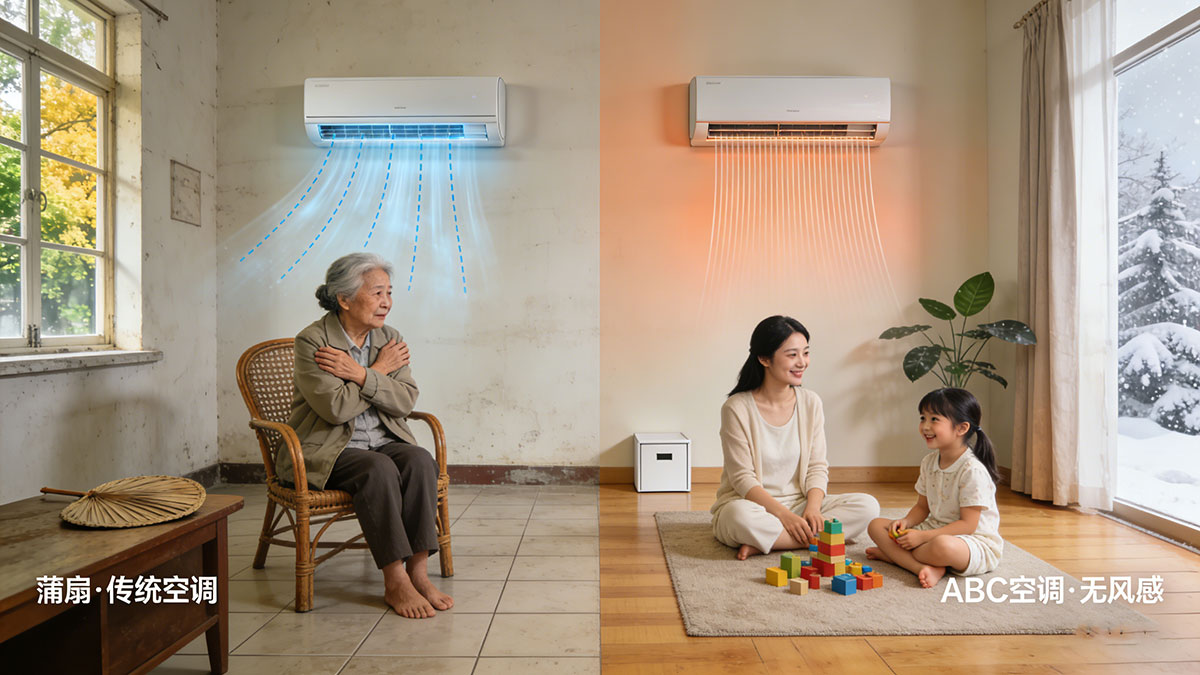
后来我长大了,家里装了空调。奶奶第一次感受到冷气时,眼睛瞪得圆圆的:“这盒子比蒲扇厉害多了!”可她住了两天就说:“这风太凉了,肩膀受不了。”于是她把空调温度调高,又拿起了蒲扇。
那时候我不理解——明明有冷暖空调,为什么还要用蒲扇?
直到二十多年后的今天,我自己也开始在夏天躲着空调的出风口,我才明白奶奶说的“风太硬”是什么意思。
而现在,当我第一次体验ABC空调系统时,我突然想到了奶奶和她的蒲扇。
我想,再过二十年,我们回忆今天的空调,大概就像今天我们看蒲扇一样——带着一丝怀念,又带着一丝庆幸:终于不用再被风吹了。
从蒲扇到空调:人类对抗温度的简史
在空调发明之前,人类对抗炎热和寒冷的方式,本质上只有两种:忍,或者扇。
蒲扇、折扇、团扇——扇出来的风,是人的力气换来的。手停了,风就停了。
后来有了电风扇,风不再需要人力,但它依然是风。吹在皮肤上,带走水分,留下干燥和不适。再后来,窗式空调出现了,再后来是分体式空调。我们终于可以在夏天制造“冷”,在冬天制造“热”。
这当然是一个巨大的进步。
但是,进步的同时,我们也被困在了“吹风”这个模式里。
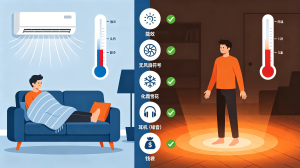
空调采暖时,热风往上飘,头热脚冷,皮肤干燥,嗓子冒烟。冷暖空调制冷时,冷风直吹,肩膀酸痛,膝盖发凉。晚上睡觉,要么被风吹醒,要么被热醒。电费单来了,心里更凉。
我们管这叫“空调病”,然后安慰自己:总比没有空调强吧?
是的,比没有强。但这就是终点了吗?
二十年后的某一天,一场对话
2046年,一个普通的夏夜。
我儿子小宇带着他的女儿来我家吃饭。小宇今年三十出头,在一家建筑事务所做设计。他女儿朵朵五岁,光着脚在地板上跑来跑去。
朵朵跑到墙边,指着一台老式分体式空调的室内机,好奇地问:“爸爸,这是什么呀?”
小宇看了一眼,说:“那是老古董,叫空调。你太爷爷那辈人用的。”
“什么是空调?”
“就是……一个会吹冷风的机器。夏天的时候,它从那个口子里吹出很冷的风,把房间弄凉快。”
朵朵歪着头:“那风不会吹得人难受吗?”
小宇笑了:“会的。所以他们那时候夏天都躲着空调吹,肩膀上搭条毛巾,晚上睡觉要盖很厚的被子,怕被风吹着凉。”
朵朵一脸不可思议:“那他们为什么不铺地冷呢?地板凉凉的,又没风,多舒服啊。”
小宇摸了摸她的头:“因为那时候还没有ABC空调系统啊。你从出生起就用空调连地暖,当然不知道吹风有多难受。”
朵朵想了想,又问:“那他们冬天怎么办?”
“冬天更惨。”小宇说,“热风从上面吹下来,头顶热得冒汗,脚底下还是凉的。而且空调一化霜,还会突然吹一阵冷风。”
朵朵皱起眉:“好可怜。还好我们现在的无风感空调不用吹风。”
我在旁边听着,没有说话,但心里翻涌。
二十年前,我写过一篇文章,标题是《二十年后,我们如何回忆现在的空调?就像我们现在看蒲扇一样》。
没想到,今天这一幕,真的发生了。
我们的“现在”,正在成为“过去”
朵朵不理解“吹风的空调”,就像我小时候不理解奶奶的蒲扇。
一代人觉得理所当然的技术,在下一代人眼里,可能是落后、粗糙甚至不可理喻的。
我们看蒲扇:手摇,风小,累人。
二十年后的孩子看今天的分体式空调:强风,干燥,温度不均,化霜偷袭,电费高。
这不是他们矫情,而是技术真的进步了。
今天的ABC空调系统,就是那个让“吹风式空调”变成“老古董”的技术。
什么是ABC空调?三个字母,一场革命
ABC空调系统,全称“基于空调伴侣的耦合式辐射空调系统”。
三个字母代表:
- A = Air-source unit,传统的空气能室外机(热泵主机)
- B = Buddy unit,空调伴侣(国家实用新型专利 ZL 2021 2 1195781.6)
- C = Conditioning unit,传统的室内机(风盘)
听起来复杂?其实核心就一句话:
普通空调只会吹风,ABC空调还会“铺地”。
怎么做到的?它在传统分体式空调的基础上,增加了一个叫“空调伴侣”的模块。这个伴侣把冷媒回路和铺在地板下的PE水管网连接起来。
于是,ABC空调系统有了两种“输出”方式:
- 对流:室内机吹风(和普通空调一样),快速升温或降温。
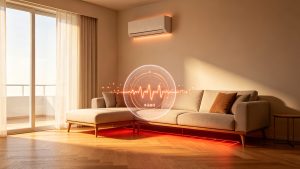
- 辐射:地板下的水管网散热或散冷,温柔、均匀、没有风感。
更重要的是,地板本身成了一个巨大的“温度电池”。冬天储热,夏天储冷。即使室外机关机,地板还能持续释放冷热好几个小时。
这就是空调连地暖的真正形态——不是两套系统,而是一套系统,两种模式,协同工作。
为什么说它是“终结者”?五个无法拒绝的理由
1. 没有风感,告别“空调病”
这是最直观的区别。
普通冷暖空调,不管你怎么调,风总是要吹出来的。冷风直吹肩膀,热风烤得脸干。ABC空调系统的辐射模式,完全不依赖空气流动。热量或冷量从地板均匀地辐射上来,你只感觉到温度的变化,感觉不到风的流动。
冬天,光脚踩在地板上,暖意从脚底升上来。夏天,地板凉而不冰,整个房间像被清凉的空气包裹,却没有一丝风。
你终于可以睡一个不被风吹醒的觉。
2. 温度均匀,没有“头热脚冷”
普通空调采暖,热空气轻,全往天花板跑。你坐在沙发上,头顶28℃,脚踝18℃。ABC空调系统的辐射采暖,热量从地面向上辐射,脚最暖,头稍凉——这恰恰是人体最舒适的垂直温差分布。
夏天也一样。冷空气重,普通空调的冷风往下沉,脚冷头热。ABC的辐射供冷,冷量从地面均匀向上,头凉脚不冷,舒服。
3. 极端天气不腿软
普通热泵空调在-10℃以下,制热能力断崖式下跌。ABC空调因为热力学循环被优化(过冷度大幅提升),即使在-20℃,依然能稳定制热,能效远高于普通机型。
夏天超过43℃,普通空调制冷效率暴跌。ABC空调同样因为过热度的优化,保持高效运行。
4. 化霜不吹冷风,无声无感
传统空调冬天化霜时,四通阀反向,室内机会突然吹一阵冷风。你正窝在沙发上看电视,一阵凉风袭来,美好心情瞬间打折。
ABC空调化霜时,可以只从地板里“借用”热量。空调伴侣启动水泵,把地板储存的热量送到室外机化霜。室内机全程不吹风,你甚至感觉不到系统正在化霜。
5. 能效更高,电费更低
由于两级换热的设计,ABC空调在制冷时过热度更优,制热时过冷度更大,单位电能的冷/热产出比普通空气能热泵高出20%~30%。
这意味着同样的电费,你换来的是更多的舒适,或者同样的舒适,更少的电费。
如果配上光伏:零碳不是梦
ABC空调的地板储能特性,让它成为光伏发电的绝配。
白天光伏发电最猛的时候,系统把电能转化为冷或热,存进地板。晚上光伏下班了,地板释放储存的能量,维持室温。你几乎不用从电网买电。
这比任何电池都划算——地板储能的成本只有电池的十分之一,寿命超过50年。
二十年后的家,屋顶是光伏,地板是储能,ABC空调系统是调度中心。能源自给自足,舒适无风无声。
那时候的人再看我们今天“白天关空调、晚上开空调”的习惯,大概会觉得像我们看蒲扇一样——原始,又可爱。
二十年后,我们如何回忆现在?
2046年,我的孙女朵朵长大了,成了一名建筑设计师。
有一天她回来跟我说:“爷爷,我今天去参观了一个老房子,里面还装着那种老式分体式空调。我试了一下,那风吹得我浑身不舒服。你们当年是怎么忍过来的?”
我想了想,说:“因为我们不知道还有更好的。”
就像奶奶当年不知道空调是什么,她用了一辈子蒲扇。我们当年不知道ABC空调系统是什么,我们忍了一辈子吹风。
技术进步的意义,不是让生活更复杂,而是让生活更简单、更舒服。
ABC空调系统的出现,不是给空调加了一个功能,而是重新定义了“空调”应该是什么样子——它不应该是一个吹风的机器,而应该是一个无声、无风、无感的温度管家。
从蒲扇到ABC,我们走了多久?
- 蒲扇:几千年。
- 电风扇:一百多年。
- 窗式空调:一百年。
- 分体式空调:五十年。
- ABC空调系统:就在今天。
每一次跨越,都是人类对“舒适”理解的升级。从“有风就行”,到“冷热就行”,再到“无风、均匀、储能、智慧”。
而我们现在正站在第三次跨越的起点。
再过二十年,当ABC空调系统普及到千家万户,当孩子们从小就在无风感、温度均匀、静音运行的环境里长大,他们回看我们今天用的空调,一定会问:
“你们当年是怎么忍过来的?”
而我们能回答的,只有一句话:
“因为我们那时候,还不知道ABC。”
你的家,什么时候进化?
写到这里,我想起奶奶的那把蒲扇。
它现在还挂在我书房的墙上。每次看到它,我都会想起那个夏天,奶奶摇着扇子,说“风扇的风太硬”。
现在我终于明白了她说的“硬”是什么意思。那是未经处理的、粗暴的、不考虑人体感受的风。
今天的空调,某种意义上,就是电风扇的升级版——风更冷了,更热了,但本质上还是“吹风”。
而ABC空调系统,是第一次真正跳出“吹风”这个框架。它用辐射的方式,把温度交给地板,把风感还给自然。
二十年后的某一天,当你光着脚踩在温润的地板上,看着窗外大雪纷飞,而你只穿一件单衣,你会想起今天这篇文章。
你会庆幸,自己选择了进化。
(本文基于国家实用新型专利 ZL 2021 2 1195781.6 及发明专利申请 202510997961.2 撰写。)
关键词列表
空调, ABC空调系统, 空调伴侣, 无风感空调, 空调采暖, 空调连地暖, 冷暖空调, 热泵空调, 空气能, 热泵, 分体式空调, 辐射空调, 五恒系统, 空气能热泵, 地暖空调, 两联供, 空调系统, 热泵采暖, 中央空调, 家用空调
Twenty Years From Now, How Will We Remember Today’s Air Conditioners? Just Like We Now See Palm Leaf Fans
Memories of a Palm Leaf Fan
My grandmother had a palm leaf fan, brownish-yellow, with a cloth strip wrapped around its edge. She used it for over forty years.
When I was a child during summer power outages, she would sit on a bamboo chair and fan me. The breeze was gentle, not harsh. I asked her, “Grandma, why don’t you use an electric fan?” She smiled and said, “The electric fan’s wind is too hard, it gives me a headache. A palm leaf fan’s wind is alive — it knows where to blow.”
Later I grew up, and we got an air conditioner. The first time my grandmother felt the cool air, her eyes widened. “This box is much more powerful than a palm leaf fan!” But after staying two days, she said, “This wind is too cold, my shoulders can’t take it.” So she turned up the temperature and picked up her palm leaf fan again.
Back then I didn’t understand — why use a palm leaf fan when you have a heating and cooling air conditioner?
It wasn’t until twenty years later, when I myself started avoiding the direct draft of air conditioners, that I understood what my grandmother meant by “the wind is too hard.”
And now, when I first experienced the ABC Air Conditioning System, I suddenly thought of my grandmother and her palm leaf fan.
I think, twenty years from now, when we look back on today’s air conditioners, it will be just like how we see palm leaf fans today — with a touch of nostalgia and a bit of relief: finally, no more being blown by wind.
From Palm Leaf Fan to Air Conditioner: A Brief History of Fighting Temperature
Before the air conditioner, humans had essentially two ways to fight heat and cold: endure, or fan.
Palm leaf fans, folding fans, round fans — the wind they made came from human effort. When the hand stopped, the wind stopped.
Then came electric fans. Wind no longer required human power, but it was still wind. It blew on the skin, taking moisture and leaving dryness and discomfort. Later came window air conditioners, then split-type air conditioners. Finally, we could produce “cold” in summer and “heat” in winter.
This was undoubtedly a huge step forward.
But along with progress, we became trapped in the “blowing air” paradigm.
With air conditioning heating, hot air rises, leaving your head hot and feet cold. Your skin dries, your throat hurts. With heating and cooling air conditioners in cooling mode, cold air blows directly on your shoulders, making them ache. At night, you’re either woken by the draft or by the heat. Then the electricity bill arrives, and your heart sinks even more.
We call this “air conditioner sickness” and console ourselves: it’s still better than having no air conditioner at all.
Yes, it’s better than nothing. But is this the end point?
Someday Twenty Years From Now, A Conversation
2046, an ordinary summer evening.
My son Xiaoyu brought his daughter to my house for dinner. Xiaoyu was in his early thirties, working as an architect. His daughter Duoduo was five, running around barefoot on the floor.
Duoduo ran to the wall, pointed at an old split-type air conditioner indoor unit, and asked curiously, “Dad, what’s this?”
Xiaoyu glanced at it. “That’s an antique, called an air conditioner. It’s what your great-grandfather’s generation used.”
“What’s an air conditioner?”
“It’s a machine that blows cold air. In summer, it blows very cold air from that vent to cool the room.”
Duoduo tilted her head. “Doesn’t the wind bother you?”
Xiaoyu smiled. “It did. So back then, people would avoid the air conditioner draft in summer, put a towel on their shoulders, and sleep under thick blankets at night to avoid catching a chill from the draft.”
Duoduo looked incredulous. “Then why didn’t they just use floor cooling? The floor is cool, no wind, so comfortable.”
Xiaoyu patted her head. “Because back then, there was no ABC Air Conditioning System. You’ve been using air conditioning connected to underfloor heating since you were born, so of course you don’t know how uncomfortable drafts are.”
Duoduo thought for a moment, then asked, “What about winter?”
“Winter was worse,” Xiaoyu said. “Hot air blew from above — your head would be sweaty, but your feet were still cold. And when the air conditioner defrosted, it would suddenly blow a burst of cold air.”
Duoduo frowned. “That’s so sad. I’m glad our draft-free air conditioner doesn’t need to blow air.”
I listened quietly, but my heart was churning.
Twenty years ago, I wrote an article titled “Twenty Years From Now, How Will We Remember Today’s Air Conditioners? Just Like We Now See Palm Leaf Fans.”
I never imagined this scene would actually come true.
Our “Present” Is Becoming “Past”
Duoduo couldn’t understand a “blowing air conditioner,” just as I couldn’t understand my grandmother’s palm leaf fan as a child.
What one generation takes for granted, the next generation may see as backward, crude, or even incomprehensible.
We look at palm leaf fans: hand-powered, weak breeze, tiring.
Children twenty years from now will look at today’s split-type air conditioners: strong drafts, dryness, uneven temperatures, defrost surprises, high electricity bills.
This isn’t their fussiness — it’s technological progress.
Today’s ABC Air Conditioning System is the technology that will turn “blowing air conditioners” into “antiques.”
What Is ABC Air Conditioning? Three Letters, One Revolution
The ABC Air Conditioning System stands for “Air Conditioner Buddy coupled radiant air conditioning system.”
The three letters represent:
- A = Air-source unit (traditional outdoor air source unit, the heat pump)
- B = Buddy unit (Air Conditioner Buddy, National Utility Model Patent ZL 2021 2 1195781.6)
- C = Conditioning unit (traditional indoor fan coil unit)
Sounds complicated? The core idea is simple:
Ordinary air conditioners only blow air. ABC also “covers the floor.”
How? It adds a module called the “Air Conditioner Buddy” to the traditional split-type air conditioner. This Buddy connects the refrigerant loop to a PE pipe network embedded under the floor.
Thus, the ABC Air Conditioning System has two ways to “output”:
- Convection: the indoor unit blows air (just like an ordinary air conditioner) for rapid heating or cooling.
- Radiation: the underfloor pipe network radiates heat or coolness — gentle, even, draft-free.
More importantly, the floor itself becomes a massive “thermal battery.” It stores heat in winter and coolness in summer. Even if the outdoor unit shuts down, the floor continues to release stored energy for hours.
This is the true form of air conditioning connected to underfloor heating — not two separate systems, but one system, two modes, working together.
Why Is It a “Terminator”? Five Irrefutable Reasons
1. No Draft — Goodbye to “Air Conditioner Sickness”
This is the most obvious difference.
With an ordinary heating and cooling air conditioner, no matter how you adjust it, air always blows. Cold air blasts your shoulders; hot air dries your face. The radiation mode of the ABC Air Conditioning System doesn’t rely on air movement at all. Heat or coolness radiates evenly from the floor. You only feel the temperature change — you don’t feel any air movement.
In winter, walk barefoot on the warm floor, and warmth rises from under your feet. In summer, the floor is cool but not cold, and the whole room feels wrapped in refreshing air without a single draft.
You can finally sleep without being woken by a draft.
2. Even Temperature — No More “Hot Head, Cold Feet”
With ordinary air conditioning heating, hot air is light and rises to the ceiling. You sit on the sofa — 28°C at head level, 18°C at your ankles. With ABC’s radiant heating, heat radiates upward from the floor. Your feet are warmest, your head slightly cooler — and that’s exactly the vertical temperature distribution most comfortable for the human body.
Summer is the same. Cold air is heavy; ordinary air conditioners blow cold air that sinks, leaving your feet cold and head hot. ABC’s radiant cooling sends coolness evenly upward — your head is cool, your feet not cold. Comfortable.
3. Unfazed by Extreme Weather
Ordinary heat pump air conditioners suffer a sharp drop in heating capacity below -10°C. ABC, thanks to its optimized thermodynamic cycle (greatly increased subcooling), maintains stable heating even at -20°C, with far higher efficiency than conventional models.
Above 43°C in summer, ordinary air conditioners lose cooling efficiency. ABC, with its optimized superheating, maintains high performance.
4. Defrosting Without Cold Drafts — Silent and Imperceptible
When a traditional air conditioner defrosts in winter, the four-way valve reverses, and the indoor unit suddenly blows a burst of cold air. You’re curled up on the sofa watching TV, and that cold blast ruins your mood.
When ABC defrosts, it can “borrow” heat only from the floor. The Air Conditioner Buddy activates the pump, sending stored floor heat to the outdoor unit for defrosting. The indoor unit doesn’t blow air at all. You might not even notice the system is defrosting.
5. Higher Efficiency, Lower Electricity Bills
Thanks to its two-stage heat exchange design, ABC has better superheating in cooling mode and greater subcooling in heating mode. Its energy output per kilowatt-hour is 20–30% higher than that of an ordinary air source heat pump.
That means the same electricity bill buys you more comfort — or the same comfort for a lower bill.
Paired with PV: Zero Carbon Is Not a Dream
The floor storage characteristic of ABC air conditioning makes it a perfect match for solar PV.
During the day, when PV generation peaks, the system converts electricity into stored heat or coolness in the floor. At night, when PV stops, the floor releases its stored energy to maintain room temperature. You barely draw any electricity from the grid.
This is far more cost-effective than any battery — the cost of floor storage is about one-tenth that of a battery, with a lifespan exceeding 50 years.
In the home of twenty years from now, PV on the roof, floor as storage, and the ABC Air Conditioning System as the dispatch center. Energy self-sufficient, comfort draft-free and silent.
People then, looking back at our habit of “turning off the air conditioner during the day and turning it on at night,” will probably find it as quaint as we find palm leaf fans today — primitive, yet endearing.
Twenty Years From Now, How Will We Remember Today?
- My granddaughter Duoduo has grown up and become an architect.
One day she came back and told me, “Grandpa, today I visited an old house that still had those old split-type air conditioners installed. I tried it — the draft was so uncomfortable. How did you people back then tolerate it?”
I thought for a moment and said, “Because we didn’t know there was anything better.”
Just as my grandmother didn’t know what an air conditioner was and used a palm leaf fan her whole life. We didn’t know what the ABC Air Conditioning System was, so we endured drafts our whole lives.
The meaning of technological progress is not to make life more complicated, but to make it simpler and more comfortable.
The ABC Air Conditioning System doesn’t just add a feature to an air conditioner — it redefines what an air conditioner should be. It shouldn’t be a machine that blows air, but a silent, draft-free, imperceptible temperature butler.
From Palm Leaf Fan to ABC: How Long Have We Come?
- Palm leaf fan: thousands of years.
- Electric fan: over a hundred years.
- Window air conditioner: a hundred years.
- Split-type air conditioner: fifty years.
- ABC Air Conditioning System: today.
Each leap represents an upgrade in humanity’s understanding of “comfort.” From “airflow is enough” to “hot/cold is enough” to “draft-free, even, storage, intelligent.”
And we now stand at the starting point of the third leap.
Twenty years from now, when the ABC Air Conditioning System has spread to millions of homes, when children grow up in draft-free, even-temperature, silent environments, they will look back at the air conditioners we use today and ask:
“How did you people back then tolerate it?”
And all we can answer is:
“Because back then, we didn’t know about ABC yet.”
When Will Your Home Evolve?
As I write this, I think of my grandmother’s palm leaf fan.
It still hangs on the wall of my study. Every time I see it, I remember that summer when my grandmother waved the fan and said, “The electric fan’s wind is too hard.”
Now I finally understand what she meant by “hard.” It’s the untreated, crude wind that doesn’t consider human comfort.
Today’s air conditioners, in a sense, are just upgraded electric fans — the air is colder or hotter, but it’s still essentially “blowing air.”
The ABC Air Conditioning System is the first to truly break out of the “blowing air” framework. It uses radiation to hand temperature over to the floor, and returns the sensation of wind to nature.
One day twenty years from now, when you walk barefoot on a warm floor, watching snow fall outside while you wear only a light shirt, you’ll remember this article.
And you’ll be glad you chose to evolve.
(This article is based on National Utility Model Patent ZL 2021 2 1195781.6 and Invention Patent Application 202510997961.2.)
Keyword List
air conditioner, ABC air conditioning system, air conditioner buddy, draft-free air conditioner, air conditioning heating, air conditioning connected to underfloor heating, heating and cooling air conditioner, heat pump air conditioner, air source energy, heat pump, split-type air conditioner, radiant air conditioning, five-constant system, air source heat pump, underfloor heating air conditioner, two-in-one system, air conditioning system, heat pump heating, central air conditioning, household air conditioner