引言:一个被忽视了几十年的问题
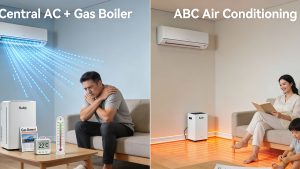
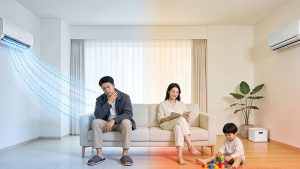
每年夏天,当第一波热浪袭来,我们打开空调,期待的是凉爽与舒适。然而现实往往是:空调出风口正对的地方冷得要裹毯子,而房间的另一头依然闷热;夜里开着空调睡觉,早上起来口干舌燥、皮肤紧绷;家里的老人嫌冷不愿开,年轻人不开又热得受不了。到了冬天,空调制热更是尴尬——热风往上飘,脚底冰凉,头顶冒汗,再怎么调温度,总觉得差点意思。
这个问题,困扰了中国家庭几十年。
我们已经习惯了空调的”不舒服”,甚至把它当作理所当然。但你有没有想过,空调这项发明已经走过了半个多世纪,为什么在舒适性上始终无法突破?为什么我们花了那么多电费,换来的却是一种”将就”的生活?
答案是:我们一直在用一种”搬运热量”的工具,试图解决”环境舒适”的问题。这两件事,根本就不是一回事。
而现在,一个被称为”空调伴侣”的小小装置,正在悄然改变这个局面。它让传统的空调系统蜕变为一种全新的舒适系统——ABC空调系统。这不仅仅是一次产品升级,更是我们对”居住舒适”这个命题的一次根本性重新思考。
第一章:空调的百年困局——我们为什么总在”将就”?
1.1 从窗机到分体:两次进化,舒适性却没跟上
回顾家用空调的发展史,每一次形态进化都带来了巨大的进步,但舒适性始终是短板。
第一次形态:窗式空调。 上世纪七八十年代,窗机进入千家万户。它把制冷和制热带进了家庭,但噪音大、效率低、外观笨重,舒适性谈不上,能用就行。
第二次形态:分体式空调。 压缩机和换热器分离,室内机安静了许多,外观也好看了一些。风管机、多联机等变种不断涌现,效率越来越高,外观越来越薄。但核心问题始终没有解决——它依然是用”吹风”的方式来调节室温。
风,是空调舒适性最大的敌人。
直吹太冷,不吹又不凉。于是人们发明了”无风感空调””柔风空调”,试图通过改变出风方式来缓解不适。但这只是在”风”上做文章,本质并没有改变——你依然在用一种强制对流的方式来调节一个三维空间的温度场。
1.2 “空调病”不是病,是系统缺陷
很多人抱怨的所谓”空调病”——头疼、关节酸痛、呼吸道不适、皮肤干燥——其实并不是医学意义上的疾病,而是传统空调系统原理性缺陷的直接后果。
传统空调是通过对流换热来工作的。室内机风机把空气吹过换热器,冷空气或热空气被直接送入室内。这种方式有几个天然的问题:
垂直温差大。 冷空气下沉,热空气上浮。夏天制冷时,地面温度比头顶高好几度;冬天制热时,热风全堆在天花板,脚底冰凉。人体的舒适区间很窄,上下温差超过3℃就会明显不适。
气流不均匀。 空调出风口附近的温度远低于(或高于)房间其他位置。为了把整个房间调到目标温度,空调必须加大风量、提高功率,这又加剧了直吹感和干燥感。
湿度控制差。 空调在制冷时会大量除湿,导致室内空气过于干燥。而干燥的空气会让皮肤、呼吸道的水分快速蒸发,产生不适。
噪音与风感并存。 风机运转带来噪音,高速气流带来体感不适。即使是最安静的变频空调,在夜间也可能影响浅睡眠者。
这些问题,不是某一个品牌的缺陷,而是整个技术路线的天花板。
1.3 “五恒系统”:美好但遥远的梦
近年来,建筑暖通行业开始推崇”五恒系统”的概念——恒温、恒湿、恒氧、恒洁、恒静。这种系统通常采用毛细管网辐射末端,让整个天花板和墙面变成换热面,通过辐射而非对流来调节室温。效果确实好,体感温和、无风感、温差小,被称为”像春天一样的室内环境”。
但五恒系统的门槛太高了。
造价动辄几十万,安装需要在装修前做全屋集成设计,后期维护复杂,运行费用也不低。对于已经装修好的家庭来说,几乎不可能加装。它更像是一种”富人专享”的舒适方案,距离普通家庭很远。
有没有一种方案,既能带来接近五恒系统的舒适体验,又能以普通家庭可以接受的成本实现?
这就是”空调伴侣”诞生的初衷。
第二章:空调伴侣——让传统空调”脱胎换骨”
2.1 什么是空调伴侣?
空调伴侣,顾名思义,是空调的”伴侣”——一个可以与传统分体空调(包括挂机、柜机、风管机、多联机)协同工作的辅助装置。
它体积不大,通常安装在室外机附近或室内隐蔽位置,通过与现有空调系统的冷媒管路连接,引入一套独特的二次换热机制。同时,它连接着铺设在地板下的PE管回路,让地板成为系统的辐射换热面。
简单来说,空调伴侣做了一件关键的事:它在传统空调”搬运热量”的过程中,截取了一部分热量(或冷量),通过地板辐射的方式,以更柔和、更均匀的方式释放到室内。
这就像给空调装上了一个”翻译器”——空调还在用它熟悉的方式工作(压缩冷媒、对流换热),但空调伴侣把其中一部分能量”翻译”成了地板辐射的温和语言,让人体感受到的是完全不同的舒适。
2.2 ABC空调系统:一次命名,三重含义
这套由传统室外机(A,Air-source unit)、空调伴侣(B,Buddy unit)和传统室内机(C,Conditioning unit)组成的系统,被命名为ABC空调系统。
ABC,既是三个核心组件的英文首字母缩写,也暗含着”从A到C”的进阶逻辑——它代表的是家用空调从诞生以来的第三次形态进化:
- 第一次进化(A时代): 窗式空调,一体化结构,解决”有没有”的问题。
- 第二次进化(A+C时代): 分体式空调,室内外分离,解决”好用不好用”的问题。
- 第三次进化(A+B+C时代): ABC空调系统,在分体空调基础上加入空调伴侣,解决”舒不舒服”的问题。
这不是推倒重来,而是在现有基础上的智慧升级。你不需要更换空调,不需要大动干戈重新装修,只需要加装一个空调伴侣,就能让用了多年的老空调”脱胎换骨”。
2.3 它是怎么工作的?
技术原理并不复杂,但设计极为巧妙。
冬天制热时: 空调的压缩机排出高温高压的冷媒气体。在传统空调中,这些气体直接进入室内机冷凝放热。而在ABC系统中,冷媒首先经过空调伴侣的换热器,将一部分热量传递给循环水,水再流经地板下的PE管,以辐射方式给房间加热。经过这一步”预放热”后,冷媒再进入室内机,完成剩余的制热任务。
这意味着,制热过程变成了”两级放热”——先给地板加热,再给空气加热。地板的温暖从脚底升起,室内机的暖风辅助调温,两者协同,体感远比单纯的暖风更舒适。
夏天制冷时: 流程反过来了。低温冷媒先经过室内机,吸收室内空气的热量实现制冷。然后,冷媒带着剩余的”冷量”经过空调伴侣,给地板下的PE管提供辐射冷却。这样一来,室内上方有空调的对流冷,地面有地板的辐射冷,上下同时作用,垂直温差大大缩小。
再也不用忍受”头顶冰窖、脚下火炉”的尴尬了。
第三章:不只是”舒服”——ABC空调的六大优势
3.1 无风感舒适:告别”空调直吹”
这是ABC空调最直观的体验提升。传统空调的制冷制热主要靠风机,而ABC系统中,地板辐射承担了相当一部分的换热任务。你可以把空调的风速调到最低,甚至关掉风机,地板依然在默默工作。
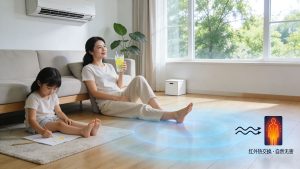
尤其是夏天,传统空调让你感觉是被”冷风吹着”,而ABC系统让你感觉是”地面本身是凉的”——就像赤脚走在凉爽的石板路上,是一种从脚底渗透上来的清凉。没有风噪,没有直吹,体感温度更均匀。
这就是很多人说的”无风感空调”的真正实现方式。不是通过导风板把风换个方向吹,而是从根本上减少了对”风”的依赖。
3.2 温度场均匀:告别”冰火两重天”
地板辐射的特点是”低温大面积”。它不像空调出风口那样用一个点来对抗整个房间,而是用整个地面作为一个均匀的换热面。热量(或冷量)从地面自然地向上扩散,符合人体”头凉脚暖”的舒适需求。
实际使用中,ABC系统的室内垂直温差可以控制在1-2℃以内,而传统空调的垂直温差往往达到4-6℃甚至更大。这种均匀感,是单纯靠调空调温度无法实现的。
3.3 能效更高:更省电的舒适
有人可能会问:加了地板辐射,是不是更费电了?
恰恰相反。ABC系统的核心创新之一,就是通过热力学上的优化,提升了整个系统的能效。
道理是这样的:在制冷模式下,系统等效于把蒸发器”分成了两级”(室内机+空调伴侣),增大了总蒸发面积。冷媒经过两级充分蒸发后,回到压缩机时的过热度更高,意味着蒸发器的利用率更高,系统能效比提升。
在制热模式下同理:系统等效于把冷凝器”分成了两级”(空调伴侣+室内机),增大了总冷凝面积。经过两级充分冷凝后,节流前的液体冷媒过冷度更高,单位质量的冷媒能携带更多热量,制热效率提升。
通俗地说,同样的电费,ABC系统能给你更多的冷量和热量。在极端天气(酷暑、严寒)下,这种效率优势更加明显。传统空调在零下低温时制热效率骤降,而ABC系统因为过冷度的提升,能在低温工况下依然保持稳定的制热效果。
3.4 极端天气的”定海神针”
每年冬天,当寒潮来袭,很多南方家庭的空调制热效果大打折扣,甚至频繁停机。这是因为低温环境下,传统空调的冷媒循环容易出现”闪发”现象——冷媒在节流阀前就部分汽化了,导致蒸发过程不稳定,系统效率暴跌。
ABC系统因为过冷度的大幅提升,天然抵御这种问题。即使在极端低温下,冷媒依然能以稳定的液态通过节流装置,蒸发过程完整,制热效果稳定。
更值得一提的是特殊解冻功能。假如遇到长期停电导致地暖管冻住的极端情况,系统可以先启动室内机和室外机正常供暖(甚至开启电辅热),让室内温度逐步回升,热量从空气传导到地板,再传导到地暖管,温和地自然解冻。等地暖管恢复流通后,再启动空调伴侣加速运行。这种”先暖房、再暖地、后融管”的阶梯式解冻策略,比传统的暴力化冻方式安全得多。
3.5 化霜不吹冷风:冬天也能舒适无忧
传统空调在冬天制热时,室外机容易结霜。化霜时,四通阀反向,室外机变成制热状态融化冰霜,而室内机突然开始吹冷风。对于正在享受暖风的用户来说,这种突兀的冷风切换是非常不舒适的体验。
ABC系统有一个巧妙的解决方案:化霜时,系统可以从地板蓄热体中提取热量来化霜,而室内机无需切换模式。地板本身就是一个巨大的”热量缓冲池”,从中抽取少量热量对地板温度的影响微乎其微,人在室内几乎感受不到任何变化。
这就好比,传统空调化霜是”从你的被窝里抽走热量”,而ABC系统化霜是”从一池温水中取一瓢水”。地板的热容量远大于室内空气,足以在不影响舒适度的前提下支撑化霜过程。
3.6 兼容与升级:不需要推倒重来
ABC系统最大的实用优势之一是兼容性。它不是一个需要从零开始安装的全新系统,而是可以与现有的分体空调系统(壁挂机、柜机、风管机、多联机)配合使用。
如果你家已经装好了空调,加装一个空调伴侣,铺设地板下的PE管(可以在二次装修或局部翻新时完成),就可以升级为ABC系统。如果你正在规划新房装修,那更是天然的完美时机——从一开始就规划好ABC系统,成本更低,效果最好。
这种”增量式升级”的思路,让ABC空调不再是遥不可及的高端方案,而是普通家庭触手可及的舒适选择。
第四章:从”调节温度”到”调节环境”——一场理念的革新
4.1 人居环境的第四次跃迁
如果把眼光放远,ABC空调系统的意义远不止于一款新产品。
回顾人居舒适度的发展历程,我们正在经历一场持续数千年的跃迁:
远古时期:自然调节。 人类选择岩洞居所,利用地形和自然通风来调节温度。我们的祖先靠建筑选址、朝向设计、通风气道来适应气候——这是”被动式”的舒适调节。
农耕时期:初级调节。 土屋、砖瓦房出现,火炕、炭盆、火炉提供了基本的取暖手段。夏天靠蒲扇、凉席、水井降温。这是”主动但原始”的舒适调节。
工业时期:热量搬运调节。 电风扇、暖气片、空调、空气能热泵相继出现。我们学会了用机械手段”搬运”热量——把室外的冷搬到室内,把室内的热搬到室外。效率高了,但体感舒适性始终有瓶颈。
现在:环境级无感调节。 ABC空调系统代表的是下一个阶段——不再是单纯地搬运热量,而是通过辐射与对流的协同、对冷媒循环的精细调控,实现对整个室内环境的”无感智慧调节”。你感觉不到空调在工作,但室内温度是适宜的,空气是柔和的,地板是温暖或凉爽的。
正如两千年前的古人无法想象我们现在用电风扇吹风的场景,二十年后,当ABC空调系统推广应用,习惯了这种舒适环境的人们,恐怕也很难想象我们今天是如何忍受传统空调那直来直去的冷风的。
这不是科幻,这是技术演进的必然方向。
4.2 从”统一调控”到”独立精细”
ABC空调系统还代表着一种理念的转变:从统一集中式到独立精细化的转变。
过去,城市的舒适调节是”集中供暖”式的——一条管线供应整栋楼,温度不可调,时间不可控。后来有了分体式空调,每家每户可以独立控制,但室内依然是”一个空调管一个房间”的粗放模式。
ABC系统将调节精度进一步细化。地板辐射面提供的是”底层舒适”——均匀、温和、持续的基础温控;室内机提供的是”顶层微调”——针对局部温度偏差的精准补偿。两者协同,实现了从”粗放制冷制热”到”精细化环境营造”的升级。
4.3 从”单一形式”到”多形式协同”
传统空调是”单一形式”的——要么是风盘吹风,要么是地暖辐射,要么是暖气片散热。你选了一种,就只能用一种。
ABC系统打破了这种局限。在一套系统中同时集成了对流换热(室内机吹风)、辐射换热(地板辐射)和传导换热(地板蓄热缓冲),三种换热方式在不同工况下各司其职、协同工作。
夏天,辐射供冷是主角,对流制冷是辅助,体感温柔不刺骨。冬天,辐射供暖和对流供暖并举,脚暖头凉,符合人体生理需求。极端工况下,地板蓄热提供缓冲,化霜不影响舒适度。
这不是简单的叠加,而是系统性的协同——一加一大于二的效果。
第五章:谁需要ABC空调?
5.1 已经受够传统空调不适感的家庭
如果你每年夏天都要和家人”争夺”空调温度——有人嫌冷、有人嫌热;如果你冬天开空调制热,脚底冰凉但头顶冒汗;如果你半夜被空调风吹醒,裹着被子调风向——ABC系统就是你的答案。
5.2 正在规划新房装修的家庭
如果你正在装修新房,这是最好的时机。将ABC系统纳入整体设计,成本最优化,效果最大化。一次投入,未来几十年享受超越五恒系统的舒适体验。
5.3 关心老人和孩子健康的家庭
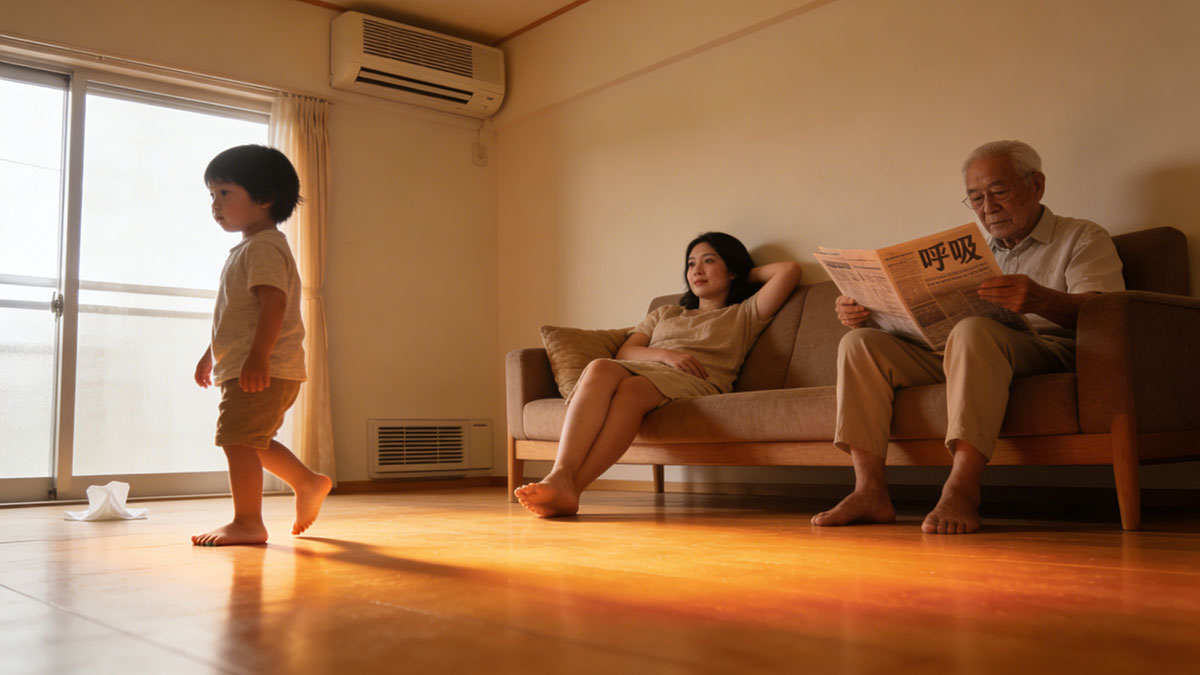
老人和孩子对温度变化更敏感。传统空调的强对流、大温差、干燥环境,对他们的健康影响更大。ABC系统的温和辐射特性,特别适合这些敏感人群。没有直吹风感,温度均匀,湿度损失小,让全家人都能找到舒适的体感。
5.4 追求品质生活的用户
如果你对生活品质有追求,不满足于”能用就行”,而是希望家里的每一个细节都经过精心考量——那空调这件事,值得你重新思考。毕竟,我们在家里度过的时间最长,室内的舒适度直接关系到每一天的生活质量。
5.5 关注节能和长期使用成本的理性消费者
ABC系统在能效上的优势意味着更低的运行电费。初始投入虽然高于普通空调,但从长期使用成本来看,节省的电费和提升的舒适度,让这笔投入物超所值。
第六章:这不是一个产品,是一个生态的开始
6.1 已获专利保护的创新技术
空调伴侣的核心技术已获得国家实用新型专利(专利号:ZL 2021 2 1195781.6),ABC空调系统及压印换热器等关键技术也已提交国家发明专利申请。这意味着这项技术不仅在理论层面经过了充分验证,在知识产权层面也已建立起保护屏障。
6.2 开放兼容,赋能现有空调产业
ABC系统不是要取代现有的空调产业,而是为整个行业赋能。任何品牌、任何型号的分体空调,理论上都可以与空调伴侣配合使用。这种开放兼容的定位,让它有潜力成为整个行业的”标准配件”,而非某一品牌的封闭系统。
6.3 未来展望
想象一下这样的场景:未来的家庭装修标配不再是”选什么品牌的空调”,而是”你的空调系统有没有ABC”。就像今天的汽车标配ABS防抱死系统一样,ABC空调系统有望成为室内舒适度的”标配方案”。
从窗式空调到分体式空调,每一次形态的进化都重新定义了人们对”室内环境”的期待。而ABC空调系统的出现,正在开启第三次进化——从”调节温度”到”调节环境”,从”被动忍受”到”主动舒适”。
我们有理由相信,在不远的将来,”开了空调为什么家里还是不舒服”这个问题,将和”为什么马车跑不快”一样,成为历史的回响。
结语
回到文章开头的那个问题:开了空调,为什么家里还是不舒服?
因为传统空调只是在”搬运热量”,而你需要的是”营造环境”。
空调伴侣做的,就是在传统空调和理想环境之间,架起一座桥梁。它不需要你更换空调,不需要你推倒重来,只需要一个小小的”伴侣”,就能让你家里的空调从一个”温度调节器”升级为一个”环境营造器”。
差的就是这个”伴侣”。现在,它来了。
ABC空调系统——让每一个家,都是舒适的样子。
关键词: 空调,ABC空调系统,空调伴侣,无风感空调,空调采暖,空调连地暖,冷暖空调,热泵空调,空气能,热泵,辐射空调,地板采暖,五恒系统,空调能效,空调舒适性,耦合式空调,分体空调,制冷制热,暖通空调,室内环境
English Version
Why Does Your Home Still Feel Uncomfortable With the AC On? What You’re Missing Is This “Buddy”
Introduction: A Problem Overlooked for Decades
Every summer, when the first heat wave hits, we turn on the air conditioner expecting cool comfort. But reality often tells a different story: the spot directly in front of the vent is cold enough for a blanket, while the far corner of the room remains stuffy. We wake up with dry mouths and tight skin. The elderly in the family refuse to turn it on because it’s too cold; the young ones can’t stand the heat without it. Come winter, heating with an AC unit is even more awkward — warm air rises to the ceiling, your feet freeze while your head sweats, and no matter how you adjust the temperature, something always feels off.
This problem has plagued Chinese households for decades.
We’ve grown accustomed to the “uncomfortableness” of air conditioning, accepting it as inevitable. But have you ever considered that air conditioning technology has been around for over half a century, yet comfort has never truly been achieved? Why do we spend so much on electricity, only to settle for a “good enough” experience?
The answer: we’ve been using a “heat transfer tool” to solve an “environmental comfort problem.” These are fundamentally different things.
Now, a small device called the “AC Buddy” is quietly changing the game. It transforms traditional air conditioning into something entirely new — the ABC Air Conditioning System. This isn’t just a product upgrade; it’s a fundamental rethinking of what “residential comfort” means.
Chapter 1: The Century-Long Dilemma of Air Conditioning
1.1 From Window Units to Splits: Two Evolutions, Zero Comfort Breakthroughs
Looking back at the history of home air conditioning, each evolutionary leap brought tremendous progress, yet comfort remained the persistent weak link.
First generation: Window units. In the 1970s and 80s, window air conditioners entered homes across the country. They brought cooling and heating to families, but were noisy, inefficient, and bulky. Comfort was an afterthought — as long as it worked.
Second generation: Split-type air conditioners. The compressor and heat exchanger were separated. Indoor units became quieter, sleeker in appearance. Ducted units, multi-split systems, and other variants emerged. Efficiency climbed, units grew thinner. But the core problem persisted — they still relied on “blowing air” to regulate room temperature.
Air movement is the greatest enemy of air conditioning comfort.
Direct airflow is too cold; no airflow means no cooling. Manufacturers invented “windless air conditioners” and “gentle breeze units,” trying to alleviate discomfort by changing how air is delivered. But this is merely addressing the symptom — you’re still using forced convection to regulate the temperature field of a three-dimensional space.
1.2 “Air Conditioning Sickness” Isn’t a Disease — It’s a System Deficiency
Many people complain about so-called “air conditioning sickness” — headaches, joint pain, respiratory discomfort, dry skin. In truth, these aren’t medical conditions at all. They are direct consequences of fundamental flaws in traditional AC system design.
Conventional air conditioners work through convective heat exchange. The indoor unit blows air across a heat exchanger, directly introducing cold or hot air into the room. This approach has several inherent problems:
Large vertical temperature differences. Cold air sinks; hot air rises. When cooling in summer, floor temperature can be several degrees higher than head height. When heating in winter, warm air pools at the ceiling while the floor stays cold. The human comfort zone is narrow — vertical differences exceeding 3°C cause obvious discomfort.
Uneven airflow. Temperature near the AC outlet is drastically different from the rest of the room. To bring the entire room to the target temperature, the AC must increase fan speed and power output, which worsens the direct-blow sensation and dryness.
Poor humidity control. Air conditioners dehumidify excessively during cooling, making indoor air too dry. Dry air accelerates moisture evaporation from skin and respiratory passages, creating discomfort.
Noise and draft coexist. Fan operation brings noise; high-velocity airflow creates physical discomfort. Even the quietest inverter AC can disturb light sleepers at night.
These aren’t defects of any particular brand — they’re the ceiling of an entire technological approach.
1.3 The “Five Constants System”: A Beautiful but Distant Dream
In recent years, the HVAC industry has championed the concept of the “Five Constants System” — constant temperature, humidity, oxygen, cleanliness, and quietness. These systems typically use capillary tube radiation networks, turning entire ceilings and walls into heat exchange surfaces, regulating temperature through radiation rather than convection. The results are genuinely impressive — gentle sensation, windless, minimal temperature differences — often described as “a spring-like indoor environment.”
But the barrier to entry is far too high.
Costs easily run into hundreds of thousands of yuan. Installation requires whole-house integration design before renovation. Maintenance is complex, and operating costs are significant. For homes that are already renovated, retroactive installation is virtually impossible. It’s more of a “luxury comfort solution,” far from accessible for ordinary families.
Is there a solution that delivers a comfort experience approaching the Five Constants System, at a cost ordinary families can accept?
This is exactly why the “AC Buddy” was born.
Chapter 2: The AC Buddy — Giving Traditional AC a Complete Makeover
2.1 What Is the AC Buddy?
The AC Buddy, as the name suggests, is the air conditioner’s “companion” — an auxiliary device that works in conjunction with traditional split-type air conditioning systems (including wall-mounted units, cabinet units, ducted units, and multi-split systems).
It’s compact in size, typically installed near the outdoor unit or in a concealed indoor location. By connecting to the existing AC system’s refrigerant lines, it introduces a unique secondary heat exchange mechanism. Simultaneously, it connects to PE pipe loops laid under the floor, transforming the floor into the system’s radiant heat exchange surface.
In simple terms, the AC Buddy does one crucial thing: during the traditional AC’s heat transfer process, it intercepts a portion of the heat (or cooling capacity) and releases it into the room through floor radiation — more gently and more evenly.
It’s like installing a “translator” for your air conditioner. The AC continues working in its familiar way (compressing refrigerant, convective heat exchange), but the AC Buddy “translates” part of that energy into the gentle language of floor radiation, delivering a completely different comfort experience to the human body.
2.2 The ABC Air Conditioning System: One Name, Triple Meaning
This system, composed of the traditional outdoor unit (A — Air-source unit), the AC Buddy (B — Buddy unit), and the traditional indoor unit (C — Conditioning unit), is named the ABC Air Conditioning System.
ABC serves as both an acronym for the three core components and an implicit logic of progression — representing the third evolutionary form of home air conditioning since its inception:
- First evolution (The A era): Window units. Integrated structure. Solved the problem of “existence.”
- Second evolution (The A+C era): Split-type air conditioning. Indoor-outdoor separation. Solved the problem of “usability.”
- Third evolution (The A+B+C era): The ABC System. Adding the AC Buddy to split-type air conditioning. Solving the problem of “comfort.”
This isn’t a teardown-and-rebuild — it’s an intelligent upgrade on the existing foundation. You don’t need to replace your air conditioner. You don’t need a major renovation. Simply installing an AC Buddy can give your years-old AC a complete transformation.
2.3 How Does It Work?
The technical principle isn’t complicated, but the design is remarkably ingenious.
Winter heating mode: The AC compressor discharges high-temperature, high-pressure refrigerant gas. In a traditional AC, this gas flows directly into the indoor unit for condensation and heat release. In the ABC system, the refrigerant first passes through the AC Buddy’s heat exchanger, transferring a portion of its heat to circulating water. The water then flows through PE pipes under the floor, heating the room through radiant floor heating. After this “pre-release” of heat, the refrigerant enters the indoor unit to complete the remaining heating task.
This means heating becomes a “two-stage heat release” — first heating the floor, then heating the air. Warmth rises gently from underfoot while the indoor unit’s warm air provides supplementary temperature control. The two work in harmony, delivering a sensation far more comfortable than warm air alone.
Summer cooling mode: The process reverses. Cold refrigerant first passes through the indoor unit, absorbing indoor air heat for cooling. Then, carrying residual “cooling capacity,” the refrigerant flows through the AC Buddy, providing radiant cooling to the PE pipes under the floor. This way, convective cooling from above and radiant cooling from below work simultaneously, dramatically reducing vertical temperature differences.
No more enduring the embarrassment of “an ice cave above, a furnace below.”
Chapter Three: Beyond “Comfortable” — Six Advantages of the ABC System
3.1 Windless Comfort: Goodbye to “Direct AC Blast”
This is the most immediately noticeable improvement. Traditional AC relies on fans for heating and cooling. In the ABC system, floor radiation handles a significant portion of heat exchange. You can set the fan to its lowest speed — or even turn it off entirely — and the floor continues working quietly.
Especially in summer, traditional AC makes you feel “blown on by cold air,” while the ABC system makes you feel “the floor itself is cool” — like walking barefoot on refreshing stone, a coolness that seeps upward from beneath your feet. No wind noise, no direct blast, more uniform sensation.
This is how true “windless air conditioning” is actually achieved — not by redirecting airflow with guide vanes, but by fundamentally reducing dependence on “wind” altogether.
3.2 Uniform Temperature Field: Goodbye to “Hot and Cold Zones”
Floor radiation works on the principle of “low temperature, large area.” Instead of using a single point to battle an entire room (like an AC outlet), it uses the entire floor as a uniform heat exchange surface. Heat (or cool) naturally diffuses upward from the floor, matching the body’s ideal comfort pattern of “cool head, warm feet.”
In practice, the ABC system keeps vertical temperature differences within 1-2°C, while traditional AC often creates differences of 4-6°C or more. This uniformity simply cannot be achieved by adjusting AC temperature alone.
3.3 Higher Energy Efficiency: Comfort That Saves Money
Some may wonder: adding floor radiation — doesn’t that consume more electricity?
Quite the opposite. One of the ABC system’s core innovations is thermodynamic optimization that improves overall system energy efficiency.
Here’s the logic: in cooling mode, the system effectively “splits the evaporator into two stages” (indoor unit + AC Buddy), increasing total evaporating surface area. After two-stage thorough evaporation, the refrigerant returns to the compressor with higher superheat, meaning greater evaporator utilization and improved system efficiency.
The same principle applies in heating mode: the system effectively “splits the condenser into two stages” (AC Buddy + indoor unit), increasing total condensing surface area. After two-stage thorough condensation, the liquid refrigerant before the expansion valve has higher subcooling, meaning each unit mass of refrigerant carries more heat — boosting heating efficiency.
In plain language: for the same electricity cost, the ABC system delivers more cooling and heating capacity. This efficiency advantage becomes even more pronounced in extreme weather (scorching heat, bitter cold). When traditional AC’s heating efficiency plummets in sub-zero temperatures, the ABC system’s enhanced subcooling enables stable heating performance even in extreme cold.
3.4 The “Anchor” in Extreme Weather
Every winter, when cold waves strike, many families in southern China find their AC heating severely compromised, or even cycling on and off repeatedly. This happens because in low-temperature environments, traditional AC refrigerant cycles are prone to “flash evaporation” — the refrigerant partially vaporizes before the expansion valve, destabilizing the evaporation process and causing system efficiency to nosedive.
The ABC system’s significantly enhanced subcooling inherently resists this problem. Even in extreme cold, refrigerant passes through the expansion device as a stable liquid, evaporation remains complete, and heating stays consistent.
Notably, there’s a special defrost function. In the unlikely event of an extended power outage causing the radiant pipes to freeze, the system can first activate the indoor and outdoor units for normal heating (even engaging electric auxiliary heat), gradually raising room temperature. Heat conducts from air to floor to radiant pipes, gently thawing them naturally. Once flow is restored, the AC Buddy engages to accelerate the process. This “warm room first, warm floor second, melt pipes third” staged defrost strategy is far safer than traditional brute-force methods.
3.5 Defrost Without Cold Drafts: Comfort Even in Winter
During winter heating, traditional AC outdoor units are prone to frost buildup. During defrost, the four-way valve reverses, the outdoor unit switches to heating mode to melt ice, and the indoor unit suddenly starts blowing cold air. For users enjoying warm air, this abrupt switch to cold drafts is highly uncomfortable.
The ABC system has an elegant solution: during defrost, the system draws heat from the floor’s thermal mass to defrost, without the indoor unit needing to switch modes. The floor itself is a massive “heat buffer pool.” Drawing a small amount of heat from it barely affects floor temperature, and occupants notice virtually no change.
Think of it this way: traditional AC defrosting “pulls heat from your blanket,” while ABC system defrosting “takes a ladle from a warm pool.” The floor’s thermal capacity far exceeds that of indoor air — more than enough to support defrost without any comfort impact.
3.6 Compatibility and Upgrade: No Need to Start Over
One of the ABC system’s greatest practical advantages is its compatibility. It’s not a completely new system requiring installation from scratch — it works with existing split-type AC systems (wall-mounted, cabinet, ducted, multi-split).
If your home already has air conditioning, simply install an AC Buddy and lay PE pipes under the floor (possible during secondary renovation or partial remodeling), and you can upgrade to an ABC system. If you’re planning a new home renovation, that’s the perfect opportunity to design the ABC system in from the start — lower cost, maximum effect.
This “incremental upgrade” approach makes ABC air conditioning an accessible comfort choice for ordinary families, not an exclusive luxury.
Chapter Four: From “Temperature Control” to “Environment Creation” — A Paradigm Shift
4.1 The Fourth Leap in Human Habitat Comfort
Looking at the bigger picture, the significance of the ABC system extends far beyond a single product.
Throughout thousands of years of human comfort evolution, we’re witnessing a sustained, fourth major leap:
Ancient times: Natural regulation. Humans chose cave dwellings, using terrain and natural ventilation to regulate temperature. Our ancestors relied on building site selection, orientation design, and ventilation pathways to adapt to climate — “passive” comfort regulation.
Agricultural era: Primitive regulation. Earth houses and brick-tile structures emerged. Heated beds (kang), charcoal basins, and fire stoves provided basic heating. Summer cooling came from hand fans, bamboo mats, and well water — “active but primitive” comfort regulation.
Industrial era: Heat transfer regulation. Electric fans, radiators, air conditioners, and air-source heat pumps appeared in succession. We learned to “transfer” heat mechanically — moving outdoor coolness indoors, indoor heat outdoors. Efficiency improved, but sensory comfort always had a ceiling.
Now: Environmental-level imperceptible regulation. The ABC system represents the next phase — no longer simply transferring heat, but achieving “imperceptible intelligent regulation” of the entire indoor environment through coordinated radiation and convection, with precise refrigerant cycle control. You can’t feel the AC working, yet the temperature is pleasant, the air is gentle, and the floor is warm or cool as needed.
Just as people two thousand years ago couldn’t imagine us using electric fans, people twenty years from now — accustomed to ABC comfort environments — will find it hard to believe how we endured the direct blasts of traditional air conditioning today.
This isn’t science fiction. It’s the inevitable direction of technological evolution.
4.2 From “Unified Control” to “Independent Precision”
The ABC system also embodies a conceptual shift: from centralized, unified control to independent, fine-grained regulation.
In the past, urban comfort was “centralized heating” — one pipeline serving an entire building, temperature uncontrollable, timing inflexible. Then came split-type AC, where each household could independently control their environment. But indoors, it remained a crude “one AC per room” model.
The ABC system takes precision further. Floor radiation provides “base-layer comfort” — uniform, gentle, continuous baseline temperature control. The indoor unit provides “top-layer fine-tuning” — precise compensation for local temperature deviations. The two work in concert, upgrading from “crude heating and cooling” to “refined environmental creation.”
4.3 From “Single Method” to “Multi-Method Synergy”
Traditional air conditioning is “single-method” — it’s either fan-coil blowing, floor radiant heating, or radiator convection. You pick one, and you’re stuck with it.
The ABC system breaks free from this limitation, simultaneously integrating convective heat exchange (indoor unit airflow), radiative heat exchange (floor radiation), and conductive exchange (floor thermal buffering) — three heat transfer methods that each play their role under different operating conditions, working in synergy.
In summer, radiant cooling takes the lead with convective cooling as support — gentle, not biting. In winter, radiant and convective heating work together, warm feet and cool head, matching human physiological needs. Under extreme conditions, floor thermal mass provides buffering, ensuring defrost doesn’t compromise comfort.
This isn’t simple layering — it’s systematic synergy where one plus one equals more than two.
Chapter Five: Who Needs the ABC System?
5.1 Families Fed Up with Traditional AC Discomfort
If every summer you “battle” over AC temperature with family members — some too cold, some too hot; if winter AC heating leaves your feet icy while your head sweats; if you’re woken at night by AC drafts, adjusting vents while wrapped in a blanket — the ABC system is your answer.
5.2 Families Planning New Home Renovation
If you’re renovating a new home, this is the optimal moment. Integrating the ABC system into overall design delivers optimized costs and maximum impact. One investment, decades of comfort exceeding Five Constants System standards.
5.3 Families Concerned About Elderly and Children’s Health
The elderly and children are more sensitive to temperature fluctuations. Traditional AC’s strong convection, large temperature differentials, and dry environment impact their health more severely. The ABC system’s gentle radiation characteristics are particularly suitable for these sensitive groups — no direct drafts, uniform temperatures, minimal humidity loss, allowing every family member to find their comfort zone.
5.4 Quality-of-Life Enthusiasts
If you pursue quality of life, unsatisfied with “good enough,” wanting every detail in your home thoughtfully considered — then air conditioning deserves your rethinking. After all, we spend more time at home than anywhere else, and indoor comfort directly affects daily quality of life.
5.5 Rational Consumers Focused on Energy Savings and Long-Term Costs
The ABC system’s efficiency advantages mean lower operating electricity costs. While initial investment exceeds standard AC, long-term savings on electricity combined with enhanced comfort make this investment exceptionally worthwhile.
Chapter Six: Not Just a Product — The Beginning of an Ecosystem
6.1 Patent-Protected Innovation
The AC Buddy’s core technology has been granted a national utility model patent (Patent No.: ZL 2021 2 1195781.6). The ABC system and key technologies such as the stamped heat exchanger have also been submitted for national invention patent applications. This means the technology has not only been thoroughly validated theoretically but also has established intellectual property protection.
6.2 Open Compatibility, Empowering the Existing AC Industry
The ABC system isn’t trying to replace the existing air conditioning industry — it’s empowering it. Split-type air conditioners of any brand and model can theoretically work with the AC Buddy. This open, compatible positioning gives it the potential to become an “industry-standard accessory” rather than a proprietary closed system.
6.3 Future Outlook
Imagine a future where standard home renovation isn’t about “which brand of AC to choose,” but “does your AC system have ABC?” Just as modern cars come standard with ABS anti-lock braking, the ABC system has the potential to become the “standard configuration” for indoor comfort.
From window units to split-type air conditioning, each evolutionary leap redefined people’s expectations of “indoor environments.” The ABC system’s emergence is initiating the third evolution — from “temperature regulation” to “environment creation,” from “passive endurance” to “active comfort.”
We have every reason to believe that in the near future, the question “why does my home still feel uncomfortable with the AC on?” will become a historical echo, like “why can’t a horse-drawn carriage go fast?”
Conclusion
Returning to the question posed at the beginning: why does your home still feel uncomfortable with the AC on?
Because traditional air conditioning merely “transfers heat” — what you need is an “environment creator.”
What the AC Buddy does is build a bridge between traditional air conditioning and the ideal environment. It doesn’t require replacing your AC. It doesn’t require starting from scratch. Just a small “companion” can upgrade your home’s air conditioner from a “temperature regulator” to an “environment creator.”
What you’re missing is this “Buddy.” And now, it’s here.
ABC Air Conditioning System — Making every home the way comfort should be.
Keywords: air conditioning, ABC air conditioning system, AC buddy, windless air conditioning, air conditioning heating, AC with floor heating, heating and cooling AC, heat pump air conditioning, air-source, heat pump, radiant air conditioning, floor heating, five constants system, AC energy efficiency, air conditioning comfort, coupled air conditioning, split-type air conditioning, cooling and heating, HVAC, indoor environment